
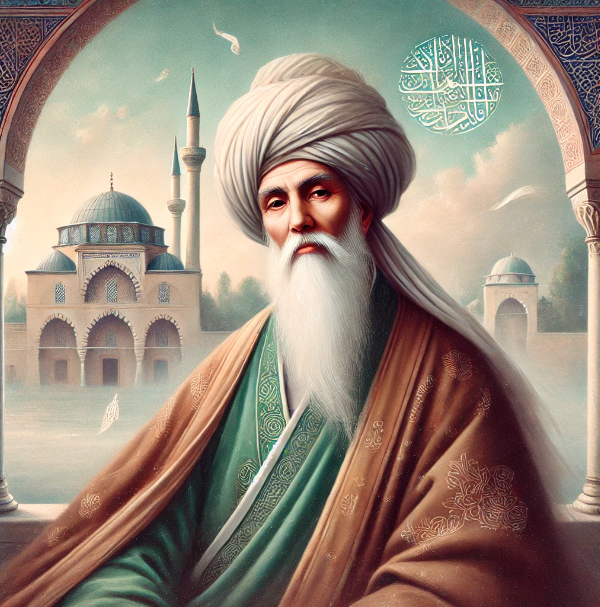
Who is Hacı Bayram Veli?
Hacı Bayram Veli, born in 1352 in the village of Solfasol near Ankara, was a Turkish Sufi mystic, scholar, and poet. His real name was Numan, and he is the founder of the Bayramiye order in Anatolia. One of his most prominent qualities was his ability to convey the spiritual dimensions of Islam in a way that the common people could understand, reaching wide audiences. He held a significant place in the religious and social life of the Ottoman Empire, particularly during the 14th and 15th centuries.
- Full Name: Numan bin Ahmed
- Birth: Around 1352 in Solfasol village near Ankara, Ottoman Empire
- Education: He received his early education in Ankara and later pursued advanced studies in religious sciences. He was a student of Somuncu Baba, a renowned Sufi master.
- Spiritual Path: Hacı Bayram Veli is known for establishing the Bayrami Sufi Order (Bayramiyye), which emphasized love, humility, and unity with God. The order spread widely in Anatolia and influenced Ottoman thought and culture.
- Teaching: He taught at a madrasa in Ankara and had many disciples, including Akşemseddin, who later became a mentor to Sultan Mehmed II (Mehmed the Conqueror).
- Death: Hacı Bayram Veli passed away in 1429 in Ankara, and his tomb, located near the Hacı Bayram Mosque, remains a significant religious site.
Hacı Bayram Veli’s teachings focused on spiritual discipline, asceticism, and the inner aspects of Islam, making him a beloved figure in Ottoman Sufism.
Education and Scholarly Work
After receiving his early education in Ankara, Hacı Bayram Veli continued his studies in Bursa, where he studied under renowned scholars of the time. His education at the Bursa Ulu Mosque madrasas deepened his knowledge of religious sciences, Islamic philosophy, and Sufism. His spiritual journey intensified after meeting Sheikh Hamideddin Aksarayi, also known as Somuncu Baba. Under Somuncu Baba’s guidance, Hacı Bayram Veli began his mission to spiritually educate and guide people.
Founder of the Bayramiye Order
Hacı Bayram Veli founded the Bayramiye Sufi order, which left a lasting impact across the Ottoman Empire. The order’s main principle was love and devotion to God, coupled with helping individuals achieve spiritual purification and become beneficial members of society. His approach to Sufism was centered on making everyday life more meaningful, which attracted attention from both the general population and the state officials of the time.
Hacı Bayram Veli Mosque and Tomb
One of the most well-known landmarks associated with Hacı Bayram Veli is the Hacı Bayram Veli Mosque and his tomb, located in Ankara. This mosque is an important site of Ottoman architecture and continues to serve as a place of worship. His tomb, situated next to the mosque, is visited by thousands of people every year.
Legacy and Influence
One of Hacı Bayram Veli’s most famous students was Akşemseddin, who played a crucial spiritual role in the conquest of Constantinople alongside Sultan Mehmed the Conqueror. Through this connection, Hacı Bayram Veli left a deep imprint on the spiritual landscape of the Ottoman Empire.
Today, Hacı Bayram Veli is considered a guide for many individuals who seek spiritual paths in Anatolia. His contributions to Islamic thought and his cultural legacy through the Bayramiye order have left a lasting impact on generations to come.
Here are some of Hacı Bayram Veli’s well-known sayings translated into English:
- “The world is the field of the hereafter; sow what you will harvest.”
This highlights the importance of actions in this world, as they will bear fruit in the hereafter. - “He who finds a companion in this world finds the path to the hereafter.”
Emphasizing the value of good companionship and the spiritual guidance that can lead one toward eternal peace. - “If you want to attain peace, first purify your heart.”
Stressing the importance of inner purification and sincerity in one’s spiritual journey. - “The essence of all wisdom is to recognize one’s own shortcomings.”
A call for humility and self-awareness, encouraging people to look within and be modest in their knowledge. - “Whoever knows himself knows his Lord.”
This expresses the idea that self-awareness and deep contemplation can lead to a deeper understanding of God.
These sayings reflect Hacı Bayram Veli’s teachings on spirituality, self-reflection, and the relationship between the material world and the divine.













Bir Cevap Yazın