

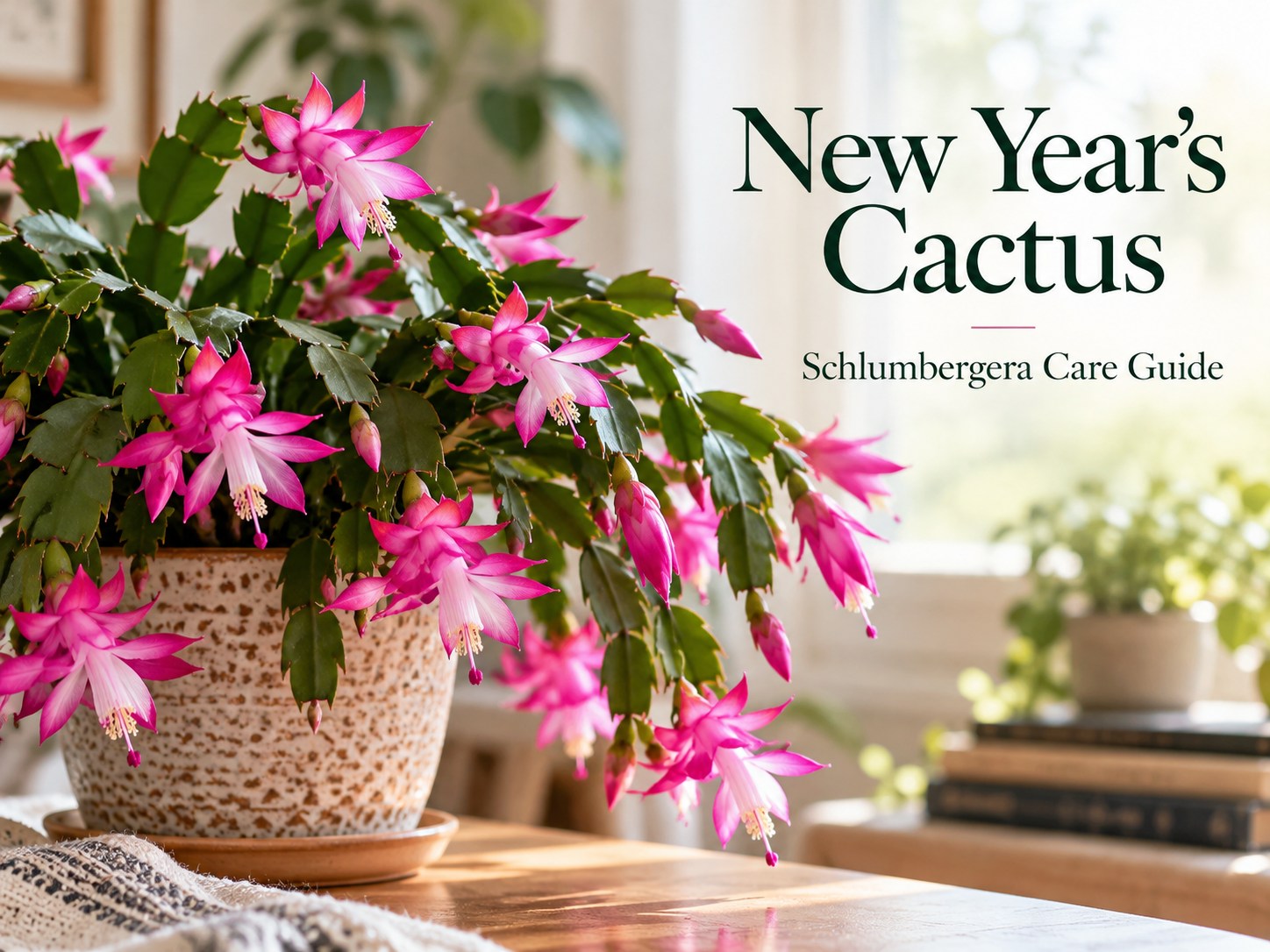
Few houseplants brighten the colder months like a holiday cactus. A healthy Schlumbergera can produce dozens of jewel-toned flowers just as winter begins. Plants described as a “New Year’s cactus” often belong to the Christmas or Thanksgiving cactus group, and their exact bloom dates depend on the cultivar and growing conditions. This guide explains how to identify yours and keep it healthy beyond the holiday season.
Quick care: Give your holiday cactus bright, indirect light, an airy, well-drained potting mix and water when the medium is drying out. To encourage winter flowers, provide a period of long, uninterrupted autumn nights and relatively cool temperatures. Once buds form, keep its conditions consistent.
What Is a New Year’s Cactus?
“New Year’s cactus” is a descriptive common name, not a separate botanical species. It usually refers to a holiday-blooming Schlumbergera plant with flowers around late December or January. The name alone cannot identify whether the plant is a true Christmas cactus (Schlumbergera × buckleyi), Thanksgiving cactus (Schlumbergera truncata) or a modern hybrid. Their cultivation needs are similar, but flowering times and stem shapes can differ.
Unlike desert cacti, Schlumbergera originates in humid forests of southeastern Brazil. These plants are epiphytic cacti—in nature they may grow in tree crotches among organic debris. Their flat segmented stems perform photosynthesis, and flowers develop at the stem tips.
New Year’s Cactus Care at a Glance
| Care factor | Recommendation |
|---|---|
| Plant group | Schlumbergera holiday cactus, usually a Christmas cactus or related hybrid |
| Light | Bright, filtered or indirect daylight |
| Water | Water thoroughly, then let the mix dry appropriately; maintain more consistent moisture during blooming |
| Potting mix | Airy, freely draining mix with organic matter and perlite or a similar amendment |
| Temperature | Approximately 60–70°F (16–21°C) for everyday indoor care |
| Flower-bud conditions | Cool nights around 55–65°F (13–18°C) plus long, uninterrupted darkness for several weeks |
| Fertilizer | Diluted balanced houseplant feed during active growth |
| Pruning | Shorten segments just after flowering to encourage branching |
| Repotting | Only when needed; spring or early summer is preferable |
1. The Best Light for Schlumbergera
Bright, filtered daylight helps holiday cacti maintain healthy stems and support flowering. An east-facing window often provides gentle morning light. A brighter south- or west-facing window can work if strong midday sun is filtered, especially in summer. Too much direct sun may bleach or scorch stem segments; too little light can lead to weaker growth and fewer flowers.
If you place the plant outdoors in warm weather, choose a protected spot with partial shade rather than suddenly moving it from a dim room into full sun. Bring it back indoors before cold weather or frost becomes a risk.
2. Watering Through the Seasons
Holiday cacti are not desert succulents. Their forest origins mean they do not thrive under the same very dry regimen used for many true desert cacti. Still, prolonged waterlogging is dangerous. Water thoroughly until moisture drains from the holes, empty the saucer, and allow the medium to dry appropriately before watering again.
- Spring and summer: Check soil regularly as new segments grow. Water more often in warm, bright rooms and less often in cool, dim conditions.
- Autumn bud formation: Avoid large swings between bone-dry and saturated soil. Consistency becomes especially important once buds are visible.
- Flowering season: Aim for evenly moist—not soggy—potting mix; significant drying can trigger flower or bud drop.
- After flowering: Reduce watering somewhat while growth slows, increasing again when new spring growth appears.
If stems wilt even though the soil is wet, inspect for root damage. Adding more water to already waterlogged soil can make the problem worse.
3. Soil, Drainage and the Right Pot
A container with drainage holes is essential. Good holiday cactus mixes retain some moisture but also contain enough air spaces for roots to breathe. An all-purpose potting medium amended with perlite or coarse components often works well. University of Minnesota Extension describes a blend incorporating sterile potting soil, peat moss and sand or perlite.
Holiday cacti usually bloom well when slightly root-bound and do not need annual repotting. If roots have crowded the pot or the mix has become compacted, repot in spring or early summer. Choose a container only slightly larger than the previous one, because excess wet medium increases rot risk.
4. Temperature and Humidity
For most of the year, ordinary room temperatures around 60–70°F (16–21°C) work well. Cooler evenings can be helpful for flower initiation later in the year, but freezing temperatures and sudden drafts should always be avoided. Do not position the pot directly above a radiator or in the path of hot-air vents.
Because Schlumbergera comes from humid forest habitats, it benefits from an environment that is not excessively dry. In heated homes, a room humidifier or grouping plants can be more reliable than occasional misting. Good air movement and healthy drainage remain important.
5. How to Get a New Year’s Cactus to Bloom
The main flowering signals are shorter days and/or cool nights. Iowa State University Extension reports that many holiday cacti need around 14–16 hours of uninterrupted darkness to initiate buds, though some cultivars flower with about 12 hours. University of Minnesota Extension notes that around six weeks of short days, alongside nights in the 55–65°F (13–18°C) range, can support bud development.
- Begin the routine in autumn, roughly six to eight weeks before the hoped-for flowering period; timing varies by cultivar.
- Give the plant a bright location during the day but keep its nights genuinely dark—ordinary room lights can interrupt the signal.
- Keep evening temperatures relatively cool without exposing the plant to frost or abrupt cold drafts.
- Water carefully and avoid changing several factors at once.
- Once buds appear, resist moving or rotating the plant repeatedly; stable conditions help prevent bud drop.
Plants sold as Thanksgiving cactus often flower earlier than plants commonly identified as true Christmas cactus. A healthy plant is not necessarily “late” because its flowers do not arrive exactly on January 1. For a deeper troubleshooting checklist, see our Christmas Cactus Not Blooming guide.
6. Fertilizing Without Overdoing It
A diluted, balanced houseplant fertilizer once a month during active growth is usually enough. University of Minnesota Extension suggests half-strength feeding in summer, and it describes using a lower-nitrogen formulation as buds begin forming in fall. Follow your product’s label and avoid increasing fertilizer in hopes of forcing flowers. Light and temperature are the more important flowering signals.
7. Pruning and Propagation
Prune after flowering when the plant begins preparing for new growth. At a joint between stem segments, twist or snip off a section using clean tools. Pruning encourages branching, which can create more potential flowering tips over time.
To propagate, take a healthy cutting with two to five joined segments. Allow the cut end to dry briefly, then place the base in a moist, airy rooting medium such as perlite or coarse sand. Keep it bright but out of harsh sun. Maintain light moisture rather than soaking the cutting, and transplant into a small pot once roots are established. Rooting may take several weeks.
8. Christmas, Thanksgiving and Easter Cactus: How to Tell Them Apart
| Common name | Stem edges | Typical flowering period |
|---|---|---|
| Thanksgiving cactus (S. truncata) | Noticeably pointed, claw-like teeth | Mid-autumn to early winter |
| True Christmas cactus (S. × buckleyi) | Rounded scallops, arching habit | Late November through winter |
| Easter cactus (commonly Schlumbergera gaertneri) | Smoother margins with small ripples or bristles | Usually spring |
Plant labels can be unreliable, especially with hybrids. Use both the stem shape and the plant’s flowering behavior to make a reasonable identification rather than assuming that the holiday in its common name is a strict deadline.
9. Troubleshooting Common Holiday Cactus Problems
Why are buds dropping before the flowers open?
Sudden changes in temperature, location, moisture or drafts are frequent culprits. Move the plant only when necessary, keep it away from heaters and prevent drastic watering fluctuations.
Why are the stem segments limp?
It could be dehydration, but wet soil plus limp stems can indicate root rot. Always check the potting mix and drainage before reaching for the watering can.
What are the small brown or cottony marks?
Scale insects and mealybugs occasionally affect holiday cacti. Inspect joints and undersides of segments. Isolate affected plants and choose treatments labeled for ornamental houseplants if needed.
Why is the plant growing but not flowering?
The room may be too warm at night, artificial lighting may interrupt the dark period, or the plant may be growing in insufficient daylight. Correct these environmental factors gradually.
Seasonal Care Calendar
| Season | Your focus |
|---|---|
| Spring | Resume active watering as growth starts; prune or repot after flowering |
| Summer | Bright filtered light, moderate feeding and careful drainage |
| Autumn | Long dark nights, cool conditions and consistent watering to initiate buds |
| Winter | Protect blooms and buds from drafts; reduce watering after flowers fade |
Frequently Asked Questions
Is New Year’s cactus different from Christmas cactus?
Usually not in a botanical sense. “New Year’s cactus” is a loose common name for a holiday-blooming Schlumbergera. Identify the plant by its actual type or cultivar where possible.
Can Schlumbergera live for many years?
Yes. Holiday cacti can be long-lived houseplants when they receive appropriate light, drainage and seasonal care.
Does a holiday cactus need direct sunlight?
It generally thrives in bright, filtered light rather than intense midday sun. Gentle morning sunlight is often suitable.
Should I repot it every winter?
No. Slightly crowded roots are normally acceptable, and repotting during blooming is unnecessarily disruptive. Repot only when the plant needs it.
Final Thoughts
The secret to a thriving New Year’s cactus is understanding what kind of cactus it really is: a forest-dwelling Schlumbergera, not a desert cactus. Provide bright filtered light, a well-drained but not chronically dry root zone, and consistent seasonal signals. With gentle care, it can flower year after year.
For related winter-flowering plant advice, you can also explore our seven reasons a Christmas cactus will not bloom.
Sources and Further Reading
- Iowa State University Extension — All About Holiday Cacti
- University of Minnesota Extension — Holiday Cacti


Bir yanıt yazın