
🌌 Introduction
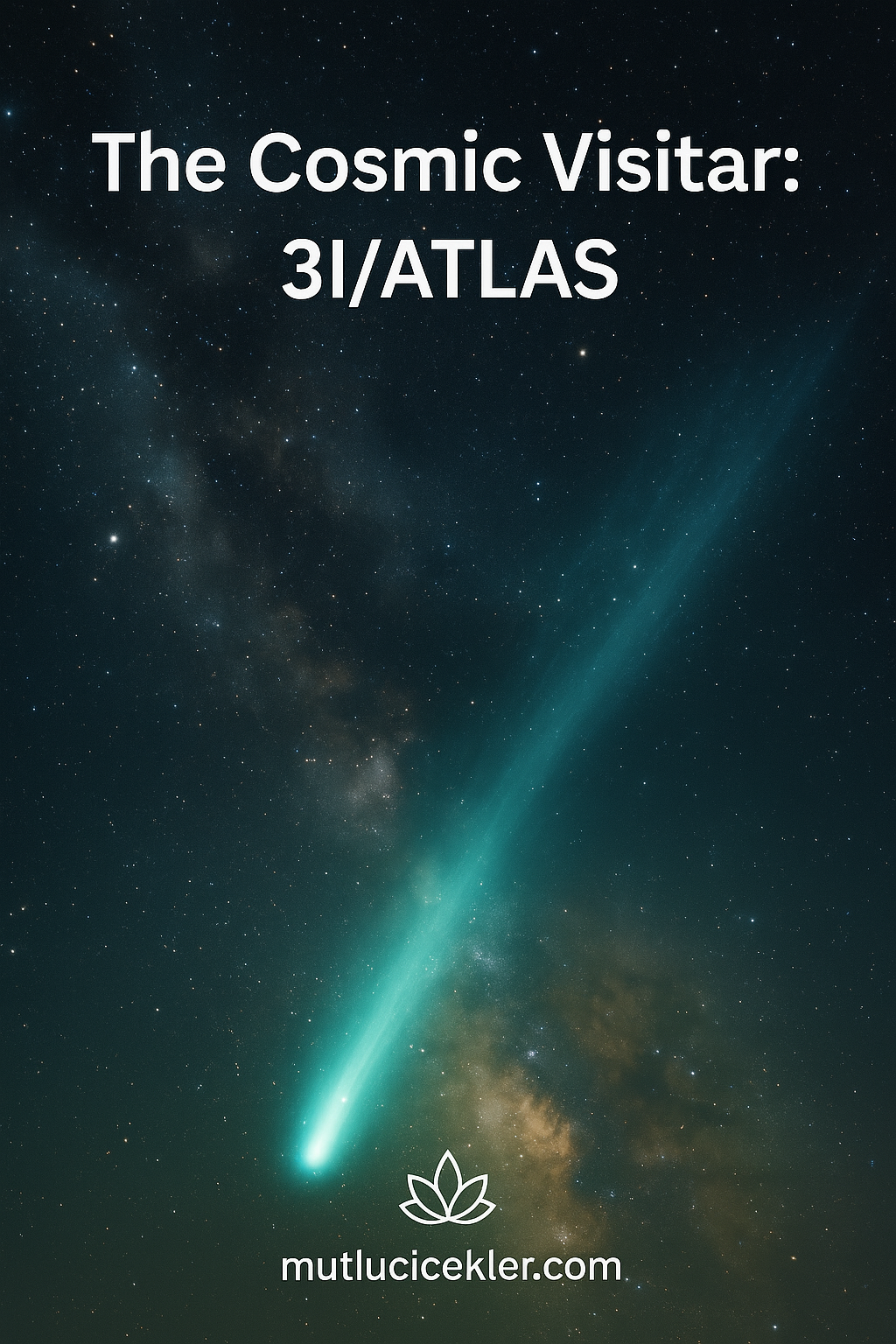
One of the most fascinating new discoveries in astronomy is 3I/ATLAS (C/2025 N1) — the third confirmed interstellar object ever detected in our Solar System.
The term “3I” stands for Interstellar Object number three, meaning it originated from beyond our Sun’s gravitational reach.
But what exactly is 3I/ATLAS, how was it discovered, and why does it matter so much? Let’s explore this mysterious cosmic traveler in detail.
🔭 What Is 3I/ATLAS?
- The “3I” designation means it’s the third interstellar visitor ever observed (after 1I/ʻOumuamua and 2I/Borisov).
- ATLAS refers to the Asteroid Terrestrial-impact Last Alert System, a telescope network that monitors the sky for near-Earth objects.
- Officially named C/2025 N1 (ATLAS), this object is a comet-like body that entered our Solar System on a hyperbolic orbit, meaning it will pass once and never return.
In simple terms, it’s a cosmic messenger — a piece of another star system briefly visiting ours.
🌍 Discovery and Orbit Details
🔹 Date of discovery: July 1, 2025
🔹 Discovered by: The ATLAS telescope in Río Hurtado, Chile
🔹 Closest approach to the Sun (Perihelion): October 29, 2025 — about 1.36 AU
🔹 Closest approach to Earth: Around 1.8 AU, completely safe distance
🔹 Orbit type: Hyperbolic, confirming its interstellar origin
Its trajectory proves that 3I/ATLAS isn’t bound by the Sun’s gravity — it’s merely passing through our neighborhood from deep space.
🧪 Physical and Chemical Properties
🔸 The nucleus size is uncertain but estimated between 0.8 km and 24 km in diameter.
🔸 Observations from the James Webb Space Telescope (JWST) reveal that the comet’s tail is rich in carbon dioxide (CO₂) gas.
🔸 Water vapor and ice were also detected, though in unusual proportions compared to ordinary comets.
These differences suggest that 3I/ATLAS may have formed under conditions very different from those in our Solar System.
🌠 Why Is It Important?
3I/ATLAS gives scientists a rare opportunity to study matter from another star system — a true sample of alien chemistry.
- It helps researchers understand how planetary systems form and evolve elsewhere in the galaxy.
- It’s only the third interstellar object ever recorded, making it scientifically historic.
- While some media speculated about “alien technology,” astronomers confirm it behaves like a natural comet — not an artificial craft.
🔭 Observation Tips for Skywatchers
🌌 3I/ATLAS will not be visible to the naked eye due to its faint brightness.
🌌 It can be tracked through telescopes near the Sagittarius constellation in late 2025.
🌌 The best observation window will be autumn 2025.
🌌 A dark-sky site, long exposure, and infrared filters will greatly improve visibility.
❓ FAQ (Frequently Asked Questions)
Q-1️⃣: Could 3I/ATLAS hit Earth?
No. Its trajectory keeps it far away — the closest distance is about 1.8 AU (≈ 270 million km).
Q-2️⃣: Is it an alien spacecraft?
No evidence supports that claim. Scientists confirm it’s a natural comet with predictable motion and outgassing behavior.
Q-3️⃣: How old is it?
Models suggest it could be over 7 billion years old, possibly older than the Sun itself.
🌟 Conclusion
The 3I/ATLAS comet is not just another icy rock drifting through space — it’s a messenger from another star system.
Its rare visit gives astronomers a glimpse into the building blocks of distant worlds and reminds us how vast and connected our universe truly is.
For space lovers and astronomy enthusiasts, following this celestial event is nothing short of breathtaking.





Bir Cevap Yazın