

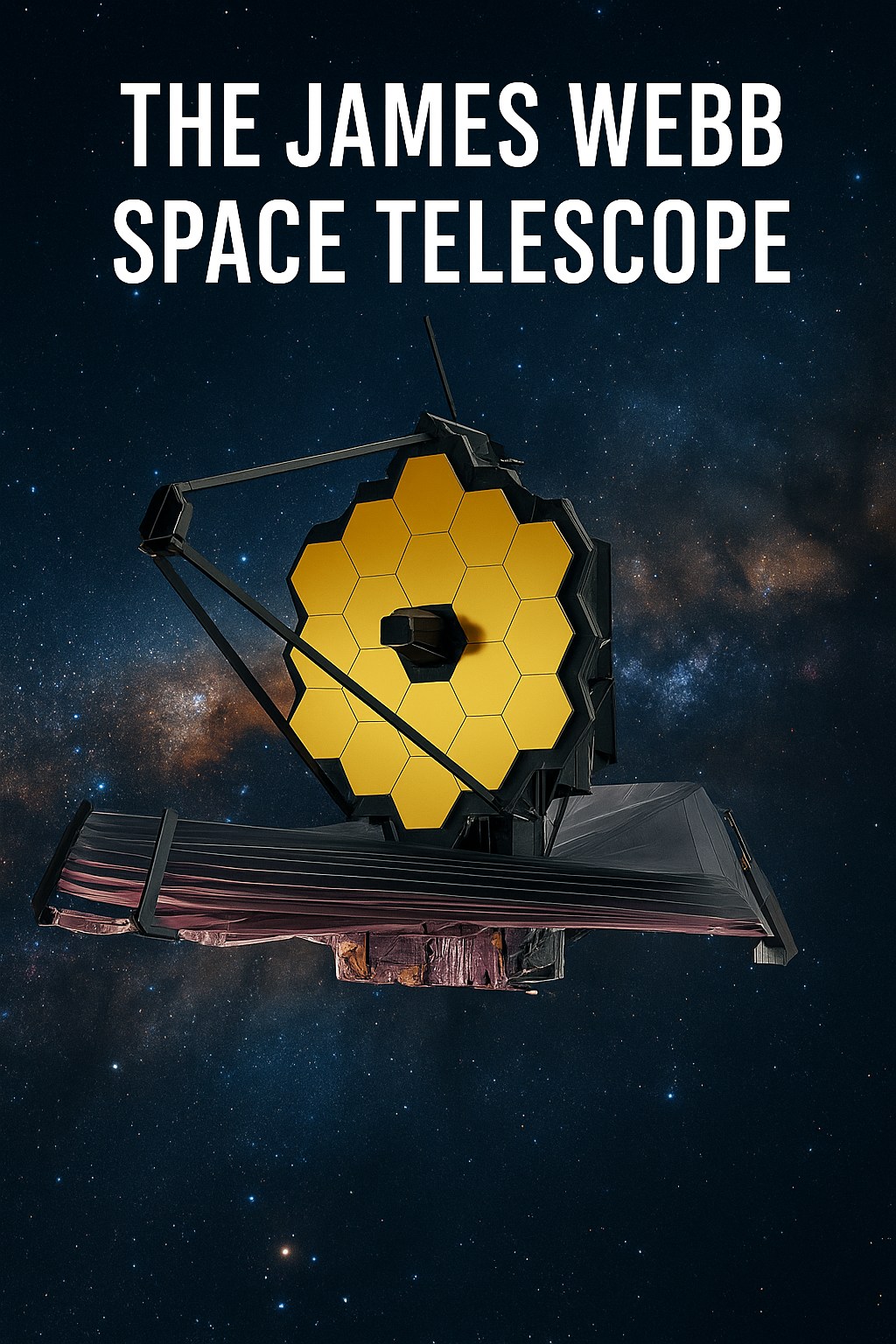
The James Webb Space Telescope (JWST) is the most advanced space observatory ever sent into orbit. Launched on December 25, 2021, JWST takes humanity deeper into the cosmos than ever before—revealing the birth of stars, the earliest galaxies, the structure of the universe, and the atmospheres of distant exoplanets.
With its massive gold-coated mirrors, infrared vision, and extraordinary clarity, JWST is not just a telescope—it is a time machine that allows us to see billions of years into the past.
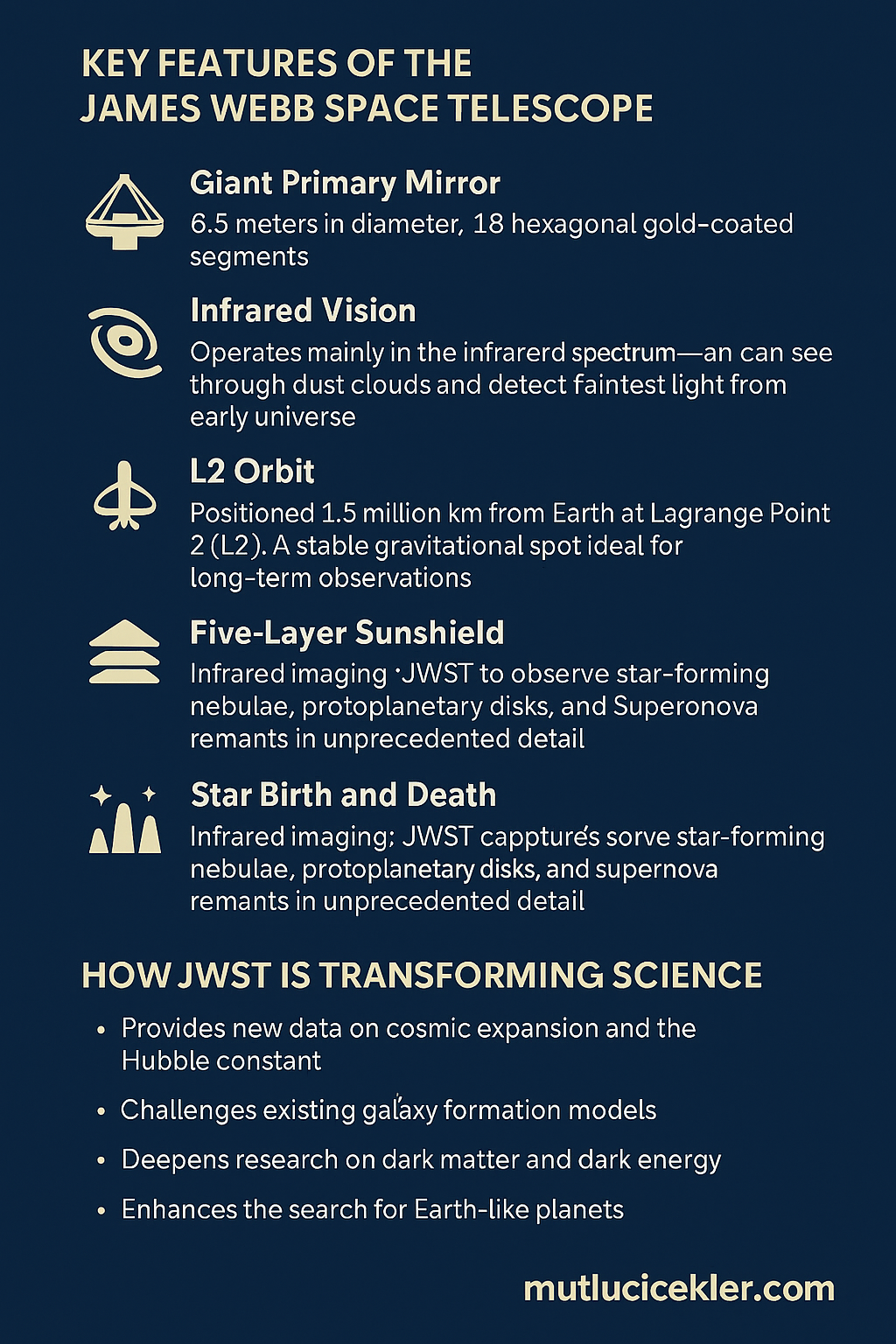
🌌 Key Features of the James Webb Space Telescope
🔭 1. Giant Primary Mirror
- 6.5 meters in diameter
- Made of 18 hexagonal, gold-coated segments
- More than three times larger than the Hubble mirror
🌡 2. Infrared Vision
- Operates mainly in the infrared spectrum
- Allows scientists to see through dust clouds and detect the faintest light from the early universe
🛰 3. L2 Orbit
- Positioned 1.5 million km from Earth at the Lagrange Point 2 (L2)
- A stable gravitational spot ideal for long-term observations
🛡 4. Five-Layer Sunshield
- The size of a tennis court
- Keeps the telescope at -233°C to ensure accurate infrared measurements
🚀 Major Discoveries Made by JWST
🌠 1. The Oldest Known Galaxies
JWST detected galaxies formed only 350–400 million years after the Big Bang—far earlier than expected.
These findings may change our understanding of cosmic evolution.
🌍 2. Exoplanet Atmospheres
JWST can analyze the chemical signatures of distant planets and detect:
- Water vapor
- Methane
- Carbon dioxide
- Possible biosignatures
This is a breakthrough in the search for habitable worlds.
⭐ 3. Star Birth and Death
Infrared imaging allows JWST to observe:
- Star-forming nebulae
- Protoplanetary disks
- Supernova remnants
in unprecedented detail.
🌌 4. The Most Detailed “Pillars of Creation”
The iconic Pillars of Creation in the Eagle Nebula were captured with stunning clarity, revealing structures never seen before.
🔍 How JWST Is Transforming Science
- Provides new data on cosmic expansion and the Hubble constant
- Challenges existing galaxy formation models
- Deepens research on dark matter and dark energy
- Enhances the search for Earth-like planets
JWST is redefining our understanding of how the universe works.
🌟 Conclusion
The James Webb Space Telescope is one of humanity’s greatest scientific achievements. Every new image and measurement brings us closer to understanding the origins of the universe, the formation of stars, and the potential for life beyond Earth.
In the coming years, JWST will continue to revolutionize astronomy and inspire curiosity across the world.
🔍 FAQ – James Webb Space Telescope
✔ What is JWST used for?
To observe the earliest galaxies, star-forming regions, distant exoplanet atmospheres, and cosmic structures invisible to other telescopes.
✔ How is JWST different from Hubble?
Hubble sees mainly visible light; JWST sees infrared, allowing it to see older and more distant objects.
✔ How far is JWST from Earth?
About 1.5 million kilometers away at the L2 point.
✔ Can JWST detect life?
It cannot see life directly, but it can detect chemical biosignatures such as methane, CO₂, and water vapor.
✔ How long will JWST operate?
It is expected to function for 10–20 years, depending on fuel usage.


Bir yanıt yazın