


For more than 75 years, generations of students learned the same simple fact: Pluto was the ninth planet of the Solar System.
Then everything changed.
In 2006, astronomers officially reclassified Pluto as a dwarf planet, reducing the number of recognized planets in our Solar System from nine to eight.
But why was Pluto removed from planet status? Did scientists discover something wrong with Pluto? And could Pluto ever become a planet again?
The real story is not that Pluto changed. Our understanding of the outer Solar System did.
Why Is Pluto No Longer a Planet?
Pluto lost its official planet status because it does not meet all three requirements in the modern definition of a planet adopted by the International Astronomical Union (IAU) in 2006.
According to that definition, a planet in our Solar System must:
- Orbit the Sun
- Have enough gravity to become nearly round
- Have cleared the neighborhood around its orbit
Pluto easily satisfies the first two conditions.
The problem is the third.
Pluto travels through a region beyond Neptune filled with many icy objects known as the Kuiper Belt. It has not become gravitationally dominant enough to clear its orbital neighborhood.
For this reason, the IAU classified Pluto as a dwarf planet rather than one of the eight major planets.
What Does “Clearing Its Orbit” Actually Mean?
This phrase is sometimes misunderstood.
A planet does not need to have a completely empty orbit.
Earth, Jupiter and the other planets also have asteroids and smaller objects traveling through regions near their orbital paths.
“Clearing the neighborhood” essentially means that a celestial body has become gravitationally dominant in the region surrounding its orbit.
Large planets either absorb smaller objects, capture them as satellites, scatter them into different orbits or otherwise strongly control their local orbital environment.
Pluto does not dominate its region in the same way.
Instead, it is one of many objects occupying the distant region of the Solar System beyond Neptune.
The Discovery That Changed Pluto’s Story
Pluto was discovered in 1930 by American astronomer Clyde Tombaugh at Lowell Observatory.
At the time, astronomers knew very little about the distant outer Solar System. Pluto seemed unique and was soon accepted as the Solar System’s ninth planet.
For decades, schoolbooks showed:
Mercury – Venus – Earth – Mars – Jupiter – Saturn – Uranus – Neptune – Pluto
But increasingly powerful telescopes eventually revealed something unexpected.
Pluto was not alone.
Astronomers began discovering many icy objects beyond Neptune in what became known as the Kuiper Belt.
Then came one particularly important discovery.
Eris Helped Trigger the Planet Debate
In the early 2000s, astronomers discovered a distant world later named Eris.
Eris appeared comparable to Pluto in size.
That created a difficult question:
If Pluto was a planet, shouldn’t Eris also be a planet?
And if Eris became a planet, what about other large Kuiper Belt objects that might eventually be discovered?
Astronomers faced the possibility that the Solar System could eventually contain many more officially recognized planets.
The discovery of Eris therefore helped trigger a much larger debate over a surprisingly difficult question:
What exactly is a planet?
In August 2006, astronomers attending the International Astronomical Union General Assembly in Prague voted on a formal definition.
Under the newly adopted definition, Pluto no longer qualified as a full planet.
Instead, Pluto, Eris and Ceres became members of a category known as dwarf planets.
Pluto Did Not Suddenly Become Smaller
One common misconception is that Pluto was downgraded because scientists discovered that it was too small.
Size alone was not the deciding factor.
Pluto is certainly tiny compared with Earth.
Its diameter is approximately 2,377 kilometers (1,477 miles), making it only about one-fifth as wide as Earth.
But Pluto is massive enough for its own gravity to pull it into a nearly spherical shape.
That means Pluto satisfies the roundness requirement of the planet definition.
Its classification problem comes primarily from its orbital environment.
Is Pluto’s Strange Orbit the Reason?
Pluto does have an unusual orbit.
Its path around the Sun is considerably more elliptical and tilted than the orbits of most major planets.
Pluto takes approximately 248 Earth years to complete one journey around the Sun.
For part of its orbit, Pluto can even be closer to the Sun than Neptune.
However, Pluto’s elliptical and tilted orbit is not itself the official reason Pluto is classified as a dwarf planet.
The decisive issue is that Pluto has not cleared its orbital neighborhood.
Pluto Is Part of the Kuiper Belt
Pluto resides in the Kuiper Belt, a vast region of icy bodies beyond Neptune.
The Kuiper Belt contains remnants from the early formation of the Solar System and includes countless small icy objects as well as several dwarf planets.
Rather than being an isolated world beyond Neptune, Pluto is now understood as one of the largest and most fascinating members of a much larger population of distant objects.
In some ways, losing its planet status helped scientists understand Pluto better.
Pluto was no longer simply the smallest planet.
It became one of the most important examples of an entirely different family of worlds.
New Horizons Revealed a Surprisingly Complex Pluto
Although Pluto had already been reclassified by 2006, scientists still knew relatively little about its surface.
That changed dramatically in 2015.
NASA’s New Horizons spacecraft became the first spacecraft to explore Pluto up close when it performed a historic flyby on July 14, 2015.
The spacecraft did not land on Pluto and did not enter orbit around it. Instead, it passed through the Pluto system while collecting images and scientific measurements.
What scientists discovered was remarkable.
New Horizons revealed a surprisingly active and complicated world with:
- enormous icy plains,
- mountain ranges,
- glaciers,
- craters,
- atmospheric haze,
- unusual surface chemistry,
- and evidence of flowing ice.
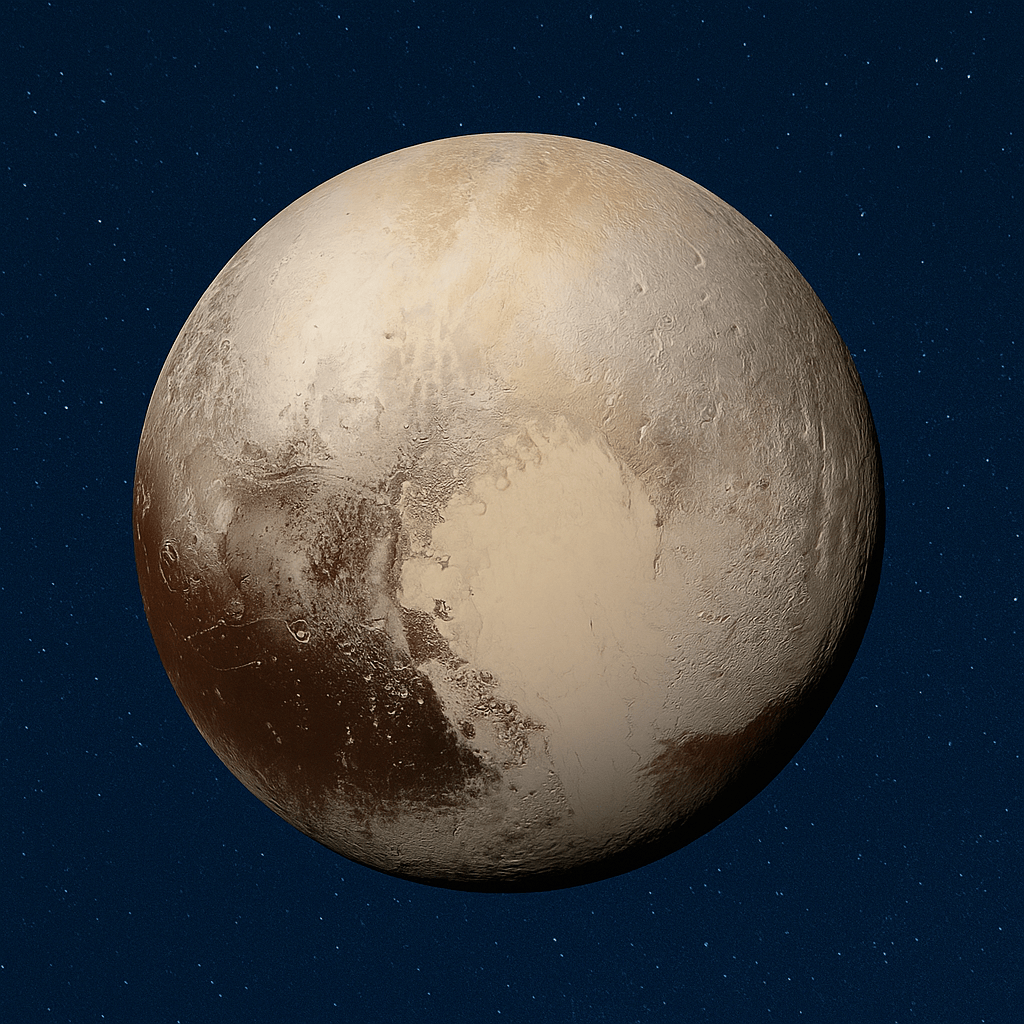
One of Pluto’s most recognizable features is its enormous bright, heart-shaped region known as Tombaugh Regio, named after Pluto’s discoverer.
Part of this region includes Sputnik Planitia, a vast plain dominated by nitrogen ice.
Pluto might officially be called a dwarf planet, but it is far from being a simple frozen rock.
Pluto Has Five Known Moons
Pluto also has a surprisingly interesting satellite system.
Five moons are currently known:
- Charon
- Styx
- Nix
- Kerberos
- Hydra
Charon is by far the largest.
It is unusually large compared with the object it orbits, with a diameter roughly half that of Pluto.
Because Pluto and Charon orbit a common point in space located outside Pluto itself, the pair has sometimes informally been described as resembling a double-world system.
However, Pluto is officially classified as a dwarf planet and Charon remains classified as its moon.
Does Pluto Have an Atmosphere?
Yes.
Despite its enormous distance from the Sun, Pluto has a thin atmosphere composed mainly of nitrogen, with smaller amounts of methane and carbon monoxide.
Pluto’s atmosphere also changes as the dwarf planet travels through its long orbit.
Because temperatures vary with Pluto’s distance from the Sun, some atmospheric gases can freeze onto the surface and later return to the atmosphere.
New Horizons also observed layers of atmospheric haze extending high above Pluto.
Could Pluto Become a Planet Again?
For now, Pluto remains officially classified as a dwarf planet.
The International Astronomical Union has not reversed its 2006 definition.
However, scientists continue to discuss how planets should be defined.
Some researchers prefer definitions based more strongly on the physical characteristics and geology of a celestial body rather than on whether it dominates its orbital neighborhood.
Under some alternative definitions, Pluto could potentially qualify as a planet.
But under the official IAU definition currently used for our Solar System, Pluto does not meet all three requirements.
So officially, the Solar System still has eight planets.
Is Pluto Still Important?
Absolutely.
Its classification does not make Pluto scientifically unimportant.
In fact, Pluto has become one of the most fascinating worlds in planetary science.
Studying Pluto and other Kuiper Belt objects can help researchers understand:
- how the Solar System formed,
- what conditions were like in its distant outer regions,
- how icy worlds evolve,
- how planetary atmospheres behave in extremely cold environments,
- and what remnants from the early Solar System can tell us about its history.
The New Horizons mission transformed Pluto from a distant point of light into a complex geological world.
Interesting Facts About Pluto
🪐 Pluto was discovered in 1930.
🔭 Clyde Tombaugh discovered Pluto at Lowell Observatory.
👧 The name Pluto was suggested by 11-year-old Venetia Burney.
❄️ Average temperatures on Pluto are around -230°C, although conditions vary.
🌑 Pluto has five known moons.
❤️ Its famous heart-shaped region is called Tombaugh Regio.
🚀 New Horizons flew past Pluto in 2015, becoming the first spacecraft to explore it up close.
☀️ One Pluto year lasts about 248 Earth years.
🌌 Pluto is located in the Kuiper Belt beyond Neptune.
Frequently Asked Questions About Pluto
Why was Pluto removed from planet status?
Pluto was reclassified because it does not satisfy all three requirements in the International Astronomical Union’s definition of a planet. In particular, it has not cleared the neighborhood surrounding its orbit.
When did Pluto stop being a planet?
Pluto was officially reclassified as a dwarf planet in August 2006 following a vote by the International Astronomical Union.
What is Pluto considered today?
Pluto is officially classified as a dwarf planet and a major object in the Kuiper Belt.
Was Pluto removed because it is too small?
No. Pluto’s size alone was not the reason. Pluto is large enough to become nearly round. Its inability to gravitationally dominate and clear its orbital neighborhood is the key issue.
How many planets are in the Solar System now?
There are officially eight planets: Mercury, Venus, Earth, Mars, Jupiter, Saturn, Uranus and Neptune.
Is Pluto bigger than Eris?
Pluto and Eris are similar in size, but current measurements indicate that Pluto is slightly larger in diameter.
Will Pluto ever become a planet again?
It is possible that definitions could change in the future, but there is currently no official decision to restore Pluto’s planet status. Under the existing IAU definition, Pluto remains a dwarf planet.
Pluto May Have Lost a Title, But Not Its Importance
Pluto’s reclassification in 2006 is sometimes described as the moment Pluto was “demoted.”
Scientifically, however, something more interesting happened.
Astronomers discovered that the region beyond Neptune was far richer and more complicated than anyone had imagined when Pluto was discovered in 1930.
Pluto did not change.
Our understanding of the Solar System did.
Today, Pluto remains one of the most recognizable and scientifically intriguing worlds beyond Neptune — a frozen, distant dwarf planet that continues to reshape what we know about the outer Solar System.
Sources: International Astronomical Union (IAU); NASA Solar System Exploration; NASA New Horizons Mission.


Bir Cevap Yazın