

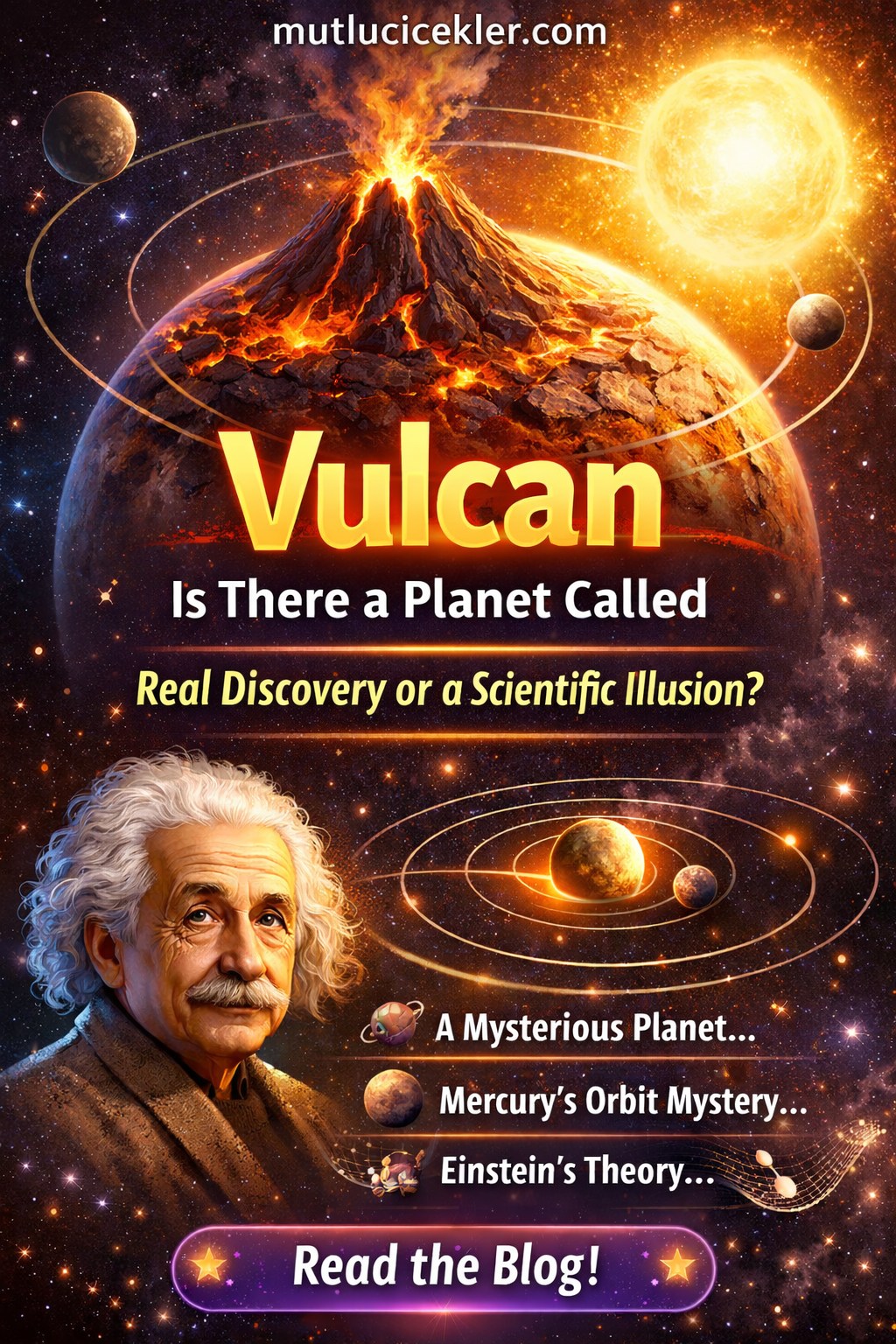
Humanity has always looked up at the sky with curiosity, imagination, and endless questions. One of the most fascinating astronomical debates revolves around a mysterious object once believed to exist: the planet Vulcan.
So, was there really a planet named Vulcan, or is it simply one of the most intriguing misconceptions in the history of science?
In this article, we explore the origin of the Vulcan hypothesis, why scientists believed in it, and how modern physics finally solved the mystery.
🔭 How Did the Vulcan Planet Theory Begin?
In the mid-19th century, astronomers noticed something strange about Mercury’s orbit around the Sun. Its path showed small irregularities that Newtonian physics could not fully explain.
French mathematician Urbain Le Verrier, famous for predicting the existence of Neptune, proposed a bold idea:
There must be an unknown planet located between Mercury and the Sun.
This hypothetical planet was named Vulcan, after the Roman god of fire.
☀️ Where Was Vulcan Supposed to Be?
According to the theory, Vulcan would have been:
- Extremely close to the Sun ☀️
- Exposed to intense heat 🔥
- Very difficult to observe 👁️
- Massive enough to disturb Mercury’s orbit 🛰️
Some astronomers even claimed to have seen Vulcan during solar eclipses, but none of these sightings could be independently confirmed.
🧠 Why Did Scientists Take Vulcan Seriously?
At the time, the idea seemed reasonable because:
- Newton’s laws had successfully explained planetary motion for centuries
- A similar method had led to the discovery of Neptune
- Orbital anomalies were often caused by unseen celestial bodies
As a result, Vulcan became a widely discussed topic in the scientific community for decades.
💥 What Proved That Vulcan Does Not Exist?
Everything changed in 1915.
Physicist Albert Einstein introduced the General Theory of Relativity, revolutionizing our understanding of gravity and spacetime.
Einstein’s equations perfectly explained Mercury’s orbital irregularities without requiring any additional planet.
📌 Conclusion:
The mysterious planet Vulcan was no longer necessary.
🪐 Was Vulcan Just an Illusion?
Yes—and no.
- ❌ Vulcan is not a real planet
- ✅ It represents a crucial step in scientific progress
- 📚 It is one of the most famous examples of a scientific hypothesis being replaced by a better theory
Vulcan reminds us that science evolves by questioning itself.
🌌 Are There Similar Mysteries Today?
Absolutely.
Modern astronomy still investigates unexplained phenomena, such as:
- 🟣 The hypothetical Planet Nine
- 🛰️ Anomalies in the Kuiper Belt
- 🌠 Thousands of newly discovered exoplanets
However, thanks to space telescopes, advanced mathematics, and AI-powered analysis, the chances of a “Vulcan-like” mistake are much smaller today.
✨ What Does the Vulcan Story Teach Us?
Although Vulcan never existed, its story teaches valuable lessons:
- 🔬 Scientific theories are always open to revision
- 🧠 Even incorrect ideas can lead to major breakthroughs
- 🌍 The universe still holds countless mysteries
Vulcan may not be real—but its legacy lives on as a symbol of human curiosity and scientific courage.
❓ Frequently Asked Questions (FAQ)
Was the planet Vulcan ever officially discovered?
No. It was never confirmed by reliable observations.
What replaced the Vulcan theory?
Einstein’s General Relativity explained Mercury’s orbit completely.
Are there planets closer to the Sun than Mercury?
Not in our solar system, but ultra-hot planets exist around other stars.
🌠 For more fascinating science, space, and discovery content, follow us:
👉 mutlucicekler.com
Bir yanıt yazın