
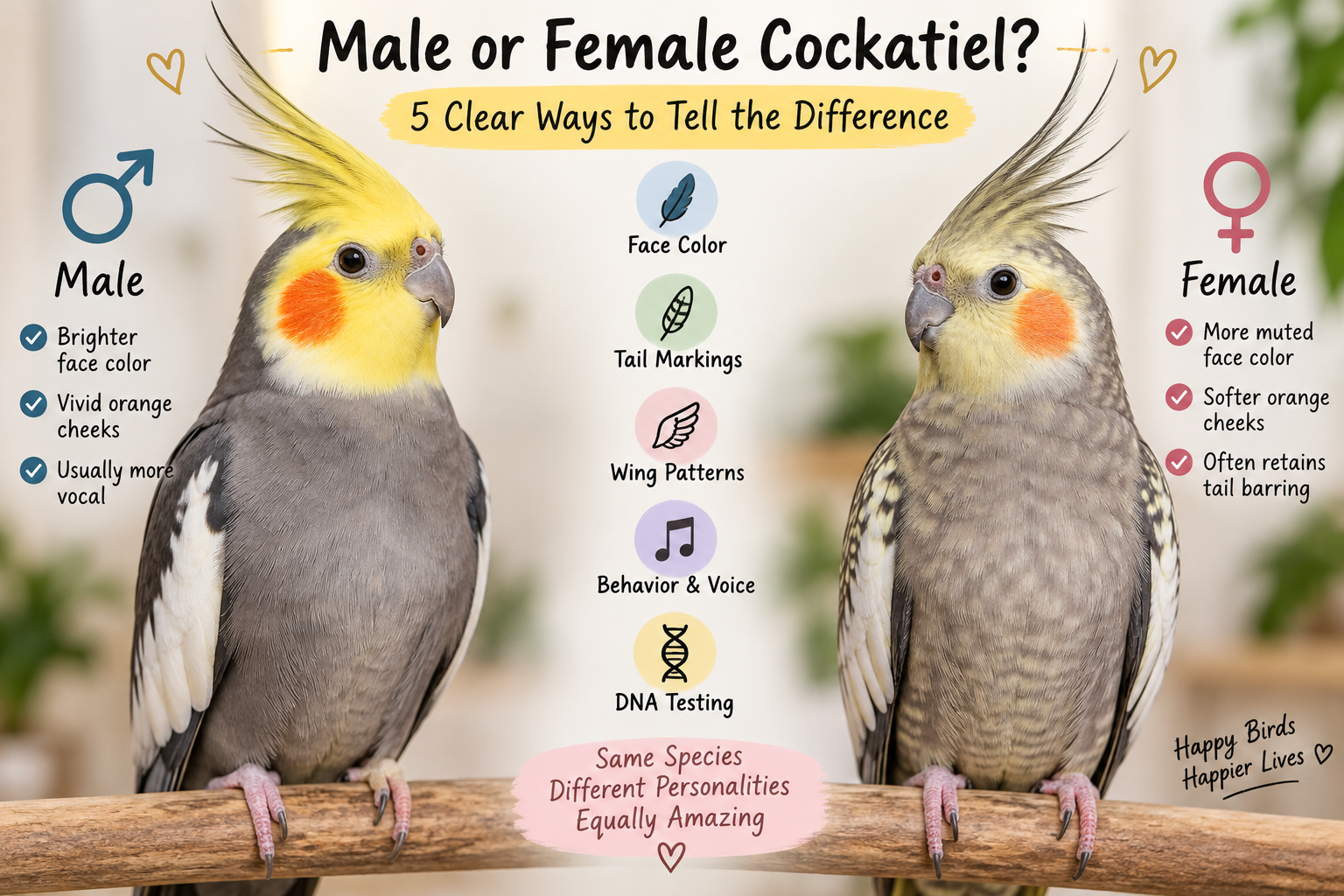
Is your cockatiel male or female? This is one of the most common questions cockatiel owners ask, especially when bringing home a young bird.
Although male and female cockatiels can look very similar, certain physical features, feather patterns, vocal behaviors, and personality traits may provide useful clues. However, age and color mutation can make visual identification difficult, and DNA testing remains the most reliable option when you need a definite answer.
In this guide, you’ll learn how to tell whether a cockatiel is male or female, when visual differences become noticeable, and why some cockatiels cannot be accurately sexed by appearance alone.
Male vs. Female Cockatiel: Quick Comparison
| Feature | Male Cockatiel | Female Cockatiel |
|---|---|---|
| Face color | Often brighter yellow in adult normal greys | Usually more muted or grey |
| Cheek patches | Often brighter orange | Often softer or less intense |
| Tail feathers | Usually lose barring after first molt | Often retain horizontal barring |
| Wing feathers | Usually fewer visible spots after maturity | May retain spots under the wings |
| Vocal behavior | Often whistles and mimics more frequently | Often quieter, but individuals vary |
| Courtship behavior | May sing, tap objects and perform displays | May crouch or show nesting behaviors |
| Visual sexing | Easier in some adult mutations | Easier in some adult mutations |
| Most reliable method | DNA test | DNA test |
Important: These characteristics are clues rather than guarantees. Individual personality, age, hormones and color mutations can significantly affect how a cockatiel looks and behaves.
1. Look at the Face and Cheek Color
One of the easiest clues in an adult normal grey cockatiel is the color of the face.
After reaching maturity, males typically develop a noticeably brighter yellow face with vivid orange cheek patches.
Adult females usually retain more grey coloration around the face, and their yellow coloring may appear less intense.
However, this method does not work reliably for every color mutation. Lutino, pied, pearl, whiteface and other mutations can make facial color much less useful for determining sex.
Male Cockatiel
An adult normal grey male often has:
- A bright yellow face
- Vivid orange cheek patches
- Stronger contrast between the face and grey body
Female Cockatiel
An adult normal grey female may have:
- More grey around the face
- Less intense yellow coloring
- Slightly softer-looking cheek patches
Remember that young cockatiels often resemble females before their first major molt.
2. Check the Tail Feathers
The underside of the tail can provide another useful clue.
Female cockatiels often have horizontal bars or stripes underneath their tail feathers.
Young cockatiels of both sexes may initially show similar markings, which is why checking a very young bird can be misleading.
After the first major molt, adult males of some mutations typically lose much of this barring, while females often retain it.
For the best view, examine the underside of the tail in good natural light without frightening or restraining the bird unnecessarily.
3. Look Under the Wings
Wing markings can also help distinguish males from females in certain cockatiels.
Females may retain pale spots or markings underneath the flight feathers after maturity. Adult males of visually sexable mutations often lose these juvenile markings after their first molt.
Again, this method depends heavily on the cockatiel’s mutation.
If your bird is pied, lutino or another mutation that changes feather pigmentation, wing markings alone should not be used to determine sex.
4. Listen to Whistling and Vocal Behavior
Behavior can provide additional clues.
Male cockatiels are often known for being enthusiastic whistlers. Some learn tunes, repeat sounds and spend considerable time trying to attract attention through vocal displays.
A male may:
- Whistle repeated melodies
- Mimic household sounds
- Sing toward mirrors or favorite objects
- Vocalize to attract attention
- Combine singing with courtship displays
Females can whistle and mimic sounds too, so a quiet bird is not automatically female, and a vocal bird is not automatically male.
Personality varies enormously between individual cockatiels.
5. Watch Courtship and Body Language
Adult cockatiels may display sex-related behaviors, particularly when hormones are active.
Male cockatiels may:
- Tap their beak on objects
- Sing or whistle during courtship
- Stretch their wings slightly away from the body
- Strut around favorite objects or people
- Perform attention-seeking displays
Females may:
- Crouch with the body lowered
- Raise the tail during hormonal behavior
- Become interested in dark or enclosed spaces
- Show nesting behavior
- Become protective of potential nesting areas
Behavior should always be interpreted together with age, feather characteristics and other clues.
When Can You Tell a Cockatiel’s Gender?
Determining the sex of a very young cockatiel by appearance can be difficult.
Juvenile males and females often look remarkably similar.
Visual differences usually become more useful after the first major molt, which commonly occurs during the first year of life.
For example, a young normal grey male may initially have a greyish face and barred tail similar to a female. As he matures and molts, the face may become brighter yellow while juvenile tail markings disappear.
If you need to know the sex before these changes occur, visual identification may not be reliable.
Male vs. Female Cockatiel After the First Molt
The first molt is particularly important when trying to identify the sex of a normal grey cockatiel.
After the molt, males may develop:
- A brighter yellow face
- Strong orange cheek patches
- Less barring underneath the tail
- Fewer juvenile spots underneath the wings
Females may retain:
- Grey facial coloration
- Tail barring
- Wing spots
- More subdued facial colors
These differences can make adult normal grey cockatiels considerably easier to sex visually than juveniles.
Can You Tell a Lutino Cockatiel’s Gender?
Lutino cockatiels can be more difficult to sex visually because their coloration removes many of the obvious differences seen in normal grey birds.
Some adult female lutinos may retain yellow spots underneath the wings and barring underneath the tail.
However, lighting, feather condition and genetics can make these patterns difficult to see.
If you have a lutino cockatiel and need certainty, DNA testing is a much better option than relying only on appearance.
What About Pearl Cockatiels?
Pearl cockatiels provide an interesting clue after maturity.
In many cases, adult males lose much of their characteristic pearl pattern after successive molts, while females tend to retain the pearling.
A young male pearl cockatiel may therefore look very similar to a female before reaching maturity.
This makes age extremely important when using feather patterns to determine sex.
Can Pied Cockatiels Be Sexed Visually?
Pied cockatiels are among the more difficult mutations to sex by appearance.
Their irregular feather patterns can hide or alter many of the traditional visual clues, including facial coloration and tail markings.
Behavior may provide hints, but it still cannot confirm sex with complete certainty.
For heavily pied cockatiels, DNA testing is generally the most dependable approach.
Does Cheek Color Tell You the Gender?
Not by itself.
Bright orange cheeks are commonly associated with adult male normal grey cockatiels, but cheek color varies according to mutation, genetics and individual coloration.
A cockatiel should never be identified as male or female based only on the brightness of its cheek patches.
Look at several characteristics together.
Is Behavior Enough to Determine Gender?
No.
Although male cockatiels are often described as more vocal and females as quieter, there are plenty of exceptions.
Some females are excellent whistlers. Some males are relatively quiet.
Environment, socialization, personality, age and previous experiences all influence behavior.
Behavior is therefore best treated as supporting evidence rather than proof.
DNA Testing: The Most Reliable Method
If you need a definite answer, DNA sexing is the most reliable method for cockatiels whose sex cannot be determined confidently by appearance.
DNA testing can be particularly useful for:
- Young cockatiels
- Lutino cockatiels
- Pied cockatiels
- Birds with unclear feather patterns
- Breeding pairs
- Owners who simply want certainty
Depending on the veterinary service or laboratory, DNA testing may use an appropriate feather or blood sample.
For advice about safe sample collection, consult an avian veterinarian or follow the instructions provided by a reputable veterinary laboratory. Avoid pulling feathers or collecting blood without proper guidance.
Male or Female Cockatiel: Which Is Better as a Pet?
Neither sex is automatically a better pet.
Both male and female cockatiels can become affectionate, intelligent and entertaining companions.
Males are often associated with more frequent whistling and vocal displays, while females are sometimes described as calmer. But individual personality matters much more than these general tendencies.
The best cockatiel for you is a healthy, well-socialized bird whose temperament fits your household and lifestyle.
Important Note About Female Cockatiels and Egg Laying
Female cockatiels can lay eggs even when no male is present.
If a female repeatedly lays eggs, it can place additional nutritional and physical demands on her body. Frequent egg laying deserves attention because complications such as calcium depletion and egg binding can occur.
If your cockatiel lays eggs frequently, appears weak, strains, sits at the bottom of the cage, has difficulty breathing, or seems unusually unwell, contact an avian veterinarian promptly.
Tips for Identifying Your Cockatiel’s Sex
Instead of relying on one characteristic, consider several clues together:
- Determine your cockatiel’s approximate age.
- Check whether the bird has completed its first major molt.
- Identify its color mutation if possible.
- Examine the underside of the tail.
- Look for spots underneath the wings.
- Observe facial coloration.
- Pay attention to whistling and courtship behavior.
- Use DNA testing when certainty is important.
Frequently Asked Questions
How can I tell if my cockatiel is male or female?
Adult normal grey cockatiels may show differences in facial color, tail barring and wing markings. Vocal and courtship behavior can provide additional clues. DNA testing is the most reliable method when visual characteristics are unclear.
At what age can you tell a cockatiel’s gender?
Visual differences often become easier to recognize after the bird’s first major molt. Before that point, juvenile males and females can look very similar.
Do male cockatiels have brighter faces?
Adult male normal grey cockatiels usually develop brighter yellow faces than females. This rule does not apply reliably to all color mutations.
Do female cockatiels whistle?
Yes. Female cockatiels can whistle, sing and mimic sounds. Males may do these behaviors more frequently on average, but vocal behavior alone cannot reliably determine sex.
Do female cockatiels have stripes under their tails?
Females of visually sexable mutations commonly retain horizontal barring underneath the tail after maturity. Juvenile males may also have barring before their first molt.
Can you tell the gender of a lutino cockatiel?
Sometimes feather markings provide clues, but lutino cockatiels can be difficult to sex visually. DNA testing is the best choice when certainty is needed.
Can a female cockatiel lay eggs without a male?
Yes. Female cockatiels can produce infertile eggs without ever mating with a male.
Is DNA testing necessary?
Not always. Some mature normal grey cockatiels can be sexed fairly confidently by appearance. DNA testing becomes particularly useful for young birds and mutations where visual characteristics are unreliable.
Final Thoughts
Determining whether a cockatiel is male or female can be surprisingly challenging. Adult normal grey cockatiels often provide useful visual clues through facial coloration, tail barring and wing markings, while behavior such as whistling and courtship displays can add supporting evidence.
However, no single behavior should be treated as proof of sex, and some color mutations make visual identification extremely difficult.
If your cockatiel is young, has a mutation such as lutino or pied, or simply does not show clear physical characteristics, DNA testing is the most reliable way to get a definitive answer.
Most importantly, whether your cockatiel is male or female, proper nutrition, social interaction, enrichment and regular avian veterinary care are far more important than gender when it comes to keeping your bird healthy and happy.
For more bird care guides and expert tips, follow us.
🌿 mutlucicekler.com

Bir Cevap Yazın