

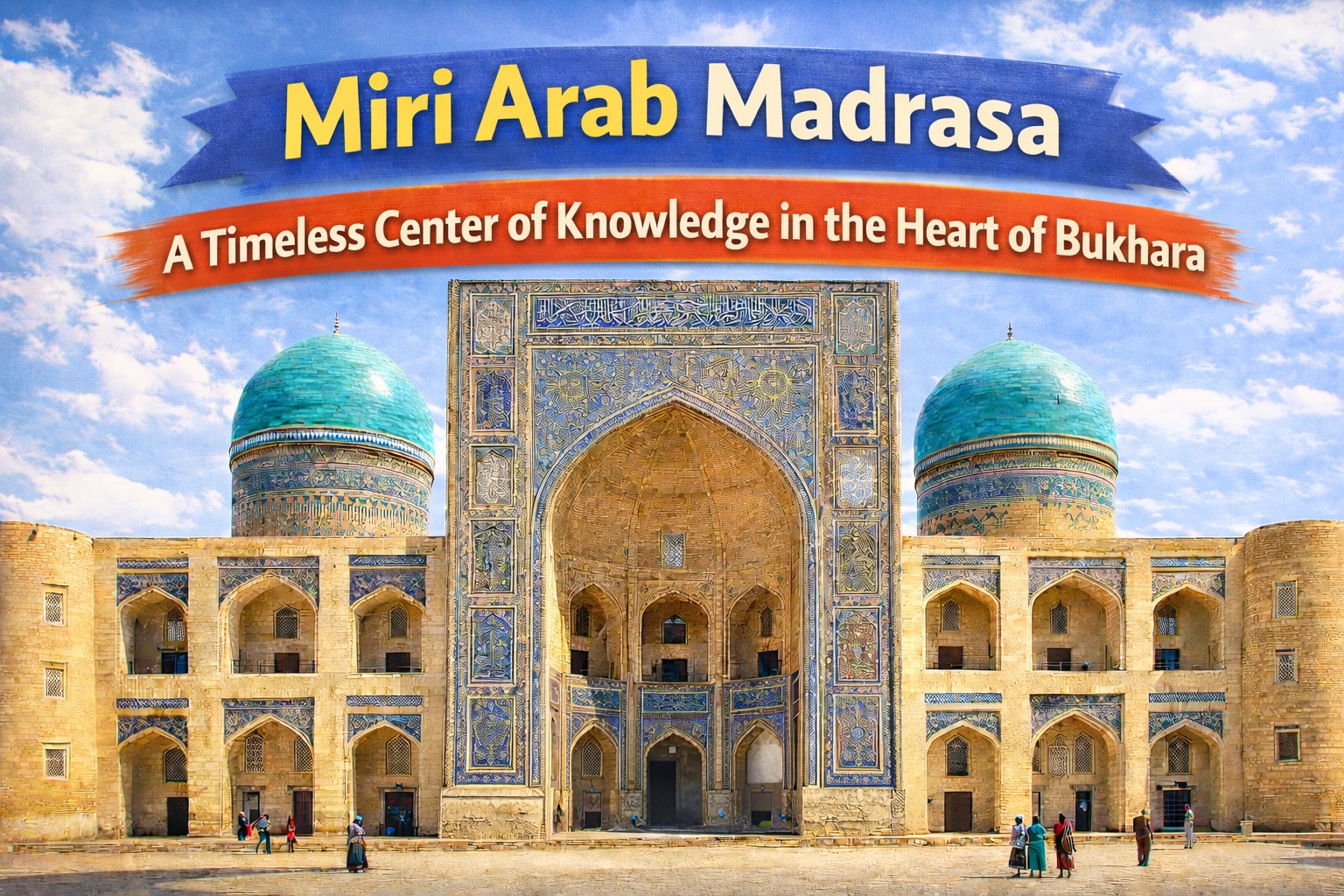
Standing opposite the great Kalyan Mosque in the heart of Bukhara, Mir-i-Arab Madrasa is one of the most recognizable religious buildings on Uzbekistan’s Silk Road. The turquoise domes, immense entrance portal and patterned tilework are striking, but its history is even more compelling: this 16th-century institution survived political upheaval, a long interruption in teaching and successive restorations.
Unlike many former madrasas converted into shops or museums, Mir-i-Arab remains associated with active Islamic education. Understanding that distinction helps visitors appreciate both the monument and the people who use it today.
Mir-i-Arab Madrasa at a glance
| Question | Answer |
|---|---|
| Location | Po-i-Kalyan (Poi Kalon) ensemble, historic Bukhara, Uzbekistan |
| Construction | Early 16th century, generally dated c. 1530–1536 |
| Patronage | Associated with the Shaybanid ruler Ubaydullah Khan and Sheikh Abdullah al-Yamani |
| Architectural highlights | Monumental pishtaq portal, two blue domes, tiled façade, inner courtyard and student cells |
| Education | Interrupted under Soviet rule; reopened in 1945 and continues to function as a religious institution |
| Heritage status | Within the Historic Centre of Bukhara, inscribed on UNESCO’s World Heritage List in 1993 |
Where is Mir-i-Arab Madrasa?
The madrasa stands on the Po-i-Kalyan square in Bukhara’s old city. Its decorated façade faces the monumental complex that includes the Kalyan Mosque and the much older Kalyan Minaret. These structures were not all built at the same time: the famous minaret dates to 1127, whereas Mir-i-Arab belongs to the Shaybanid building phase of the 1500s.
It is an easy addition to a walking route through the old town’s trading domes and historic streets. The surrounding square is an excellent place to understand the scale of the ensemble, even when access to the madrasa itself is restricted.

Why this setting matters: the mosque, minaret and madrasa illustrate different functions of a historic Islamic city—congregational worship, a landmark for the urban skyline, and religious teaching. Taken together, they help explain why Bukhara became such an influential center of learning.
History: who built Mir-i-Arab Madrasa?
Most heritage references date construction to approximately 1530–1536, during the rise of the Shaybanid rulers in Bukhara. The project is closely associated with Ubaydullah Khan (often spelled Ubaydulla Khan) and his religious mentor Sayyid Abdullah al-Yamani, commonly known as Mir-i-Arab. The title is usually understood as a reference to his Arab/Yemeni origins.
Abdullah al-Yamani was linked to the Naqshbandi Sufi tradition. He is remembered not simply as the person for whom the building was named but as a spiritual figure connected to Bukhara’s intellectual and religious life. Historical accounts vary in their treatment of patronage and precise construction dates, so it is more careful to say the madrasa was built in the 1530s than to assign every stage of the project to a single year.
A short timeline
| Period | What happened |
|---|---|
| c. 1530–1536 | Construction of the madrasa in the Shaybanid period. |
| 16th–19th centuries | Religious scholarship and teaching became central to its identity. |
| 1920s–1940s | Educational activity was disrupted and suspended under Soviet policies toward religious institutions. |
| 1945 | The institution resumed authorized Islamic education, an important exception in Soviet Central Asia. |
| Late 20th century | Conservation and restoration campaigns addressed parts of the building, including its decorative surfaces. |
| Today | The madrasa retains an educational role while forming part of the protected historic urban landscape. |
Historical correction: it is inaccurate to say Mir-i-Arab stayed open without interruption throughout the Soviet period. Uzbekistan’s official tourism account and the Islamic Civilization Center both describe its closure and reopening in 1945.
Why Mir-i-Arab became an important school
A madrasa is an institution for organized study. At Mir-i-Arab, traditions of Qur’anic interpretation (tafsir), hadith, jurisprudence (fiqh) and theology helped shape generations of religious scholars. Its place in intellectual history cannot be understood only through architecture: the people trained here went on to serve Muslim communities in several parts of the former Soviet Union.
The resumption of authorized education in 1945 was especially significant because official religious instruction had become severely restricted. This made the institution an unusual and influential center for Islamic learning during the latter Soviet decades. It should not be confused with a claim that teaching continued uninterrupted since the 1500s.
The institution continues to be described by Uzbek cultural authorities as an active religious school. Its classes and residential spaces are therefore not simply museum rooms waiting to be explored.
Architecture: how to read the façade

The exterior offers a compact lesson in 16th-century Central Asian design. Rather than seeing the building only as a beautiful blue-domed backdrop, look for how its different elements work together:
- Pishtaq: the lofty, richly ornamented entrance portal, which establishes the visual focus of the façade.
- Two turquoise-blue domes: conspicuous features of the skyline, emphasizing the composition around the main entrance.
- Glazed tiles and inscriptions: geometric and calligraphic decoration contrasting with the warmer tones of brickwork.
- Courtyard and arcades: the internal arrangement typical of many Central Asian madrasas, with teaching spaces and student rooms (hujras).
- Domed teaching and devotional rooms: spaces that connect the building’s visual splendor to its original educational and religious purposes.
The tiled façade seen today has benefited from restoration. Calling every decorative surface ‘completely original’ would be misleading. Conservation is part of this monument’s modern story, and UNESCO also cautions that the wider historic city faces pressures from changing construction practices and environmental deterioration.
What about the tombs inside?
Heritage descriptions associate the madrasa’s funerary space with Sheikh Abdullah al-Yamani and the burial of Ubaydullah Khan. These tombs are part of the building’s history, but they should not be described as generally available for tourist visits: the madrasa’s status as a working school may restrict access.
Mir-i-Arab and UNESCO World Heritage
Bukhara’s Historic Centre was inscribed on UNESCO’s World Heritage List in 1993. Mir-i-Arab is located within that historic urban ensemble. The correct distinction is that the historic center is the listed property—not that the madrasa received a separate, individual UNESCO inscription.
UNESCO emphasizes Bukhara’s preserved urban fabric and its long influence as a center of Islamic culture, trade and scholarship. A visit makes most sense when Mir-i-Arab is seen in relation to the Kalyan Mosque, minaret and the surrounding streets, rather than as an isolated photo stop.
Can visitors go inside Mir-i-Arab Madrasa?
Do not count on general interior admission. Mir-i-Arab is associated with active religious education, and entry arrangements may vary or be restricted. The façade can be appreciated from the public square; ask local staff or your licensed guide before entering any courtyard, classroom or prayer area. A ticket sold for another nearby monument does not automatically grant access to the school.
Respect worship and study, dress conservatively, and ask before photographing people. Drone flights and commercial photo shoots may require separate permissions. There is no reliable fixed admission fee or visiting timetable we can guarantee for October 2026; check conditions locally.
Travel editor’s practical notes
- Best light: early morning provides a calmer square; late-afternoon light brings out the depth of the portal. Exact lighting depends on season.
- Time to allow: around 20–40 minutes to appreciate and photograph the façade and square, longer if combining it with nearby sights.
- Location strategy: explore the Kalyan Minaret, mosque and historic trading domes in the same walk to reduce unnecessary transfers.
- Walking comfort: the old city has uneven paving and limited shade in exposed squares; carry drinking water in hot weather.
- Responsible photography: do not assume access to student rooms; photograph architectural details from permitted public viewpoints.
Editorial perspective: if you have only one hour in this part of Bukhara, use it to observe the relationship between the minaret, mosque and madrasa—not just to collect close-up shots of the blue domes. This is a researched route-planning recommendation, not a claim that the writer personally entered the school.
What else can you see nearby?
The Kalyan Minaret is a landmark from the Karakhanid period, while the Kalyan Mosque and the madrasa represent later layers of Bukhara’s architectural history. Nearby trading domes recall the city’s role in Silk Road commerce, and Lyabi-Hauz is another worthwhile stop on a longer old-town route.
For practical train arrivals, food suggestions and a two-day itinerary, see our Bukhara travel guide.
Frequently asked questions
When was Mir-i-Arab Madrasa built?
Construction is generally dated to the 1530s, often summarized as c. 1530–1536. Sources differ on the exact start and completion dates.
Who was Mir-i-Arab?
The name refers to Sheikh Abdullah al-Yamani, a religious figure associated with Yemen and the Naqshbandi tradition, linked to the madrasa’s founding.
Is Mir-i-Arab Madrasa still a functioning school?
Yes. Official Uzbek heritage and cultural sources describe the institution as retaining its role in Islamic education. Its activity was interrupted during Soviet rule and resumed in 1945.
Can tourists visit the courtyard and classrooms?
Access is not guaranteed and may be limited because the site is a working educational institution. Enjoy the exterior from Po-i-Kalyan and request permission for any interior visit.
Is the madrasa on the UNESCO World Heritage List?
It is part of Bukhara’s UNESCO-listed Historic Centre, inscribed in 1993; it is not listed separately as an individual World Heritage property.
Final thoughts
Mir-i-Arab Madrasa is important because its architecture and educational history are inseparable. The monumental portal tells one story about the ambition of 16th-century Bukhara, while the school’s closure and later reopening reveal the upheavals of the 20th century. Seeing both sides makes this historic square far more meaningful.
Sources and research notes
- Uzbekistan Travel — official national tourism account of the madrasa’s patronage, layout and twentieth-century history.
- Islamic Civilization Center in Uzbekistan — historical timeline, Soviet closure and 1945 reopening, educational activity and architectural details.
- UNESCO World Heritage Centre — Historic Centre of Bukhara, World Heritage property 602 and its cultural significance.
- Uzbek government heritage construction and restoration directorate — historical background and restoration context.
- Meros Uzbekistan cultural heritage catalog — comparative dating and monument description.
Editorial research review: 20 October 2026. This guide summarizes sourced historical and practical information; it does not claim a first-hand visit or promise access to the building’s interiors.


Bir yanıt yazın