

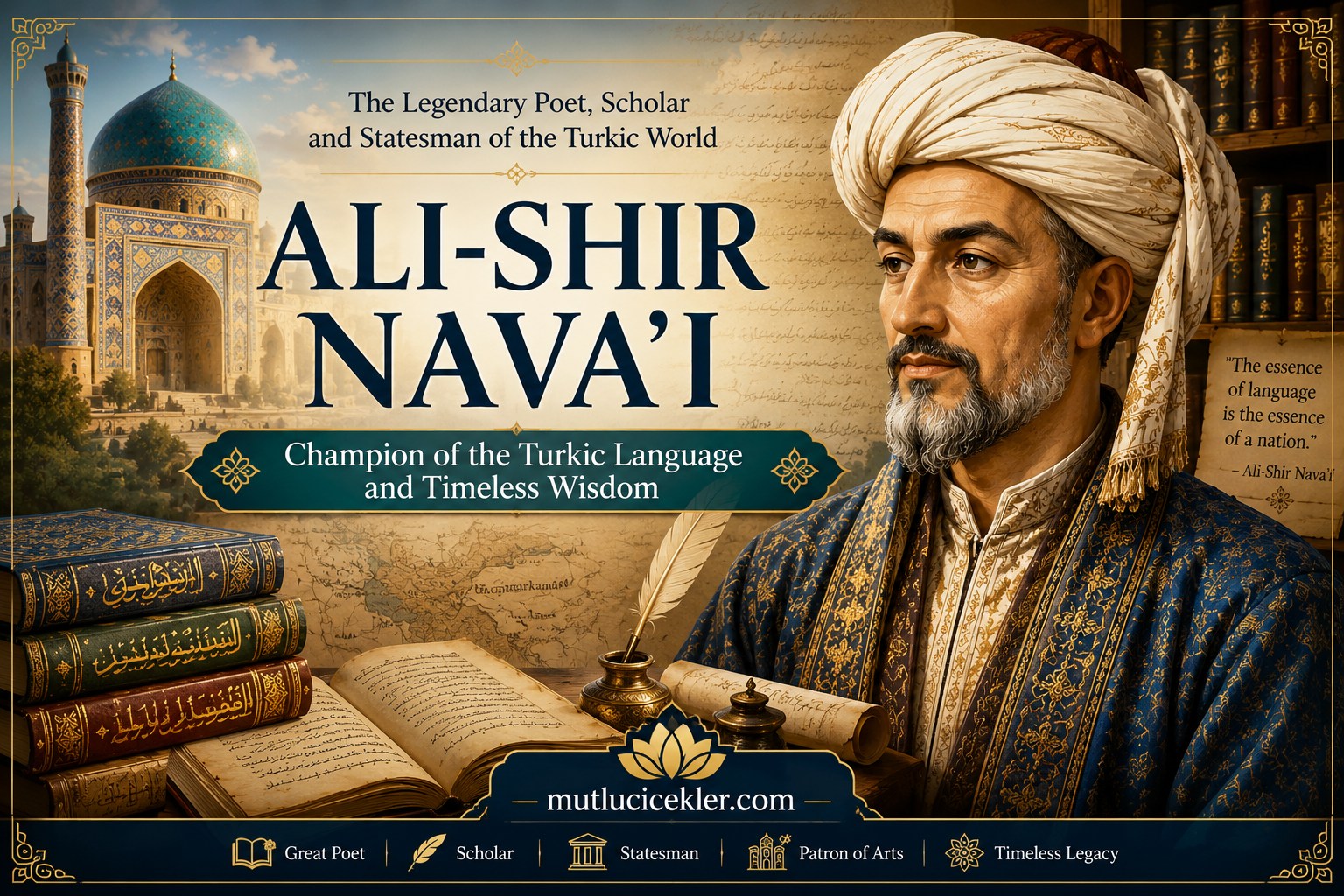
Throughout history, only a handful of writers have transformed the cultural identity of an entire language. Ali-Shir Nava’i is one of those extraordinary figures. Revered as one of the greatest poets, scholars, and statesmen of the Turkic world, he demonstrated that the Turkic language possessed the same literary richness and expressive power as Persian, reshaping Central Asian literature for generations.
Today, Ali-Shir Nava’i remains a symbol of literature, education, and cultural heritage, inspiring readers, historians, and linguists around the world.
Who Was Ali-Shir Nava’i?
Born: February 9, 1441
Birthplace: Herat (present-day Afghanistan)
Died: January 3, 1501
Occupation: Poet, writer, philosopher, linguist, statesman, philanthropist
Ali-Shir Nava’i lived during the Timurid Renaissance, one of Central Asia’s most remarkable cultural periods. Raised in an educated and influential family, he mastered Turkic, Persian, and Arabic while developing a deep interest in poetry, philosophy, history, theology, and the arts.
His lifelong friendship with Sultan Husayn Bayqara eventually placed him in influential government positions, allowing him to promote literature, architecture, education, and public welfare alongside his literary achievements.
Why Is Ali-Shir Nava’i So Important?
In the 15th century, Persian was widely regarded as the dominant literary language across much of Central Asia.
Rather than following this tradition, Nava’i deliberately chose to write many of his greatest works in Chagatai Turkic, proving that Turkic languages could express sophisticated ideas, emotions, philosophy, and poetry just as effectively.
His literary achievements:
- Elevated the status of the Turkic language.
- Standardized Chagatai Turkic as a prestigious literary language.
- Inspired generations of Turkic writers.
- Preserved Turkic cultural identity through literature.
- Influenced later Ottoman, Uzbek, Uyghur, Kazakh, and other Turkic literary traditions.
His impact continues to be recognized throughout the Turkic-speaking world today.
Early Life and Education
Ali-Shir Nava’i spent his childhood in Herat, an important cultural center of the Timurid Empire.
From an early age he received an exceptional education, studying:
- Literature
- Philosophy
- Theology
- Mathematics
- History
- Calligraphy
- Languages
He later continued his education in Samarkand, where he further refined his literary skills and intellectual pursuits.
His education played a crucial role in shaping the remarkable works that would later define Turkic literature.

Champion of the Turkic Language
One of Nava’i’s greatest achievements was his unwavering commitment to promoting the Turkic language.
At a time when many intellectuals preferred Persian, he believed that Turkic languages possessed exceptional expressive potential.
Through his writings, he demonstrated their ability to convey:
- Love
- Spirituality
- Wisdom
- Philosophy
- Heroism
- Ethics
- Political thought
His success permanently transformed the literary landscape of Central Asia.
Muhakamat al-Lughatayn: A Defense of the Turkic Language
Perhaps Nava’i’s most influential prose work is Muhakamat al-Lughatayn, often translated as “The Judgment Between Two Languages.”
In this remarkable linguistic study, he compares Turkic and Persian, arguing that Turkic possesses unique strengths in vocabulary, flexibility, and expressive richness.
Rather than criticizing Persian, Nava’i sought to demonstrate that Turkic deserved equal recognition as a literary language.
The work remains an important reference for linguists and historians studying medieval language development.
Ali-Shir Nava’i’s Most Famous Works
Muhakamat al-Lughatayn
His famous comparative study defending the literary value of the Turkic language.
Majalis al-Nafais
Considered one of the earliest biographical anthologies of poets in Turkic literature, offering valuable insights into the literary world of his era.
Khamsa
Inspired by the Persian literary tradition, Nava’i composed his own collection of five epic poems, including:
- Hayrat al-Abrar
- Farhad and Shirin
- Layli and Majnun
- Sab’ai Sayyar
- Sadd-i Iskandari
These masterpieces remain classics of Turkic literature.
Divans
Throughout his life, Nava’i compiled several collections of lyrical poetry that explored spirituality, morality, love, and human nature.
Literary Style
Ali-Shir Nava’i’s poetry combines elegance with intellectual depth.
Common themes include:
- Love
- Faith
- Mysticism
- Justice
- Morality
- Human dignity
- Wisdom
- Leadership
- Compassion
His refined language, vivid imagery, and philosophical reflections continue to resonate with modern readers.
Ali-Shir Nava’i as a Statesman
Nava’i’s influence extended far beyond literature.
During his public service, he helped establish:
- Schools
- Libraries
- Hospitals
- Mosques
- Bridges
- Public kitchens
- Charitable foundations
He actively supported scholars, artists, architects, and educators, contributing significantly to the cultural flourishing of the Timurid Empire.
Lasting Influence on the Turkic World
Ali-Shir Nava’i is celebrated across numerous countries, including:
- Uzbekistan
- Türkiye
- Kazakhstan
- Kyrgyzstan
- Turkmenistan
- Azerbaijan
In Uzbekistan especially, universities, theaters, libraries, museums, and public institutions proudly bear his name.
His works remain essential reading in departments of literature, history, and linguistics worldwide.
Timeless Ideas
Nava’i believed that:
- Knowledge elevates humanity.
- Language preserves national identity.
- Justice strengthens civilizations.
- Education shapes future generations.
- Literature unites cultures.
- Moral character defines true greatness.
These principles continue to inspire scholars and readers centuries after his lifetime.
Fascinating Facts About Ali-Shir Nava’i
- He authored more than 30 major literary works.
- He was one of the greatest representatives of Chagatai literature.
- He mastered several languages, including Turkic, Persian, and Arabic.
- He combined political leadership with literary excellence.
- His influence extends across the entire Turkic-speaking world.
- UNESCO has recognized his cultural significance through commemorative events.
Ali-Shir Nava’i’s Legacy
Ali-Shir Nava’i’s legacy reaches far beyond poetry. He helped establish a literary tradition that strengthened the identity of Turkic-speaking peoples and demonstrated that language is a cornerstone of culture and civilization.
His writings continue to inspire linguists, historians, educators, and literature enthusiasts around the world. More than five centuries later, his commitment to education, creativity, and cultural preservation remains remarkably relevant.
Conclusion
Ali-Shir Nava’i stands among history’s greatest literary figures. His contributions to Turkic literature, language, education, and public service transformed the intellectual landscape of Central Asia and continue to influence readers worldwide.
Whether appreciated as a poet, philosopher, statesman, or cultural visionary, Ali-Shir Nava’i remains one of the most enduring voices in world literary history.
Frequently Asked Questions (FAQ)
Who was Ali-Shir Nava’i?
Ali-Shir Nava’i was a 15th-century Turkic poet, writer, philosopher, and statesman widely regarded as the greatest author of Chagatai literature.
Why is Ali-Shir Nava’i famous?
He demonstrated that the Turkic language could rival Persian as a sophisticated literary language and produced some of the finest works in classical Turkic literature.
What is Muhakamat al-Lughatayn?
It is Nava’i’s famous linguistic work comparing Turkic and Persian, defending the literary richness of the Turkic language.
What language did Ali-Shir Nava’i write in?
Most of his major works were written in Chagatai Turkic, although he also wrote in Persian.
Why is Ali-Shir Nava’i still important today?
His literary achievements shaped Turkic cultural identity, influenced generations of writers, and continue to be studied by scholars worldwide.
🌿 Follow MutluCicekler.com for more inspiring articles about world history, remarkable historical figures, literature, culture, travel, science, nature, and lifelong learning.

Bir yanıt yazın