


Planning a trip to Türkiye often starts with one important question: When is the best time to visit Türkiye?
The answer depends on what kind of trip you want.
Türkiye is a large and geographically diverse country stretching between Europe and Asia. While travelers may be enjoying warm Mediterranean beaches in Antalya, temperatures can be much cooler in Istanbul or Cappadocia. Seasons also have a major impact on crowds, accommodation prices, sightseeing conditions, and the overall travel experience.
For most first-time travelers, April to May and September to October are among the best times to visit Türkiye. These months generally offer a comfortable balance of pleasant weather, manageable crowds, and good conditions for exploring destinations such as Istanbul, Cappadocia, Ephesus, Pamukkale, and Antalya.
However, summer is better for beach holidays, while winter can be ideal for travelers looking for fewer crowds and a completely different side of the country.
This guide explains the best time to visit Türkiye based on weather, crowds, prices, destinations, and travel style.
Planning your first trip? Explore our complete Türkiye Travel Guide for the best places to visit, local foods, transportation tips, itineraries, and unforgettable experiences across the country.
Quick Guide: When Is the Best Time to Visit Türkiye?
If you want a simple answer, use this as a starting point:
| Travel Goal | Best Time |
|---|---|
| Best overall experience | April–May & September–October |
| Istanbul sightseeing | April–May & September–October |
| Cappadocia | April–June & September–October |
| Mediterranean beaches | June–September |
| Antalya | May–October |
| Ephesus & Pamukkale | April–May & September–October |
| Fewer tourists | November–March |
| Potentially lower accommodation prices | Winter & shoulder seasons |
| Hiking & outdoor sightseeing | Spring & autumn |
| Snowy Cappadocia scenery | December–February |
Remember that weather varies considerably between regions, and prices can change according to demand, holidays, events, and individual destinations.
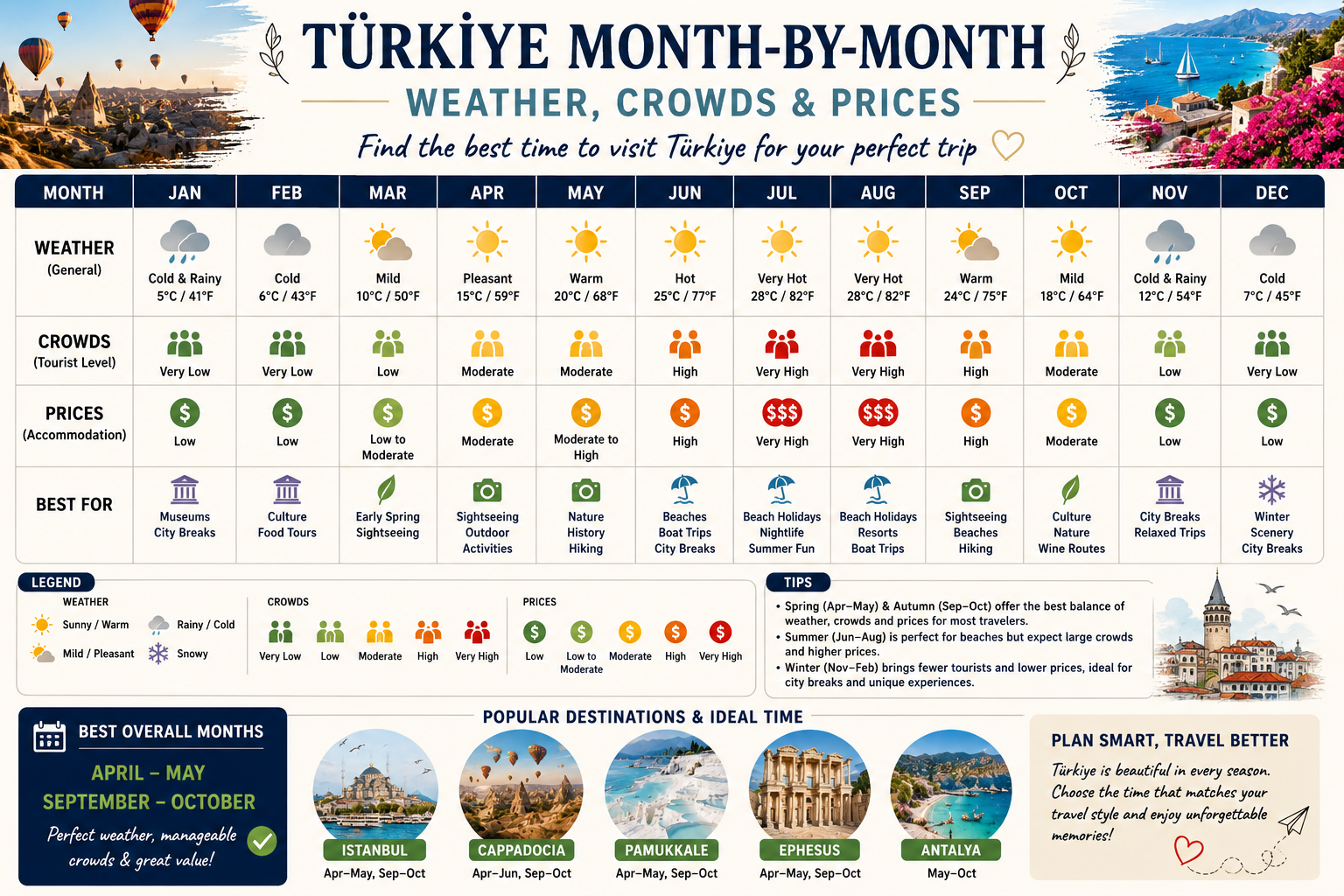
Türkiye Weather by Season
One of the biggest mistakes first-time visitors make is assuming that Türkiye has the same climate everywhere.
It does not.
Istanbul experiences four distinct seasons. The Mediterranean coast has hot summers and relatively mild winters. Central Anatolia, including Cappadocia, experiences colder winters and can receive significant snowfall.
Understanding these regional differences will help you choose the right season.
Visiting Türkiye in Spring: March to May
🌷 Best for: Sightseeing, nature, Istanbul, Cappadocia and ancient ruins
Spring is one of the most attractive seasons for traveling around Türkiye.
Temperatures generally become increasingly comfortable as the season progresses, while landscapes become greener and outdoor sightseeing becomes easier than during the hottest months of summer.
Türkiye in March
March is a transitional month.
Winter conditions can still occur, particularly in central and eastern parts of the country. Istanbul may experience cool temperatures and rain, while Cappadocia can still feel distinctly wintry.
Mediterranean destinations are generally milder, although it may still be too cool for travelers looking for a classic summer beach holiday.
March is good for:
- Cultural sightseeing
- Istanbul city breaks
- Visiting archaeological sites
- Travelers who prefer fewer crowds
- Lower-season travel experiences
Pack layers and prepare for changing weather.
Türkiye in April
April is one of the best months for sightseeing.
Temperatures become increasingly pleasant in many of Türkiye’s most popular destinations, while peak summer crowds have not yet arrived.
Istanbul is particularly beautiful during spring, with parks and gardens adding color to the city.
Cappadocia also becomes more comfortable for hiking and outdoor exploration.
April is excellent for:
- Istanbul
- Cappadocia
- Ephesus
- Pamukkale
- Cultural trips
- Photography
- Walking tours
Rain is still possible, so a lightweight waterproof jacket is useful.
Türkiye in May
May may be one of the best months to visit Türkiye for first-time travelers.
The weather is generally warm enough for comfortable travel without reaching the intense temperatures associated with midsummer in many regions.
Coastal destinations also begin transitioning into beach season.
Why visit Türkiye in May?
- Warm but generally comfortable sightseeing weather
- Longer daylight hours
- Excellent conditions for outdoor attractions
- Mediterranean destinations becoming warmer
- Good conditions for Cappadocia
- Easier exploration of archaeological sites than during midsummer
If your itinerary combines Istanbul, Cappadocia, Ephesus, Pamukkale, and Antalya, May is particularly attractive.
Visiting Türkiye in Summer: June to August
☀️ Best for: Beaches, Mediterranean holidays and long summer evenings
Summer is Türkiye’s classic holiday season.
This is particularly true along the Mediterranean and Aegean coasts, where travelers arrive for sunshine, swimming, resorts, boat trips, and seaside towns.
However, summer also brings two important considerations:
heat and crowds.
Türkiye in June
June offers a good transition into the main summer season.
Coastal temperatures are usually suitable for beach holidays, while conditions can still be more comfortable for sightseeing than later in July and August.
June is a strong choice for travelers who want to combine cultural destinations with time beside the sea.
June is ideal for:
- Antalya
- Mediterranean beaches
- Aegean coast
- Boat trips
- Swimming
- Istanbul
- Cappadocia
Popular destinations become busier as the month progresses.
Türkiye in July
July is one of the hottest and busiest months in many Turkish holiday destinations.
Mediterranean areas such as Antalya can experience intense daytime heat.
Ephesus and Pamukkale can also become extremely hot during the middle of the day because many archaeological areas provide limited shade.
July is best for:
- Beach holidays
- Swimming
- Resorts
- Coastal nightlife
- Boat trips
For archaeological sightseeing, plan visits early in the morning whenever possible.
Türkiye in August
August continues the peak summer season.
Beaches and resorts can be busy, particularly in popular coastal destinations.
Accommodation demand may also be high.
If your priority is a Mediterranean beach holiday, August can be excellent. If your priority is walking around ancient ruins for several hours, spring or autumn may provide a more comfortable experience.
Important August travel tip
Carry water, sun protection, sunglasses, and a hat during outdoor sightseeing.
Avoid scheduling the most physically demanding outdoor activities during the hottest part of the day.
Visiting Türkiye in Autumn: September to November
🍂 Best for: Sightseeing, beaches, food, cultural travel and smaller crowds
Autumn is another outstanding season for visiting Türkiye.
September can still feel like summer along the coast, while October often brings comfortable sightseeing temperatures to many popular destinations.
For travelers who want to combine Istanbul + Cappadocia + ancient sites + Mediterranean coast, early autumn is particularly attractive.
Türkiye in September
September is arguably one of the best months to travel around Türkiye.
The Mediterranean and Aegean seas remain warm, while temperatures gradually become more comfortable for sightseeing.
Peak summer crowds may also begin to decrease after the busiest holiday period.
September is great for:
- Istanbul
- Cappadocia
- Antalya
- Ephesus
- Pamukkale
- Beach holidays
- Hiking
- Multi-city itineraries
It is one of the strongest months for travelers who want both beaches and cultural sightseeing.
Türkiye in October
October offers another excellent balance.
Istanbul and Cappadocia become cooler, while coastal areas can remain pleasantly warm, particularly earlier in the month.
Why choose October?
- Comfortable city sightseeing
- Good hiking conditions
- Less intense heat
- Potentially smaller crowds
- Excellent conditions for archaeological sites
Travelers visiting later in October should pack additional layers, particularly for evenings and inland destinations.
Türkiye in November
November marks the transition toward winter.
Temperatures drop noticeably, and rain becomes more common in some regions.
However, fewer tourists can create a calmer atmosphere at major attractions.
November can be particularly appealing for travelers who prioritize museums, food, historical attractions, and city exploration rather than beaches.
Visiting Türkiye in Winter: December to February
❄️ Best for: Fewer crowds, city breaks, winter landscapes and snowy Cappadocia
Winter provides a completely different Türkiye experience.
Many travelers associate Türkiye exclusively with beaches and sunshine, but the country also has dramatic winter landscapes.
Cappadocia covered in snow can be particularly beautiful.
Türkiye in December
December brings colder conditions across Istanbul and Central Anatolia.
Snow is possible in Cappadocia, although it should never be assumed or guaranteed for a particular trip.
The Mediterranean coast remains considerably milder than inland regions.
December can be a good choice for travelers who prefer quieter sightseeing.
Türkiye in January
January is generally among the colder months of the year.
Istanbul can be rainy, windy, and occasionally snowy.
Cappadocia can experience freezing temperatures and snow.
This is not the ideal month for travelers seeking warm weather, but it can offer atmospheric city experiences and dramatic winter photography.
January is best for:
- Fewer crowds
- Museums
- Turkish food experiences
- Winter photography
- Snowy landscapes
- Travelers comfortable with cold weather
Türkiye in February
February remains wintery but gradually moves toward spring.
Conditions vary significantly from year to year and region to region.
Travelers should prepare for cold weather in Istanbul and Cappadocia while expecting milder conditions along the Mediterranean coast.
Best Time to Visit Istanbul
For most travelers, April–May and September–October offer an excellent balance for Istanbul.
These months generally provide comfortable conditions for walking between historical landmarks and exploring neighborhoods.
Spring brings greener parks and longer days, while autumn often provides pleasant temperatures after the summer heat.
Summer can still be enjoyable, but major attractions may be considerably busier.
Winter offers fewer tourists but brings colder, wetter weather.
Best for Istanbul:
Sightseeing: April–May & September–October
Fewer crowds: November–February
Long summer days: June–August
Best Time to Visit Cappadocia
Cappadocia changes dramatically with the seasons.
Spring and autumn are excellent for hiking through the valleys, visiting underground cities, and exploring Göreme.
Summer is generally dry and sunny but can become hot during the day.
Winter can transform the fairy chimneys and valleys with snow.
Best for Cappadocia:
Overall: April–June & September–October
Hiking: April–May & September–October
Winter scenery: December–February
What About Hot-Air Balloons?
Hot-air balloon flights operate throughout the year when weather conditions permit.
However, flights can be canceled because of wind, visibility, or other weather conditions in any season.
If a balloon flight is one of the main reasons for your trip, consider staying at least two or three nights rather than planning only one morning.
Best Time to Visit Antalya
Antalya has a Mediterranean climate with hot summers and relatively mild winters.
For swimming and beach holidays, June through September is the classic period.
May and October can be particularly attractive for travelers who want warm conditions without the intensity of peak summer.
Best for Antalya:
Beach holidays: June–September
Sightseeing + beach: May–June & September–October
Fewer tourists: November–March
Best Time to Visit Ephesus
Ephesus is largely an outdoor archaeological experience.
That makes temperature especially important.
July and August can be extremely hot, and shade is limited in many parts of the archaeological site.
For most travelers, April–May and September–October provide more comfortable conditions.
Arriving early in the morning can also help you avoid both intense midday heat and larger tour groups.
Best Time to Visit Pamukkale
Pamukkale can technically be visited throughout the year.
However, spring and autumn provide more comfortable conditions for walking around the travertines and exploring ancient Hierapolis.
Summer can be very hot.
Winter provides fewer crowds but cooler conditions.
Best overall:
April–May & September–October
When Is Türkiye Most Crowded?
Crowds vary enormously according to destination.
However, July and August are generally among the busiest months in popular coastal holiday destinations.
Major attractions in Istanbul, Cappadocia, Pamukkale, and Ephesus can also attract large numbers of international visitors during the broader summer travel season.
Other busy periods can include:
- Public holidays
- Religious holidays
- School holiday periods
- Major festivals
- International events
- Long weekends
If avoiding crowds is a priority, consider traveling during April, May, late September, October, or parts of winter.
When Is the Cheapest Time to Visit Türkiye?
There is no universally cheapest month because travel prices change according to destination, demand, exchange rates, flight availability, holidays, and accommodation type.
However, November through February can offer lower accommodation demand in some tourism-focused destinations outside major holiday periods.
Shoulder seasons — particularly parts of March, April, October, and November — can also provide better value than peak summer.
Important Price Tip
Do not assume that everything in Türkiye will automatically be inexpensive.
Prices can vary significantly between:
- Istanbul
- Tourist resorts
- Smaller towns
- Luxury hotels
- Local restaurants
- International restaurants
- Archaeological attractions
- Transportation options
Always check current accommodation, attraction, and transportation prices before finalizing your budget.
Peak Season vs Shoulder Season vs Low Season
Peak Season: June–August
Advantages
- Excellent beach weather
- Long daylight hours
- Full tourism infrastructure
- Great conditions for coastal activities
Disadvantages
- Larger crowds
- Higher accommodation demand
- Intense heat in some regions
- Popular attractions can feel busy
Shoulder Season: April–May & September–October
For many travelers, this is the sweet spot.
Advantages
- Comfortable temperatures
- Excellent sightseeing conditions
- Good hiking weather
- Less intense heat
- Potentially fewer crowds than midsummer
- Suitable for multi-region trips
This is why spring and autumn are often recommended for first-time visitors.
Low Season: November–March
Advantages
- Fewer tourists at many attractions
- Potential accommodation deals
- Winter landscapes
- More relaxed city experiences
Disadvantages
- Colder temperatures
- Greater chance of rain or snow
- Shorter daylight hours
- Some seasonal coastal businesses may operate reduced schedules
Best Time to Visit Türkiye Based on Your Travel Style
For First-Time Travelers
April, May, September and October
These months make it easier to combine several regions without dealing with the strongest summer heat or deepest winter conditions.
For Beach Lovers
June–September
Choose Antalya and Türkiye’s Mediterranean or Aegean coastline.
For History Lovers
April–May & September–October
Ephesus, Hierapolis, Istanbul, and other outdoor historical sites are generally more comfortable outside peak summer heat.
For Photographers
Every season offers something different.
Spring: Green landscapes and flowers
Summer: Bright coastal scenery
Autumn: Softer light and changing landscapes
Winter: Snowy Cappadocia and atmospheric cities
For Budget-Conscious Travelers
Consider late autumn, winter, and early spring, while checking current flight and accommodation prices before booking.
For Couples
May, September, and October can provide an excellent combination of pleasant temperatures, evening walks, scenic destinations, and coastal experiences.
Türkiye Month-by-Month Travel Guide
| Month | Weather | Crowds | Best For |
|---|---|---|---|
| January | Cold / Winter | Low | Cities, winter scenery |
| February | Cold | Low | Culture, quieter trips |
| March | Cool / Variable | Low–Moderate | Sightseeing |
| April | Mild | Moderate | Culture, hiking |
| May | Warm | Moderate | Excellent all-round travel |
| June | Warm–Hot | Moderate–High | Beaches + sightseeing |
| July | Hot | High | Beach holidays |
| August | Hot | High | Mediterranean holidays |
| September | Warm | Moderate–High | Excellent all-round travel |
| October | Mild–Warm | Moderate | Culture, hiking |
| November | Cool | Low–Moderate | Cities, history |
| December | Cold | Low | Winter trips |
Conditions vary significantly between regions and from year to year.
What Should You Pack for Türkiye?
Packing depends heavily on the season and destinations.
Spring
Bring:
- Light jacket
- Comfortable walking shoes
- Layers
- Small umbrella or waterproof jacket
- Sunglasses
Summer
Bring:
- Lightweight clothing
- Hat
- Sunglasses
- High-SPF sunscreen
- Comfortable shoes
- Reusable water bottle
- Swimwear for coastal destinations
Autumn
Bring:
- Light layers
- Jacket for evenings
- Comfortable walking shoes
- Rain protection
Winter
Bring:
- Warm coat
- Sweaters
- Waterproof shoes
- Scarf
- Gloves for colder inland destinations
Cappadocia can be considerably colder than Antalya during the same trip, so always check individual destination forecasts before departure.
Is Türkiye Worth Visiting During the Off-Season?
Absolutely.
Traveling outside the busiest season can completely change the experience.
Imagine walking through ancient ruins without intense summer heat, enjoying Istanbul’s cafés on a rainy winter afternoon, or seeing Cappadocia’s fairy chimneys covered with snow.
The trade-off is weather uncertainty.
Travelers who are flexible and prepared for seasonal conditions can find the off-season particularly rewarding.
Frequently Asked Questions About the Best Time to Visit Türkiye
What is the best month to visit Türkiye?
May and September are two of the strongest all-round choices because they can provide comfortable sightseeing weather while still working well for multi-region itineraries.
What is the best time to visit Türkiye for good weather?
Spring and early autumn generally offer comfortable weather across many of the country’s most popular tourist destinations.
What is the hottest month in Türkiye?
July and August are typically among the hottest periods in many parts of Türkiye, particularly along the Mediterranean coast and in inland areas.
What is the rainy season in Türkiye?
There is no single rainy season covering the entire country because regional climates vary. Istanbul tends to experience more rain during the cooler months, while Mediterranean summers are typically much drier.
What is the cheapest month to visit Türkiye?
There is no guaranteed cheapest month. However, winter months outside major holidays may offer lower accommodation prices in some destinations. Always compare current flights and hotels.
Is Türkiye too hot in July and August?
It can be very hot, particularly around Antalya, Ephesus, Pamukkale, and other southern or inland destinations. Beach holidays remain popular, but sightseeing is usually more comfortable early in the morning or later in the day.
Is October a good time to visit Türkiye?
Yes. October is one of the best months for sightseeing, particularly in Istanbul, Cappadocia, Ephesus, and Pamukkale. Coastal areas may also remain pleasantly warm, especially earlier in the month.
Is December a good time to visit Türkiye?
Yes, if you enjoy quieter cities and winter travel. Istanbul can be cold and rainy, while Cappadocia may experience snow. It is not the best period for a traditional Mediterranean beach holiday.
Final Thoughts: When Should You Visit Türkiye?
There is no bad season to discover Türkiye — only seasons better suited to different kinds of travelers.
For the best overall balance of weather, crowds, and sightseeing conditions, consider visiting during:
🌷 April–May
or
🍂 September–October
Choose June through September if Mediterranean beaches are your priority.
Choose November through March if you prefer fewer tourists, winter scenery, and a quieter travel experience.
And if this is your first journey to Türkiye, resist the temptation to plan your trip based on weather alone.
Think about where you want to go and what you want to experience.
Istanbul’s mosques and bazaars, Cappadocia’s extraordinary valleys, Ephesus’ ancient streets, Pamukkale’s white terraces, and Antalya’s Mediterranean coastline can feel completely different depending on the season.
Choose the right time for your travel style, leave enough time to enjoy each destination, and Türkiye can be memorable in every season.

Bir yanıt yazın