


Istanbul is one of those cities that can feel overwhelming on a first visit — not because it is difficult to explore, but because there is simply so much to see.
Historic mosques, Ottoman palaces, colorful neighborhoods, bustling bazaars, ferry rides across the Bosphorus, traditional Turkish breakfasts, rooftop views and centuries-old streets can all compete for your attention.
So, how many days do you really need in Istanbul?
For most first-time visitors, five days in Istanbul is an excellent amount of time. It gives you enough time to see the city’s famous landmarks without turning every day into a race.
This Istanbul 5-day itinerary for first-time visitors combines the essential sights with local food, beautiful neighborhoods and a few slower experiences that allow you to actually enjoy the city.
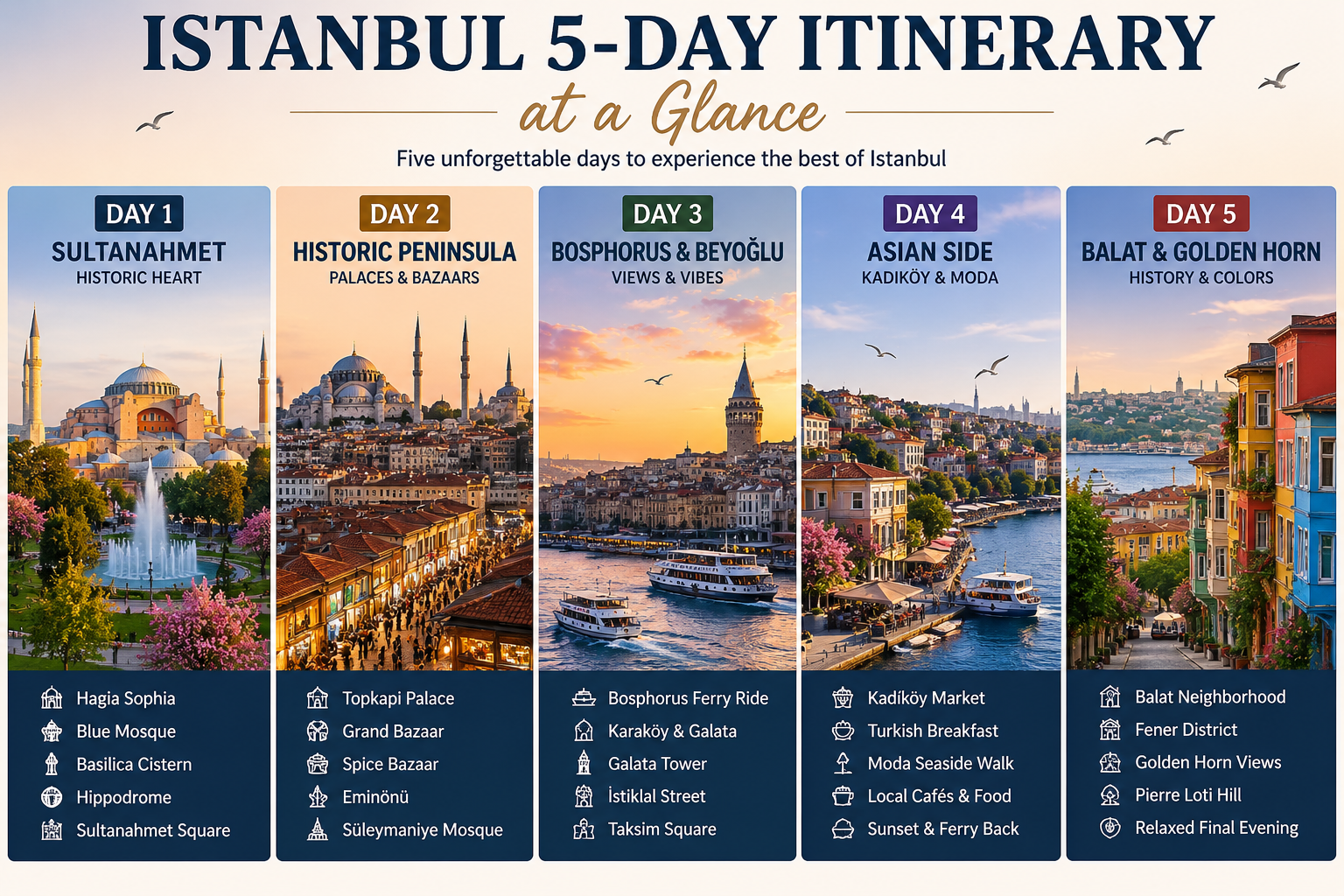
Istanbul 5-Day Itinerary at a Glance
| Day | Area | Main Highlights |
|---|---|---|
| Day 1 | Sultanahmet | Hagia Sophia, Blue Mosque, Basilica Cistern, Hippodrome |
| Day 2 | Historic Peninsula | Topkapı Palace, Grand Bazaar, Spice Bazaar, Eminönü |
| Day 3 | Bosphorus & Beyoğlu | Bosphorus ferry, Galata, İstiklal Street, Taksim |
| Day 4 | Asian Side | Kadıköy, Moda, local food and waterfront |
| Day 5 | Balat & Golden Horn | Balat, Fener, Pierre Loti area and a relaxed final evening |
This route minimizes unnecessary travel between distant parts of Istanbul and leaves enough flexibility for coffee stops, meals and spontaneous discoveries.
Day 1: Discover Historic Sultanahmet
Your first day should begin where much of Istanbul’s extraordinary history is concentrated: Sultanahmet, the heart of the Historic Peninsula.
This area contains some of the city’s most recognizable landmarks within walking distance of each other.
Hagia Sophia
Start your morning at Hagia Sophia, one of Istanbul’s most important historical monuments.
Originally constructed as a Byzantine cathedral in the 6th century, Hagia Sophia has served different religious and cultural roles throughout its long history.
Its enormous dome, historic mosaics and architectural scale make it an essential stop for first-time visitors.
Travel Tip
Arriving early is usually a good idea, particularly during busy travel periods. Remember that Hagia Sophia functions as a mosque, so visitors should follow current entry and clothing requirements.
Blue Mosque
Just across Sultanahmet Square stands another Istanbul icon: the Blue Mosque, officially known as Sultan Ahmed Mosque.
Built in the early 17th century, it is famous for its elegant domes, six minarets and İznik tiles.
Entrance to functioning mosques may be restricted during prayer times, so allow some flexibility in your schedule.
Sultanahmet Square and the Hippodrome
Don’t rush between the major attractions.
Spend some time walking through Sultanahmet Square, once part of Constantinople’s ancient Hippodrome.
Among the historical monuments around the square are:
- Obelisk of Theodosius
- Serpent Column
- Walled Obelisk
- German Fountain
It is also one of the best areas to simply stop and appreciate how different eras of Istanbul overlap in the same place.
Basilica Cistern
Continue underground to the atmospheric Basilica Cistern.
Built during the Byzantine era, this enormous underground water reservoir is supported by hundreds of columns.
Soft lighting, reflections on the water and the famous Medusa-head column bases create one of the most unusual sightseeing experiences in Istanbul.
What to Eat on Day 1
For your first Turkish lunch, consider trying:
Köfte – Turkish-style grilled meatballs
Pide – boat-shaped Turkish flatbread with different toppings
Döner – seasoned meat cooked vertically and sliced thinly
Ayran – a refreshing yogurt-based drink
Finish with Turkish coffee or tea.
Evening
Spend your first evening walking around Sultanahmet as the historic buildings begin to light up.
The atmosphere changes considerably after the busiest daytime sightseeing hours.
Day 2: Ottoman Istanbul, Bazaars and Eminönü
Day two goes deeper into Istanbul’s Ottoman heritage before ending among the lively markets and waterfront streets of Eminönü.
Topkapı Palace
Begin your morning at Topkapı Palace, once the administrative and residential center of the Ottoman sultans.
The palace complex contains courtyards, historical collections and spectacular views toward the Bosphorus.
Allow approximately 2–4 hours, depending on your interest in history.
Highlights include:
- Imperial courtyards
- Treasury collections
- Palace kitchens
- Historical chambers
- Bosphorus viewpoints
- Harem section
Check current ticket conditions before visiting, as some sections may require separate admission.
Grand Bazaar
Next, enter one of the world’s most famous covered markets: the Grand Bazaar.
With its maze of passages and thousands of shops, the bazaar is almost a neighborhood in itself.
You’ll find:
- Turkish carpets
- Ceramics
- Jewelry
- Leather goods
- Lamps
- Textiles
- Spices
- Souvenirs
You don’t need to buy anything to enjoy the experience.
Walking through its historic passages is part of discovering Istanbul.
Shopping Tip
If you plan to purchase something expensive, compare several shops rather than accepting the first offer.
Spice Bazaar
Continue toward Eminönü and visit the Spice Bazaar, also known as the Egyptian Bazaar.
The colorful displays are filled with spices, teas, dried fruits, nuts, Turkish delight and other local products.
It is smaller than the Grand Bazaar and usually easier to explore.
Eminönü and Galata Bridge
Finish the afternoon around Eminönü.
This busy waterfront district is one of the best places to observe everyday Istanbul.
Ferries arrive and depart constantly while fishermen line Galata Bridge and crowds move between the markets, tram stops and waterfront.
Try a balık ekmek, Istanbul’s famous fish sandwich, if it appeals to you.
Evening Idea: Süleymaniye
If you still have energy, head toward the Süleymaniye Mosque area before sunset.
The elevated location offers wonderful views across Istanbul and the Golden Horn.
It can be a peaceful way to end a very busy sightseeing day.
Day 3: Bosphorus, Galata and İstiklal Street
You have explored Istanbul from the streets.
Today, see it from the water.
Take a Bosphorus Ferry
A trip across or along the Bosphorus should be included in almost every first visit to Istanbul.
You don’t necessarily need an expensive private cruise.
Public ferries can provide fantastic views while also giving you a glimpse of everyday life in the city.
From the water, you may see:
- Dolmabahçe Palace
- Maiden’s Tower
- Ottoman waterfront mansions
- Bosphorus Bridge
- Mosques along the shoreline
- European and Asian neighborhoods
Buy a glass of Turkish tea on board and enjoy the scenery.
For many travelers, this simple ferry journey becomes one of their favorite Istanbul memories.
Karaköy
After your ferry experience, explore Karaköy.
The neighborhood mixes historic buildings with modern cafés, restaurants and small shops.
It’s a good place for lunch or coffee before walking uphill toward Galata.
Galata Tower and Galata
The medieval Galata Tower dominates the surrounding neighborhood.
Even if you don’t go inside, the narrow streets around the tower are worth exploring.
This part of Istanbul is particularly photogenic, with steep streets, old buildings and glimpses of the Bosphorus.
Walk Along İstiklal Avenue
Continue toward İstiklal Avenue, one of Istanbul’s best-known pedestrian streets.
Along and around the avenue you’ll encounter:
- Historic passages
- Churches
- Shops
- Cafés
- Restaurants
- Bookstores
- Street musicians
- The nostalgic red tram
Don’t remain only on the main avenue. Some of the surrounding side streets are much more atmospheric.
Taksim Square
Eventually, İstiklal Avenue leads to Taksim Square.
Taksim is less about historical monuments and more about seeing the modern, energetic side of central Istanbul.
Dinner Idea
This is a good evening to try a traditional Turkish meyhane-style meal.
Typical dishes can include small plates known as meze, grilled fish or meat and seasonal dishes.
Day 4: Cross to Asia – Kadıköy and Moda
One of the most common mistakes first-time visitors make is spending their entire trip on Istanbul’s European side.
Today, cross the Bosphorus and explore Kadıköy.
The ferry journey itself is part of the experience.
Explore Kadıköy Market
Kadıköy has a completely different atmosphere from Sultanahmet.
Instead of moving between monumental tourist attractions, spend some time exploring local streets and food markets.
Around Kadıköy Market you can find:
- Fish shops
- Bakeries
- Cheese shops
- Pickle shops
- Turkish dessert shops
- Coffee shops
- Restaurants
This is an excellent place for travelers interested in Turkish food.
Try a Traditional Turkish Breakfast
If you arrive early enough, make this your Turkish breakfast day.
A generous Turkish breakfast may include:
- Several cheeses
- Olives
- Tomatoes
- Cucumbers
- Eggs
- Bread
- Jam
- Honey
- Kaymak
- Pastries
- Unlimited Turkish tea
Don’t schedule breakfast too tightly. Turkish breakfast is meant to be enjoyed slowly.
Walk from Kadıköy to Moda
Continue toward Moda, one of the most pleasant neighborhoods on Istanbul’s Asian side.
Walk along the waterfront, explore residential streets and stop for coffee or ice cream.
After three days of intensive sightseeing, this slower pace can be very welcome.
Watch the Sunset
The Kadıköy–Moda coastline can be a beautiful place to spend the late afternoon.
On a clear day, you can look across the water toward Istanbul’s historic skyline.
Then take the ferry back to Europe after sunset and enjoy the illuminated city from the Bosphorus.
Day 5: Balat, Fener and the Golden Horn
Your final day takes you away from Istanbul’s biggest attractions and into some of its most distinctive neighborhoods.
Explore Balat
Balat has become famous for its colorful houses, steep streets and photogenic cafés.
However, there is more to the neighborhood than social-media photo spots.
Look beyond the most photographed streets and you’ll find traces of Istanbul’s multicultural history alongside ordinary neighborhood life.
Take your time here rather than rushing from one Instagram location to another.
Discover Fener
Nearby Fener is another historically important neighborhood along the Golden Horn.
The Fener and Balat area reflects layers of Greek Orthodox, Jewish, Muslim and broader Ottoman history.
Comfortable walking shoes are essential because many streets are steep.
Golden Horn
Spend part of the afternoon exploring the Golden Horn.
This historic inlet played a major role in Constantinople and Ottoman Istanbul and remains one of the defining geographical features of the city.
Depending on your pace, you can continue toward the Eyüp area.
Pierre Loti Hill Area
For panoramic views over the Golden Horn, the Pierre Loti Hill area can be added to your final afternoon.
It provides a different perspective from the Bosphorus viewpoints you’ve already experienced during the trip.
Your Final Evening in Istanbul
For your final dinner, choose something memorable rather than trying to squeeze in another attraction.
Consider:
- Turkish kebabs
- Seafood
- Meze
- Mantı
- Traditional Ottoman-inspired dishes
- Pide
- Lahmacun
Then finish with a classic Turkish dessert.
Try baklava, künefe or sütlaç, accompanied by Turkish tea or coffee.
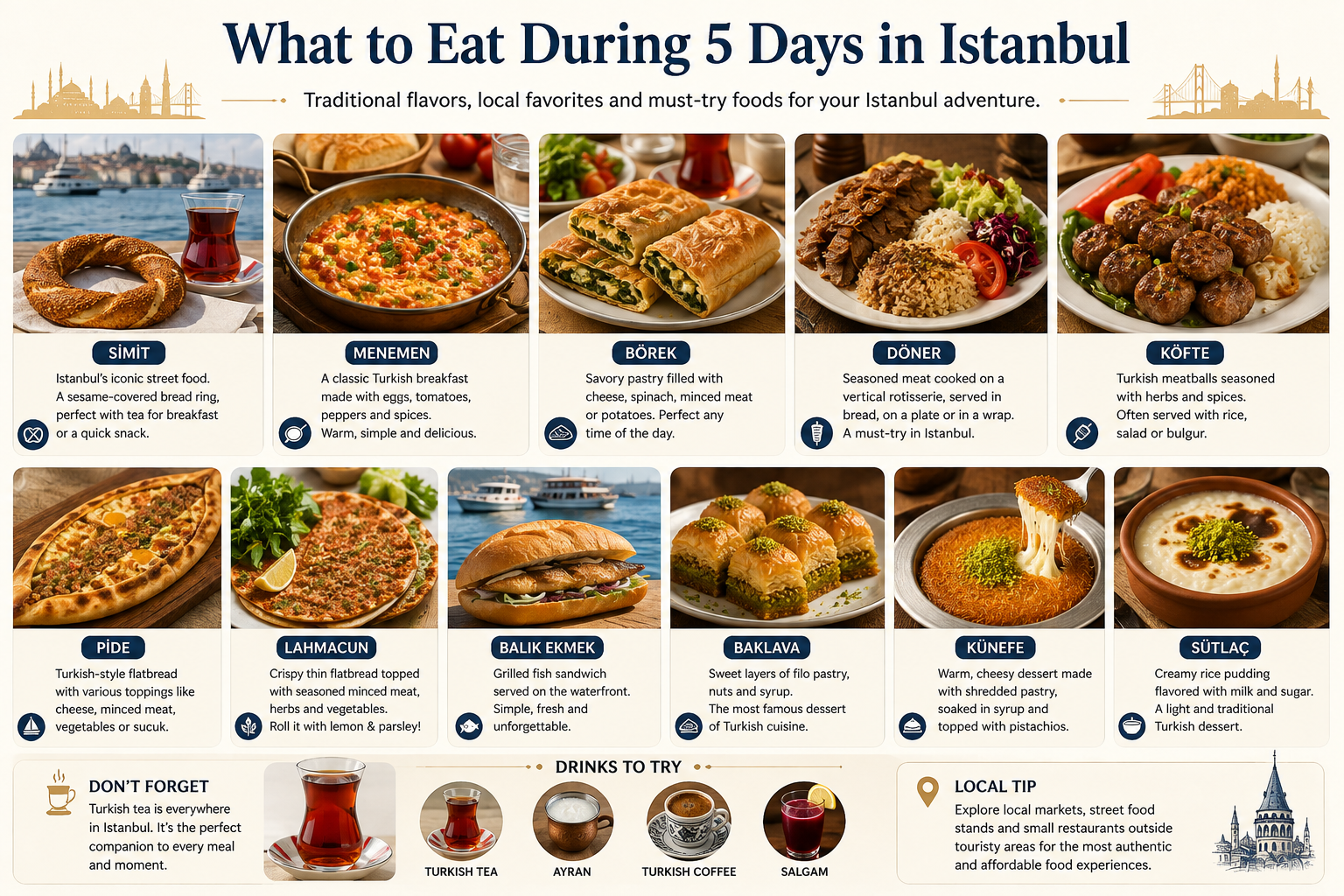
What to Eat During 5 Days in Istanbul
Food should be part of your Istanbul itinerary rather than something squeezed between attractions.
Some foods worth trying include:
| Food | What It Is |
|---|---|
| Simit | Sesame-covered bread ring |
| Menemen | Eggs cooked with tomatoes and peppers |
| Börek | Savory layered pastry |
| Döner | Vertically roasted seasoned meat |
| Köfte | Turkish meatballs |
| Pide | Turkish flatbread with toppings |
| Lahmacun | Thin flatbread topped with seasoned minced meat |
| Mantı | Small Turkish dumplings |
| Balık ekmek | Fish sandwich |
| Baklava | Layered pastry with nuts and syrup |
| Künefe | Cheese-filled shredded pastry dessert |
| Sütlaç | Turkish rice pudding |
And, of course, drink plenty of Turkish tea along the way.
How to Get Around Istanbul
Public transportation is usually the easiest way to explore Istanbul.
The city’s transport network includes:
- Metro
- Tram
- Ferries
- Buses
- Funicular services
For tourists, the T1 tram line is particularly useful because it connects several major sightseeing areas around the Historic Peninsula.
Ferries are equally important.
Don’t think of them simply as transportation — crossing the Bosphorus by ferry is one of Istanbul’s essential experiences.
Istanbulkart
If you plan to use public transportation regularly, check the current visitor options for Istanbulkart, the city’s public transportation payment system.
Transport rules, fares and card options can change, so verify the latest information when you arrive.
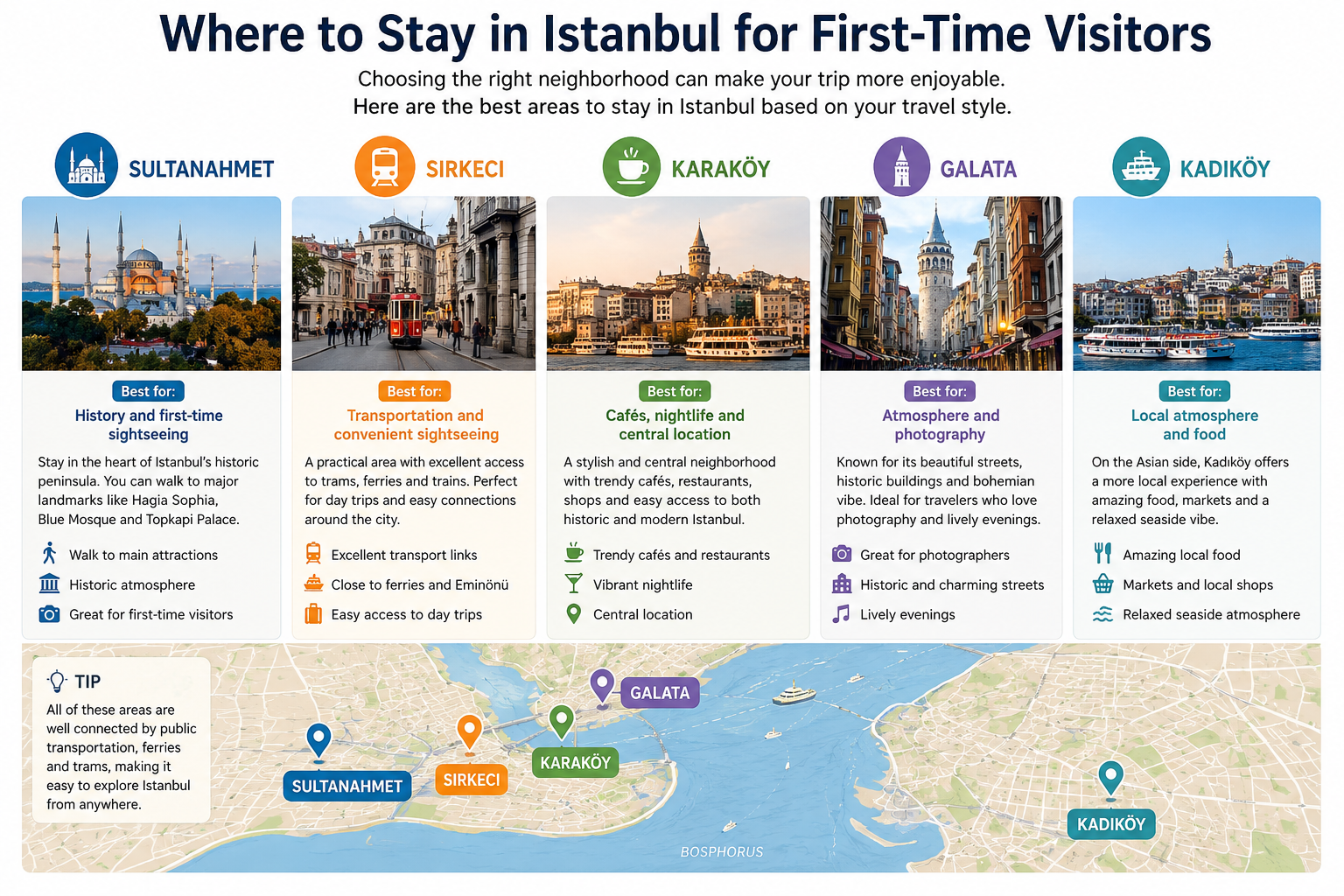
Where to Stay in Istanbul for First-Time Visitors
Your ideal neighborhood depends on your travel style.
Sultanahmet
Best for: History and first-time sightseeing
Choose Sultanahmet if you want to stay within walking distance of Istanbul’s major historical attractions.
Sirkeci
Best for: Transportation and convenient sightseeing
Sirkeci provides excellent access to the Historic Peninsula, ferries and public transportation.
Karaköy
Best for: Cafés, nightlife and central location
Karaköy provides easy access to both historic and modern Istanbul.
Galata
Best for: Atmosphere and photography
Stay here if you love historic streets, cafés and lively evenings.
Kadıköy
Best for: Local atmosphere and food
Kadıköy is ideal for travelers who don’t mind commuting by ferry and prefer a less tourist-focused environment.
How Much Money Do You Need for 5 Days in Istanbul?
The cost of an Istanbul trip can vary dramatically depending on accommodation, restaurants, attraction tickets and transportation.
Instead of relying on fixed price estimates that quickly become outdated, divide your budget into five categories:
Accommodation + Food + Transportation + Attractions + Shopping
Public transportation and local eateries can help keep costs manageable, while luxury hotels, rooftop restaurants, private tours and major paid attractions can increase the total significantly.
Always check current admission prices directly before your trip.
Best Time to Visit Istanbul
Istanbul is a year-round destination, but spring and autumn are particularly comfortable for sightseeing.
Not sure which season is right for your trip? Read our complete Best Time to Visit Türkiye: Weather, Crowds and Prices guide to compare the best months for Istanbul and other popular destinations across Türkiye.
Spring: March–May
Temperatures become milder, gardens begin to bloom and outdoor sightseeing becomes pleasant.
Summer: June–August
Expect warmer weather and busy tourist areas. Early mornings and evenings can be more comfortable for sightseeing.
Autumn: September–November
A great period for walking around the city, particularly when temperatures remain mild.
Winter: December–February
Winter is colder and wetter, but tourist crowds can be lighter. Snow is possible but not guaranteed.
Essential Istanbul Travel Tips for First-Time Visitors
1. Wear Comfortable Shoes
Istanbul involves a lot of walking, hills, cobblestones and stairs.
Good shoes make an enormous difference.
2. Don’t Try to See Everything
Istanbul is huge.
Five days is enough for an excellent introduction, but not enough to see the entire city.
That’s perfectly fine.
3. Use Ferries
They are practical, affordable and provide some of the city’s best views.
4. Start Major Attractions Early
Popular landmarks around Sultanahmet can become crowded later in the day.
5. Respect Mosque Etiquette
Many famous mosques are active places of worship.
Follow clothing requirements, remain respectful and be aware of prayer times.
6. Keep Some Flexibility
Weather, crowds and opening hours can affect your plans.
Having a flexible itinerary is better than scheduling every hour.
7. Explore Beyond Tourist Streets
Some of the most enjoyable moments in Istanbul happen away from the major landmarks — drinking tea, taking a ferry or wandering through an ordinary neighborhood.
Is 5 Days Enough for Istanbul?
Yes. Five days is enough for a first trip to Istanbul, especially when your itinerary is organized geographically.
In five days, you can experience:
- Istanbul’s Byzantine heritage
- Ottoman palaces and mosques
- The Grand Bazaar
- The Bosphorus
- Modern Beyoğlu
- The Asian side
- Local Turkish food
- Historic neighborhoods
- Several different views of the city
You will certainly leave places unexplored, but that is part of Istanbul’s charm.
Even people who have lived here for years continue discovering new corners of the city.
Frequently Asked Questions About a 5-Day Istanbul Trip
How many days should a first-time visitor spend in Istanbul?
Around 4–5 days is an excellent starting point. Five days provides enough time for major landmarks plus neighborhoods such as Kadıköy and Balat without rushing constantly.
Is Istanbul walkable for tourists?
Individual sightseeing districts are very walkable, particularly Sultanahmet, Galata, Karaköy and Kadıköy. However, Istanbul is enormous, so you’ll need public transportation to travel between different areas.
Do I need a car in Istanbul?
Most first-time visitors do not need one. Traffic and parking can make driving inconvenient, while metro, tram and ferry connections cover many tourist areas.
Should I stay on the European or Asian side?
For a first visit focused heavily on major landmarks, the European side is generally more convenient. Kadıköy on the Asian side is a great option for travelers who prioritize food, nightlife and a more local atmosphere.
What should I not miss in Istanbul?
For a first visit, prioritize Hagia Sophia, the Blue Mosque, Topkapı Palace, Basilica Cistern, Grand Bazaar, a Bosphorus ferry journey and at least one neighborhood outside the Historic Peninsula.
Is the Asian side of Istanbul worth visiting?
Absolutely. Kadıköy and Moda provide a different experience from the historic tourist areas and are particularly good for food, cafés and waterfront walks.
Can I visit Istanbul without joining a tour?
Yes. Istanbul’s major tourist districts can be explored independently using public transportation. Guided tours can still be useful if you want deeper historical context.
Final Thoughts: The Perfect 5 Days in Istanbul
Istanbul isn’t a city you simply check off a list.
During five days, you can walk through Byzantine history in Sultanahmet, explore Ottoman palaces, bargain in centuries-old bazaars, drink Turkish tea while crossing the Bosphorus, eat your way through Kadıköy and wander among the colorful streets of Balat.
But perhaps the best advice for visiting Istanbul is simple:
Leave room for the city to surprise you.
Don’t spend every minute chasing attractions.
Sit beside the Bosphorus. Order another glass of tea. Watch the ferries pass between Europe and Asia.
Because sometimes the moments you didn’t put on your Istanbul itinerary become the ones you remember most.
Plan More of Your Türkiye Trip
If Istanbul is only the beginning of your journey, continue exploring beyond the city with our Türkiye Travel Guide, where you can discover more destinations, travel ideas, local foods and practical tips for planning your trip around Türkiye.


Bir yanıt yazın