

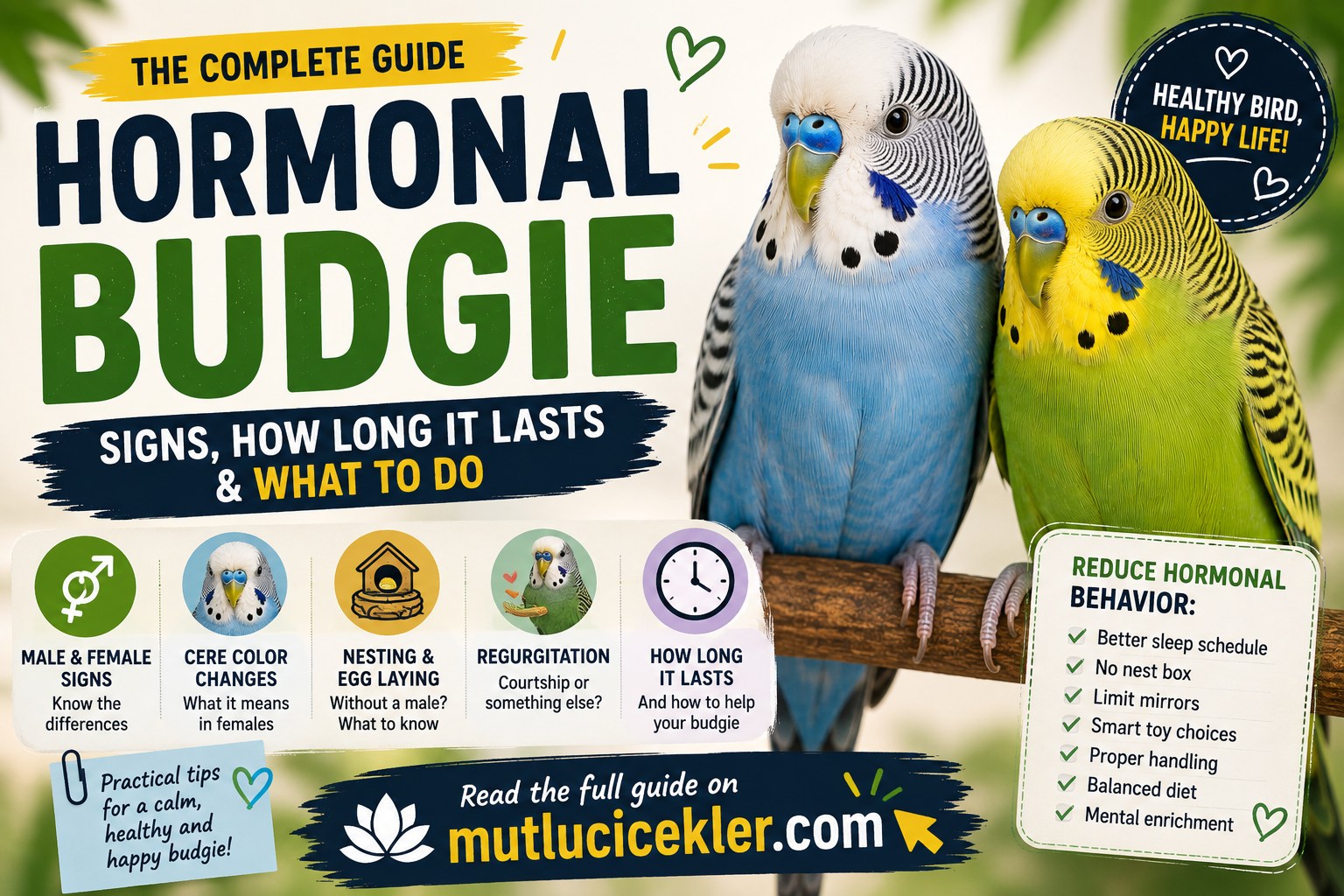
Has your budgie suddenly become louder, more territorial, aggressive, or unusually interested in mirrors, toys, or dark spaces? Your bird may be displaying hormonal behavior.
Hormonal and reproductive behaviors are a natural part of a budgie’s biology. Both male and female budgies can show noticeable behavioral changes when reproductive hormones become more active.
However, conditions inside the home can sometimes unintentionally encourage these behaviors and keep a budgie reproductively stimulated for longer than necessary.
Female budgies require particular attention because they can lay eggs even without a male present, and repeated egg laying may become a health concern.
In this guide, we’ll explore common signs of a hormonal budgie, differences between male and female behavior, cere color changes, mating behavior, how long hormonal behavior may last, and what owners can do to reduce unnecessary hormonal stimulation.
What Does It Mean When a Budgie Is Hormonal?
When budgie owners describe their bird as “hormonal,” they are usually referring to behaviors associated with increased reproductive activity.
In a natural environment, factors such as daylight and environmental conditions influence breeding behavior. Inside a home, however, certain conditions can unintentionally provide repeated breeding signals.
Possible triggers include:
- Long periods of artificial light
- Access to dark, enclosed spaces
- Nest boxes
- Strong attachment to mirrors
- Sexual attachment to particular toys
- Pair bonding with another bird
- Excessive pair bonding with a person
- Certain forms of physical touching
- Environmental conditions that encourage nesting
A budgie does not need to have a mate in order to display hormonal behavior.
Signs of a Hormonal Budgie
Hormonal behavior varies between individual birds and can look different in males and females.
Possible signs include:
- Increased vocalization
- Frequent courtship behavior
- Head bobbing
- Regurgitating food for another bird, person, mirror, or toy
- Rubbing against objects
- Increased interest in mirrors
- Territorial behavior
- Increased biting
- Searching for dark or enclosed spaces
- Nest-seeking behavior
- Becoming unusually attached to a person, bird, or object
However, not every behavioral or physical change should be blamed on hormones.
A budgie that appears persistently fluffed up, weak, unusually sleepy, has difficulty breathing, or spends excessive time on the cage floor may be ill and should be evaluated appropriately.
Male Budgie Hormonal Behavior
Male budgies can display very obvious courtship behavior.
A hormonal male may:
- Vocalize more frequently
- Bob his head repeatedly
- Court a female budgie
- Tap or touch another bird’s beak
- Regurgitate food for another bird
- Court his reflection in a mirror
- Become intensely attached to a toy
- Attempt to mate with objects
- Become unusually energetic or excited
Some males may direct the same behaviors toward their owners.
If your budgie repeatedly courts your hand or finger, regurgitates for you, or attempts to mate with your hand, he may have developed a mate-like attachment to you.
Female Budgie Hormonal Behavior
Hormonal females often display different behaviors from males.
A female budgie may:
- Search for dark spaces
- Investigate potential nesting locations
- Chew around cavities or enclosed areas
- Shred materials
- Become more territorial
- Guard her cage
- Bite more frequently
- Respond to a male’s courtship
- Display nesting behavior
Female budgies may also show noticeable changes in the cere, the fleshy area above the beak where the nostrils are located.
Does a Female Budgie’s Cere Turn Brown When Hormonal?
It can.
In many adult female budgies, the cere may become brown, darker, thicker, or more crust-like when the bird is in breeding condition.
This can be a useful clue when evaluating a female budgie’s reproductive condition.
However, cere appearance should never be considered in isolation.
A budgie’s:
- Age
- Sex
- Color mutation
- Individual characteristics
- Health
can influence how the cere looks.
If you notice unusual overgrowth, sores, discharge, significant swelling, or other abnormal changes around the cere, do not automatically assume that hormones are responsible.
What Happens to a Male Budgie’s Cere?
Adult male budgies commonly have a blue cere, although the exact appearance can vary significantly with certain color mutations.
Because of these variations, cere color alone cannot always reliably determine a budgie’s sex or hormonal condition.
This is particularly important when evaluating young budgies or birds with mutations that affect typical cere coloration.
Can a Female Budgie Lay Eggs Without a Male?
Yes.
A female budgie can produce and lay eggs without ever mating with a male.
Without fertilization, these eggs cannot develop into chicks.
However, producing an infertile egg still requires energy and nutrients from the female’s body.
Occasional egg laying and repeated or chronic egg laying are not the same issue. A female that repeatedly produces eggs should be monitored carefully, and veterinary guidance may be necessary.
How Long Does Hormonal Behavior Last in Budgies?
There is no exact number of days that applies to every budgie.
The intensity and duration of hormonal behavior may depend on:
- Age
- Sex
- Individual biology
- Daylight exposure
- Sleep schedule
- Diet
- Access to nesting spaces
- Presence of another bird
- Environmental triggers
In some budgies, hormonal behaviors decrease after environmental conditions change. In others, they may persist or repeatedly return if breeding triggers remain available.
For this reason, it is often more useful to ask what is triggering the behavior rather than focusing only on how many days it will last.
What Should You Do With a Hormonal Budgie?
Do not punish a budgie for hormonal behavior.
Courtship, nesting, territorial behavior, and other reproductive behaviors are influenced by biology. Yelling at or physically punishing a bird can create fear without addressing the underlying cause.
Instead, examine the bird’s environment and daily routine for unnecessary reproductive triggers.
1. Maintain a Consistent Sleep Schedule
A predictable day-night cycle is important for budgies.
Birds that remain exposed to household lighting, televisions, and activity late into the night may not receive a consistent period of uninterrupted darkness and rest.
Providing approximately 10–12 hours of quiet, uninterrupted rest and darkness each night is generally important for a budgie’s well-being.
Birds experiencing persistent reproductive problems may require individualized changes to their light schedule under the guidance of an avian veterinarian.
If you cover the cage at night, make sure ventilation remains adequate.
2. Avoid Providing a Nest Box Unless Breeding Is Intended
If you are not intentionally and responsibly breeding your budgies, adding a nest box simply because your bird appears hormonal is not a good solution.
A nest box can act as a strong breeding signal.
Also watch for access to places such as:
- Cardboard boxes
- Drawers
- Cabinets
- Closets
- Dark shelves
- Spaces behind furniture
- Other small enclosed areas
A female budgie may perceive these spaces as potential nesting cavities.
3. Watch for Obsession With Mirrors
Mirrors deserve particular attention with budgies.
Some birds appear to interpret their reflection as another budgie and may develop an intense attachment to it.
Warning signs can include:
- Spending excessive amounts of time beside the mirror
- Constantly courting the reflection
- Regurgitating food toward the mirror
- Guarding the mirror
- Becoming distressed or aggressive when separated from it
If a mirror is causing obsessive or reproductive behavior, removing it may be appropriate.
4. Monitor Toys That Trigger Mating Behavior
A budgie can become hormonally attached to more than just a mirror.
Some birds develop intense relationships with bells, toys, perches, or other objects.
Watch for:
- Repeated regurgitation toward an object
- Constant courtship
- Rubbing or mating behavior
- Aggressively guarding the object
- Spending most of the day focused on one toy
If one particular item repeatedly triggers reproductive behavior, consider removing or rotating it.
Do not remove all enrichment from the cage. Replace problematic objects with safe opportunities for chewing, climbing, exploring, and foraging.
5. Be Careful Where You Pet Your Budgie
Physical interaction can unintentionally contribute to reproductive stimulation in parrots.
Repeatedly stroking areas such as the:
- Back
- Under the wings
- Lower body
- Tail area
- Area around the vent
may be interpreted as sexual stimulation by some birds.
Affectionate touching is generally better focused around the head and neck.
You can also strengthen your relationship through talking, training, play, and positive interaction rather than prolonged body stroking.
6. Provide Mental and Physical Enrichment
Budgies are active, intelligent birds.
A bird with little to do may focus excessively on a favorite person, mirror, toy, or perceived mate.
Healthy activities can include:
- Foraging opportunities
- Bird-safe chewing materials
- Different types of appropriate perches
- Training sessions
- Safe toys
- Supervised out-of-cage activity
A varied routine encourages natural behaviors that are unrelated to reproduction.
7. Review Your Budgie’s Diet
Balanced nutrition is important for all budgies and deserves particular attention in females that produce eggs.
A diet consisting almost entirely of seeds is generally not considered nutritionally complete for long-term health.
At the same time, constantly providing excessive amounts of calorie-dense foods may contribute to an environment that encourages reproductive activity in some birds.
Dietary changes should be made carefully rather than suddenly.
If your budgie repeatedly lays eggs, is overweight, or has another health concern, discuss an appropriate diet with an avian veterinarian.
Do Hormonal Budgies Bite More?
Some do.
Hormonal budgies can become more territorial, especially around:
- Their cage
- A perceived nesting site
- A favorite toy
- Another bird
- A favorite person
A normally friendly budgie may suddenly bite when you reach into the cage or approach an area it has begun guarding.
Do not punish the bird for biting.
Instead, identify what is triggering the territorial response and adjust the environment where possible.
Why Is My Budgie Regurgitating Food?
This is an important distinction.
Budgies may regurgitate food as part of courtship or social feeding behavior.
A bird may deliberately bring food back up for:
- A mate
- Another bird
- Its owner
- A favorite toy
- A mirror
Regurgitation associated with courtship is different from uncontrolled vomiting.
If your budgie is forcefully throwing food, shaking its head while food scatters around the cage, appears weak, or shows other signs of illness, do not simply assume that the bird is hormonal.
Vomiting can indicate a health problem and may require veterinary attention.
Why Does My Budgie Regurgitate on a Mirror?
Your budgie may perceive the reflection as another bird and attempt to feed it.
Occasional interest and persistent obsession are different.
If your bird spends large portions of the day feeding, courting, or guarding its reflection, removing the mirror may help redirect its attention toward healthier activities.
Can a Budgie Think of Its Owner as a Mate?
Yes, some budgies can develop an excessively strong pair bond with a person.
Possible signs include:
- Courtship directed toward your hand or finger
- Regurgitating food for you
- Attempting to mate with your hand
- Becoming possessive of you
- Attacking other people who approach you
- Becoming extremely distressed when separated from you
You do not need to stop interacting with your bird.
Instead, shift the relationship toward:
- Training
- Play
- Talking
- Foraging
- Exploration
- Head scratches rather than body stroking
The goal is to maintain a strong social bond without constantly reinforcing mate-like behavior.
Should I Get My Hormonal Budgie a Mate?
Not simply to stop hormonal behavior.
Adding another budgie does not guarantee that reproductive behaviors will disappear.
In fact, another bird may increase breeding activity and introduce additional responsibilities, including:
- Potential egg laying
- Possible breeding
- Increased space requirements
- Additional veterinary care
- Separate housing if the birds do not get along
- Responsibility for any resulting chicks
A second budgie should be a long-term animal-care decision rather than a treatment for hormonal behavior.
How Do You Calm a Hormonal Budgie?
There is no instant method that safely turns off a budgie’s reproductive hormones.
Instead, several environmental changes can be considered together:
- Maintain a consistent sleep schedule
- Remove unnecessary nest boxes
- Limit access to dark, enclosed nesting spaces
- Monitor mirror obsession
- Remove or rotate toys that trigger mating behavior
- Avoid stroking the back, wings, and tail area
- Provide regular mental enrichment
- Encourage appropriate physical activity
- Maintain a balanced diet
The goal is not to eliminate normal hormones.
The goal is to prevent the home environment from continuously telling the bird that conditions are ideal for breeding.
Chronic Egg Laying in Female Budgies
Female budgies can lay infertile eggs without a male, but repeated egg production should not be dismissed as harmless.
Producing eggs places significant nutritional and physical demands on a small bird.
A female that repeatedly lays eggs may require veterinary assessment to determine whether environmental, nutritional, or medical management is needed.
Signs of Egg Binding in Budgies
Egg binding occurs when a female bird cannot pass an egg normally and can become a veterinary emergency.
Possible warning signs include:
- Sitting on the cage floor
- Weakness or lethargy
- Repeated straining
- Difficulty breathing
- Swelling or enlargement of the abdomen
- Difficulty perching
- Changes in droppings or difficulty passing droppings
- Pronounced tail movement while breathing
If you suspect egg binding, contact an avian veterinarian promptly.
Do not squeeze the abdomen or attempt to manually remove the egg at home. Incorrect handling can seriously injure the bird.
What Should You Avoid With a Hormonal Budgie?
Try to avoid:
- Adding a nest box when breeding is not intended
- Allowing unrestricted access to dark nesting spaces
- Encouraging obsessive mirror behavior
- Leaving a sexually stimulating toy available indefinitely
- Repeatedly stroking the back and tail area
- Punishing biting or courtship behavior
- Ignoring repeated egg laying
- Attempting to treat suspected egg binding at home
Environmental management is generally far more useful than punishing a bird for natural reproductive behavior.
Frequently Asked Questions
At what age do budgies become hormonal?
Budgies can begin displaying reproductive behavior as they reach sexual maturity. However, sexual maturity does not mean that a young bird should be encouraged to breed. Breeding very young birds, particularly females, can carry health risks.
Why is my female budgie’s cere turning brown?
In many adult female budgies, a brown, darker, thicker, or crustier cere can be associated with breeding condition. However, not every cere change is hormonal, and unusual growth, sores, swelling, or discharge should be evaluated appropriately.
Why does my male budgie keep bobbing his head?
Head bobbing can occur during excitement, social interaction, and courtship. Male budgies frequently use it as part of their courtship display, but the context of the behavior matters.
Why does my budgie regurgitate on toys?
The bird may be treating the toy as a mate or social partner. If regurgitation and courtship become excessive and are focused on one object, removing or rotating the object may help.
Can a female budgie lay eggs without mating?
Yes. Female budgies can lay infertile eggs without mating with a male.
Why is my hormonal budgie aggressive?
Reproductive hormones can increase territorial behavior in some birds. The budgie may guard its cage, a favorite object, a person, or an area it perceives as a nesting site.
Will getting another budgie stop hormonal behavior?
Not necessarily. Another budgie may actually increase reproductive stimulation. A second bird should be adopted because you are prepared for the long-term responsibility of caring for another budgie.
Can you completely stop hormonal behavior in budgies?
Normal reproductive hormones are part of a budgie’s biology, so completely eliminating them should not be the goal. Instead, focus on reducing unnecessary environmental triggers and supporting a healthy daily routine.
Final Thoughts
Hormonal behavior in budgies is natural, but the home environment can sometimes unintentionally encourage reproductive behavior to become excessive or persistent.
A consistent sleep schedule, limited access to nesting spaces, careful use of mirrors and toys, appropriate physical interaction, mental enrichment, exercise, and balanced nutrition can all help create a healthier environment.
Female budgies deserve particular attention because repeated egg laying can become a significant health concern.
If your budgie repeatedly lays eggs, becomes weak, struggles to breathe, spends unusual amounts of time on the cage floor, repeatedly strains, or shows other signs of illness, seek advice from an avian veterinarian rather than assuming that hormones are the only cause.
Disclaimer: This article is for general educational purposes and is not a substitute for examination, diagnosis, or treatment by a qualified avian veterinarian.
Bir yanıt yazın