
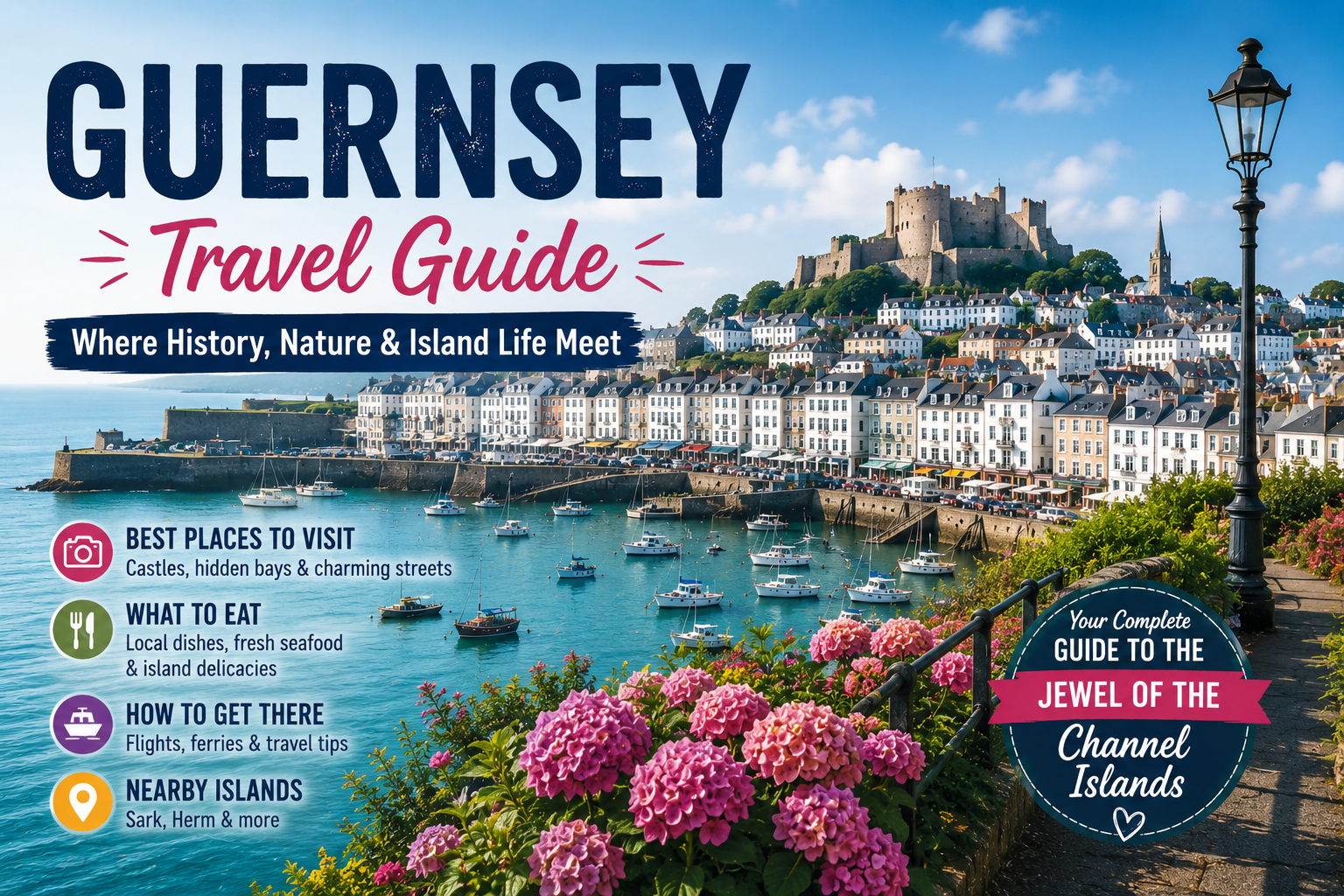
Tucked away in the English Channel between the coasts of England and France, Guernsey is one of Europe’s most fascinating island destinations. With its picturesque harbour, dramatic coastal cliffs, sandy bays, historic fortifications and distinctive island culture, Guernsey offers a refreshing alternative to Europe’s crowded city breaks.
But where exactly is Guernsey? Is Guernsey part of the UK? What are the best things to do in Guernsey, and what should you eat while visiting?
📍 Where is Guernsey?
🇬🇧 Is Guernsey part of the United Kingdom?
🏰 What are the best places to visit in Guernsey?
🍽️ What food is Guernsey famous for?
✈️ How do you get to Guernsey?
This Guernsey travel guide covers everything you need to know before visiting, from the island’s unusual political status to attractions, beaches, local food, transport and nearby islands.
📍 Where Is Guernsey?
Guernsey is located in the English Channel, off the coast of Normandy in France. It is one of the Channel Islands, an archipelago situated between southern England and northern France.
Geographically, Guernsey is much closer to France than many visitors expect.
The two best-known territories in the Channel Islands are Guernsey and Jersey, but they are separate jurisdictions with their own governments.
The name “Guernsey” can refer specifically to the main island, while the wider Bailiwick of Guernsey also includes Alderney, Sark and several smaller islands.
🌍 Is Guernsey in Europe?
Yes. Guernsey is geographically located in Europe.
🏙️ What is the capital of Guernsey?
The capital and main town is St Peter Port, a picturesque harbour town on the island’s eastern coast.
💡 In short: Guernsey is a Channel Island located near the French coast, but it is neither part of France nor part of the United Kingdom.
👑 Is Guernsey Part of the UK?
This is probably one of the most common questions about Guernsey.
❌ Guernsey is not part of the United Kingdom.
❌ It is not part of France.
❌ It is not an independent sovereign country either.
So what exactly is Guernsey?
Guernsey is a British Crown Dependency.
It is self-governing and has its own parliament, laws, courts and taxation system. The UK is responsible for certain matters such as defence and international representation, while Guernsey manages most of its domestic affairs.
This unusual arrangement is one of the things that makes the Channel Islands so interesting.
🗺️ Guernsey explained in one sentence
Guernsey is a self-governing British Crown Dependency in the Channel Islands, located off the coast of Normandy, France.
ℹ️ Guernsey at a Glance
📍 Location: English Channel, Channel Islands
🏙️ Capital: St Peter Port
🌍 Continent: Europe
🗣️ Main language: English
💷 Currency: Guernsey pound and pound sterling
🚗 Driving: Left-hand side
👑 Political status: British Crown Dependency
🏝️ Island group: Channel Islands
🇫🇷 Nearby coast: Normandy, France
Guernsey’s relatively small size makes it possible to see a surprising amount of the island even during a short break.
✈️ How to Get to Guernsey
Despite its small size, Guernsey has its own airport.
Guernsey Airport provides connections with destinations in the British Isles, although routes and schedules can vary.
Many international travellers reach Guernsey by travelling through the UK and then connecting to the island.
⛴️ Travelling by ferry is another option.
Ferry services can connect Guernsey with other Channel Islands and ports on the British and French coasts, depending on the season and current schedules.
⚠️ Travel tip: Guernsey has a unique constitutional status, so do not assume that every UK or Schengen immigration rule automatically applies in exactly the same way. Always check the latest entry, visa and transit requirements from official sources before travelling.
🏰 Best Things to Do in Guernsey
For such a small island, Guernsey has an impressive variety of attractions.
You can explore medieval fortifications in the morning, follow the footsteps of Victor Hugo in the afternoon and finish your day watching the sunset from a sandy bay.
Here are some of the best places to visit in Guernsey.
⚓ 1. Explore St Peter Port
St Peter Port should be at the top of any Guernsey itinerary.
The island’s capital is characterised by its harbour, narrow streets, historic buildings and houses rising along the hillside.
Walking is one of the best ways to explore the centre.
Spend some time around the waterfront, wander through the streets behind the harbour and enjoy the views across the water.
📸 Don’t miss: The harbour views looking back towards the colourful buildings of St Peter Port.

🏰 2. Visit Castle Cornet
Standing beside St Peter Port harbour, Castle Cornet is one of Guernsey’s most recognisable historic landmarks.
The fortress has guarded the harbour for centuries and today serves as a major visitor attraction.
Its museums and historic structures provide an introduction to Guernsey’s military history, while its elevated position offers beautiful views towards St Peter Port and the surrounding sea.
✨ If you enjoy history and photography, Castle Cornet deserves a place on your itinerary.

📚 3. Discover Hauteville House – Victor Hugo’s Home
Guernsey has a remarkable connection with one of France’s greatest writers.
Victor Hugo lived in Guernsey during his years of exile, making his home at Hauteville House in St Peter Port.
Hugo spent many years on the island and completed his masterpiece Les Misérables while living in Guernsey.
Today, Hauteville House offers visitors an opportunity to discover the writer’s extraordinary world and his connection with the island.
📖 For literature lovers, this is easily one of Guernsey’s most fascinating attractions.

🌺 4. Relax at Candie Gardens
Located above St Peter Port, Candie Gardens provides a peaceful escape from the harbour streets below.
The gardens combine greenery with impressive views over the town and surrounding waters.
🌸 Gardens
🌊 Sea views
⚓ St Peter Port panoramas
It is an easy stop to include while exploring the capital on foot.

⛪ 5. See The Little Chapel
One of Guernsey’s most unusual attractions is The Little Chapel.
The tiny chapel is famous for its elaborate decoration, featuring colourful pieces of china, pebbles and shells.
Its distinctive appearance has made it one of the island’s most photographed landmarks.
📸 It is small, quirky and unlike almost anything else you will see during your Guernsey trip.

🎖️ 6. Visit the German Occupation Museum
The Channel Islands have a unique place in Second World War history.
During World War II, the islands were occupied by German forces.
The German Occupation Museum preserves objects, documents and displays connected with life on Guernsey during the occupation.
It is an important stop for travellers who want to understand the island beyond its beaches and picturesque scenery.
🪖 7. Explore the German Underground Hospital
Another striking reminder of Guernsey’s wartime history is the German Underground Hospital.
This extensive underground complex was constructed during the German occupation and consists of tunnels and chambers carved beneath the island.
The atmosphere is very different from Guernsey’s sunny beaches and colourful harbour, providing a powerful contrast within the same trip.
🏖️ 8. Spend Time at Cobo Bay
After exploring Guernsey’s history, head towards the coast.
Cobo Bay is one of the island’s best-known beaches.
Its sandy shoreline and sea views make it a popular place to relax, particularly during warmer months.
🌅 Travel tip: Cobo Bay is also a lovely place to experience a Guernsey sunset.

🌿 9. Discover Fermain Bay
If you are looking for a more secluded coastal setting, add Fermain Bay to your itinerary.
Surrounded by green hills and cliffs, the bay showcases the quieter, more natural side of Guernsey.
🥾 Some routes involve walking, so comfortable shoes are recommended.
The scenery is worth the effort.
🌊 10. Explore Pleinmont
For dramatic coastal scenery, head towards Pleinmont.
This part of Guernsey is known for its rugged cliffs, sea views and walking opportunities.
On a clear day, the combination of open water, rocky coastline and green countryside captures exactly why Guernsey is such an enjoyable destination for walkers.
🚶 Best Things to Do in Guernsey Beyond Sightseeing
There is more to a Guernsey holiday than ticking attractions off a list.
🥾 Walk along the coastal paths.
🏖️ Discover secluded bays.
⚓ Wander through St Peter Port.
🍽️ Try traditional Guernsey food.
📸 Watch the sunset from the coast.
⛴️ Take a day trip to a neighbouring island.
Guernsey is particularly rewarding for travellers who enjoy exploring slowly rather than rushing between major attractions.
🏝️ Islands to Visit from Guernsey
One of the advantages of visiting Guernsey is the opportunity to discover some of the smaller Channel Islands.
Two particularly interesting options are Sark and Herm.
🚲 Sark
Sark offers one of the most unusual island experiences in the British Isles.
The island is known for its peaceful atmosphere, spectacular coastline and extremely limited use of motor vehicles.
🚲 Cycling
🥾 Walking
🌊 Coastal scenery
are among the best ways to experience Sark.
Depending on ferry schedules, Sark can make an excellent day trip from Guernsey.
🏖️ Herm
Tiny Herm Island is another popular escape from Guernsey.
Known for its beaches and tranquil atmosphere, Herm is ideal for travellers looking for nature, walking and time beside the sea.
⛴️ Ferry schedules can vary by season, so always check current services before planning your day trip.
🍽️ What to Eat in Guernsey
Food is another enjoyable part of discovering the island.
Guernsey’s culinary traditions reflect its island location and historical connections with both Britain and Normandy.
Fresh seafood naturally plays an important role, but there are several distinctly local foods worth trying.
🥘 Guernsey Bean Jar
One of the island’s best-known traditional dishes is Guernsey Bean Jar.
This hearty dish is traditionally prepared with beans and meat and cooked slowly for several hours.
It is simple, filling and closely associated with Guernsey’s culinary heritage.
🍲 If you want to try a genuinely traditional island dish, Bean Jar is a good place to start.
🦀 Fresh Seafood
Being surrounded by the sea has obvious advantages.
Guernsey is a great destination for seafood lovers, and depending on the season and restaurant you may find:
🦀 Crab
🦞 Lobster
🐟 Fresh fish
🦪 Shellfish
on local menus.
Eating seafood overlooking the harbour or coastline is one of those simple experiences that fits perfectly into an island holiday.
🍞 Guernsey Gâche
For something sweeter, look for Guernsey Gâche.
This traditional fruit bread is made with dried fruit and is often enjoyed sliced with butter.
Despite sometimes being described as a cake, its texture is closer to a rich fruit bread.
☕ It makes a particularly nice accompaniment to tea or coffee.
🥛 Guernsey Dairy Products
You may already have heard of Guernsey cattle.
The breed is famous internationally for producing rich, creamy milk.
While visiting the island, look out for local:
🥛 Milk
🧈 Butter
🍦 Ice cream
🥣 Cream
Trying Guernsey ice cream on a sunny day by the coast is an appropriately simple island pleasure.

🚌 Getting Around Guernsey
Guernsey’s compact size makes getting around relatively straightforward.
🚌 Bus: A convenient way to explore different parts of the island.
🚕 Taxi: Useful for shorter journeys or locations that are less convenient by public transport.
🚗 Rental car: Offers flexibility if you want to explore independently.
🚶 Walking: Ideal around St Peter Port and along sections of the coastline.
🚗 Important: Traffic in Guernsey drives on the left-hand side, and some island roads can be surprisingly narrow.
If you are unfamiliar with driving on the left, allow yourself time to adjust.
☀️ Best Time to Visit Guernsey
For most travellers, late spring through early autumn is the most appealing period to visit Guernsey.
🌸 May: Pleasant and generally quieter
☀️ June: Long days and excellent walking conditions
🏖️ July-August: Warmer and busier
🍂 September: A good option for a quieter trip
Guernsey’s location in the English Channel means the weather can change quickly.
🧥 Even during summer, packing a light waterproof jacket or windbreaker is sensible.
📅 How Many Days Do You Need in Guernsey?
For the main Guernsey attractions, 2 to 3 days can work well.
If you also want to visit Sark or Herm, enjoy coastal walks and travel at a more relaxed pace, consider 4 to 5 days.
🗓️ Suggested 4-Day Guernsey Itinerary
Day 1: ⚓ St Peter Port → 🏰 Castle Cornet → 🌺 Candie Gardens → 📚 Hauteville House
Day 2: ⛪ Little Chapel → 🎖️ World War II sites → 🏖️ Cobo Bay
Day 3: 🌿 Fermain Bay → 🥾 Coastal walking → 🌊 Pleinmont
Day 4: ⛴️ Day trip to Sark or Herm
Always adjust your plans according to weather and seasonal ferry schedules.
💷 Is Guernsey Expensive?
Guernsey is not generally considered a budget destination.
Accommodation and restaurant prices can be relatively high, particularly during the summer season.
Booking accommodation in advance can help you find a wider range of options.
Guernsey issues its own currency, the Guernsey pound, while pound sterling is also widely accepted.
💡 Money tip: Consider spending or exchanging your Guernsey notes before leaving, as Guernsey banknotes may not always be readily accepted elsewhere in the UK.
🤔 Interesting Facts About Guernsey
📚 Victor Hugo spent many years of his exile living in Guernsey.
📖 He completed Les Misérables while living on the island.
🎖️ Guernsey and the other Channel Islands were occupied by German forces during World War II.
👑 Guernsey is a Crown Dependency, not part of the United Kingdom.
🐄 The famous Guernsey cattle breed originated on the island and is renowned for its rich milk.
🏝️ Guernsey and Jersey are separate islands with separate governments.
🇫🇷 Despite Guernsey’s strong British connections, geographically it sits surprisingly close to the French coast.
❓ Frequently Asked Questions About Guernsey
📍 Where is Guernsey?
Guernsey is located in the English Channel off the coast of Normandy, France. It is one of the Channel Islands.
🇬🇧 Is Guernsey part of the UK?
No. Guernsey is not part of the United Kingdom. It is a self-governing British Crown Dependency.
👑 What country does Guernsey belong to?
Guernsey does not “belong” to a country in the conventional sense. It is a British Crown Dependency with its own government and legal system.
🇫🇷 Is Guernsey part of France?
No. Despite being geographically close to Normandy, Guernsey is not part of France.
🇪🇺 Is Guernsey in the European Union?
No. Guernsey is not a member of the European Union.
🛂 Is Guernsey in the Schengen Area?
No. Guernsey is not part of the Schengen Area.
🏙️ What is the capital of Guernsey?
The capital and main town of Guernsey is St Peter Port.
🗣️ What language is spoken in Guernsey?
English is the main language used in everyday life. The island also has a Norman linguistic heritage.
💷 What currency does Guernsey use?
Guernsey issues the Guernsey pound, and pound sterling is also widely accepted.
🏝️ Are Guernsey and Jersey the same island?
No. Guernsey and Jersey are separate Channel Islands with their own governments and political institutions.
🏖️ Is Guernsey worth visiting?
Yes, particularly if you enjoy coastal scenery, history, walking, beaches and quieter European destinations.
💙 Is Guernsey Worth Visiting?
If your idea of a memorable European trip involves more than famous capitals and crowded tourist attractions, Guernsey is well worth considering.
The island combines:
⚓ the charming harbour of St Peter Port,
🏰 centuries of history at Castle Cornet,
📚 the fascinating legacy of Victor Hugo,
🎖️ extraordinary World War II history,
🏖️ peaceful beaches and hidden bays,
🥾 dramatic coastal walking routes, and
🍽️ distinctive local food.
Guernsey may not have the international fame of many European island destinations — and that is part of its appeal.
Here, you can spend the morning wandering through a historic harbour town, the afternoon walking above dramatic cliffs and the evening enjoying local seafood beside the water.
Small in size, rich in history and surrounded by beautiful coastline, Guernsey is one of the Channel Islands’ most intriguing destinations to discover. 🇬🇬🌊
Bir Cevap Yazın