
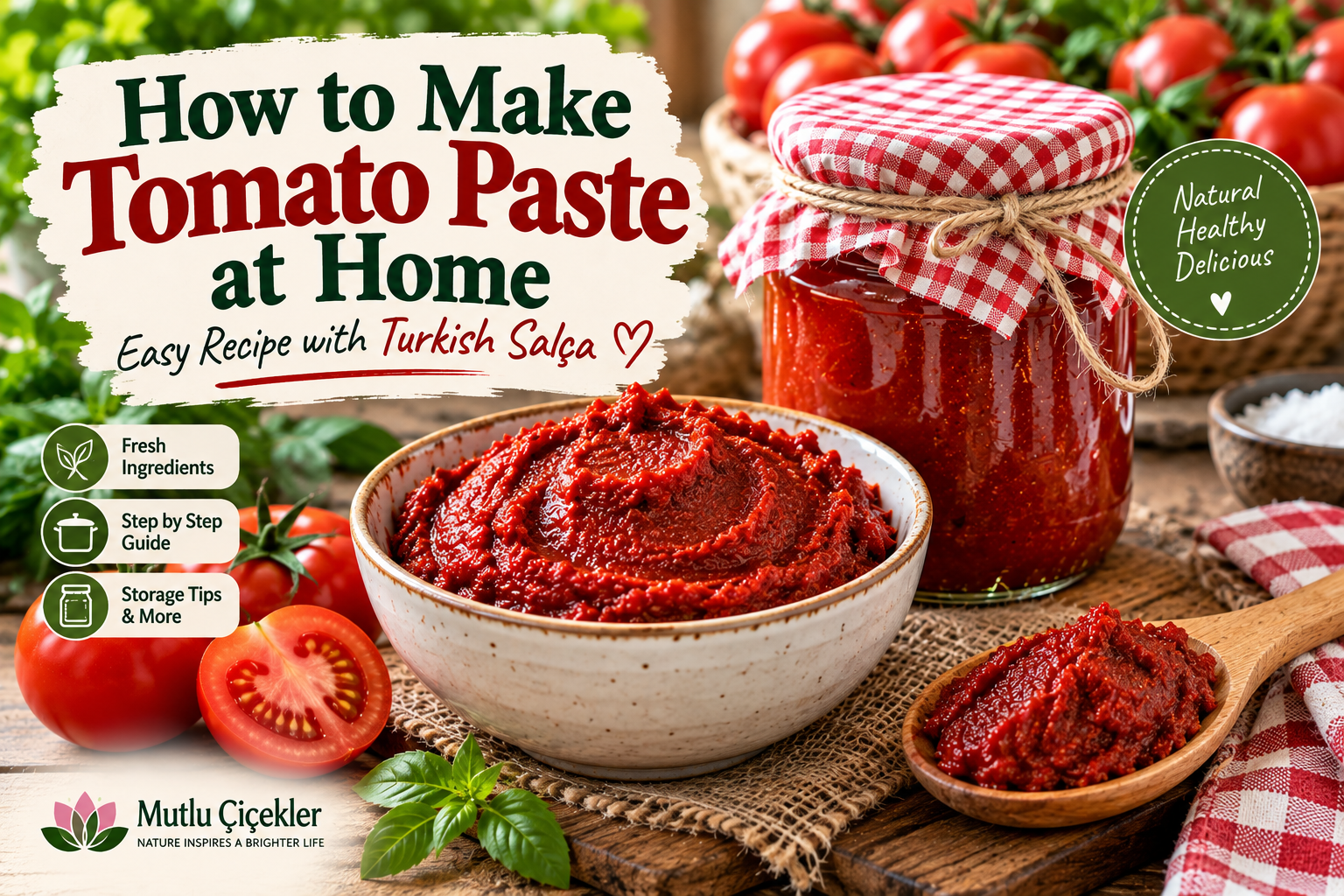
Homemade tomato paste is one of the best ways to preserve the rich flavor of ripe summer tomatoes. Thick, intensely savory, and wonderfully versatile, it can be used in soups, stews, pasta sauces, rice dishes, marinades, and countless other recipes.
In Türkiye, tomato paste is known as domates salçası, or simply salça, and it is a staple ingredient in Turkish cooking. Traditionally prepared when tomatoes are at their peak, homemade salça has a concentrated tomato flavor that can transform even a simple dish.
So, how do you make tomato paste at home? This guide covers everything from choosing tomatoes and achieving the right consistency to storage, yield, and important food-safety tips.
What Is Turkish Tomato Paste (Salça)?
Salça is a thick paste traditionally made by reducing tomatoes or red peppers until much of their water has evaporated.
Domates salçası refers specifically to tomato paste, while biber salçası is made from red peppers.
Tomato salça is widely used throughout Turkish cuisine. A spoonful can add color, depth, and a concentrated savory tomato flavor to soups, stews, bulgur dishes, beans, vegetables, and sauces.
Ingredients for Homemade Tomato Paste
For a basic homemade tomato paste, you only need a few ingredients:
- 5 kg (about 11 lb) ripe tomatoes
- 2–3 tablespoons coarse salt or pickling salt, adjusted to taste
- A small amount of olive oil for refrigerated storage, optional
The final amount of salt can be adjusted according to taste and how the paste will be used.
Important: Salt and olive oil should not be considered substitutes for an appropriate food-preservation method when tomato paste is intended for long-term room-temperature storage.
What Are the Best Tomatoes for Tomato Paste?
The best tomato paste starts with the right tomatoes.
Choose tomatoes that are:
- Fully ripe
- Meaty rather than watery
- Naturally flavorful
- Fresh and firm
- Free from mold and spoilage
Plum or paste-type tomatoes are particularly useful because they generally contain more flesh and less water than many slicing varieties.
However, other ripe tomatoes can also be used. Tomatoes with a high water content simply require more reduction time.
Do not use moldy or spoiled tomatoes.
How to Make Tomato Paste at Home
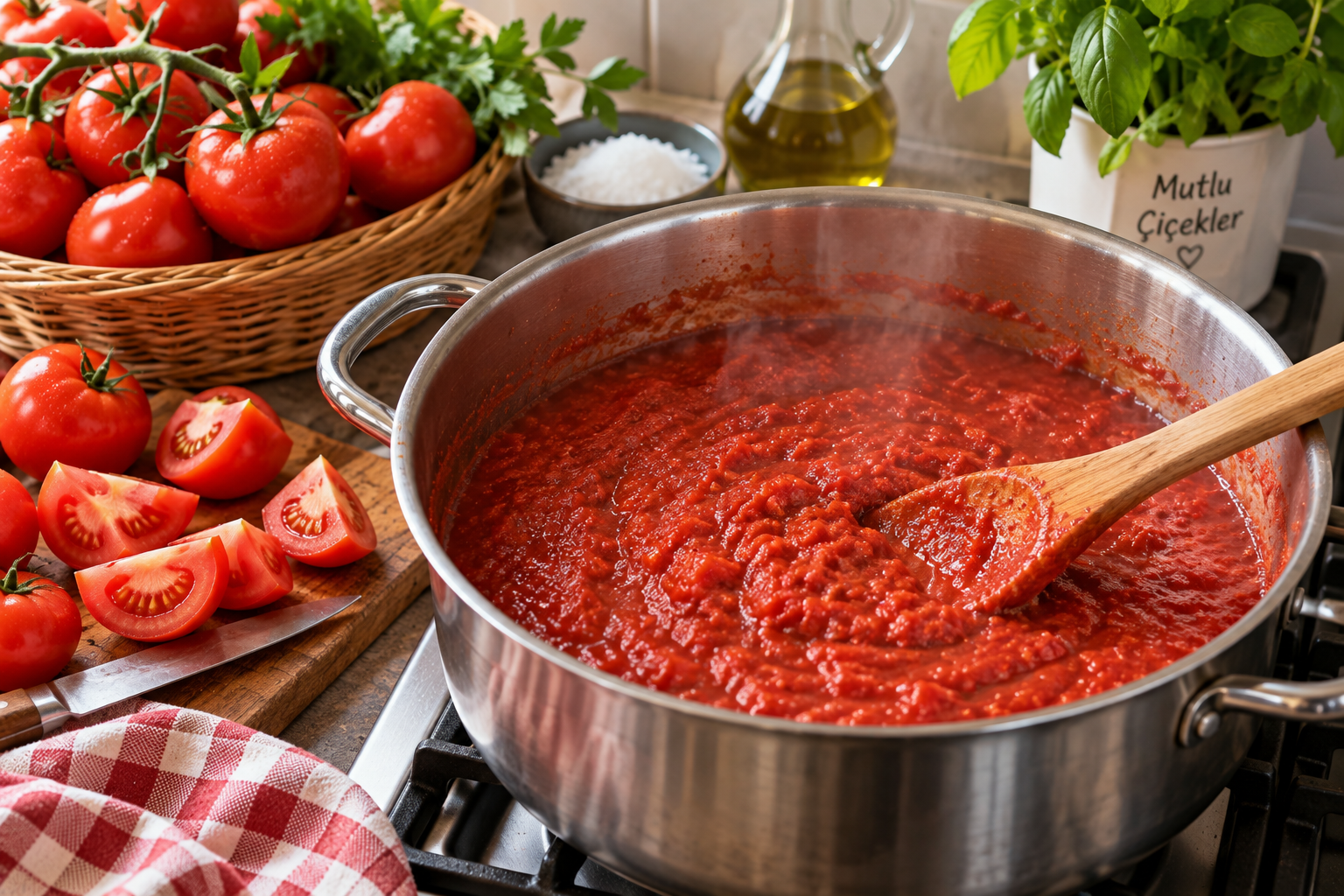
1. Prepare the Tomatoes
Wash the tomatoes thoroughly under clean running water.
Remove the stems and any damaged areas, then cut the tomatoes into large chunks.
Transfer them to a large, heavy-bottomed pot.
2. Cook Until Soft
Place the pot over medium heat.
As the tomatoes heat, they will begin releasing their natural juices. Cook them, stirring occasionally, until they become completely soft.
There is usually no need to add water because ripe tomatoes contain plenty of moisture.
Avoid using excessively high heat, which can cause the tomatoes to scorch on the bottom of the pot.
3. Remove the Skins and Seeds
Once the tomatoes are completely soft, remove the pot from the heat and allow them to cool slightly.
Pass the cooked tomatoes through a food mill or fine strainer.
This separates most of the skins and seeds from the tomato pulp and produces a smoother purée.
4. Reduce the Tomato Purée
Return the tomato purée to a wide pot.
Cook over medium-low heat, stirring regularly, so that excess water gradually evaporates.
A wide pot provides more surface area and can help the moisture evaporate more efficiently.
As the mixture becomes thicker, stir more frequently to prevent scorching.
Add the salt during this stage.
How Do You Know When Tomato Paste Is Ready?
The tomato purée will gradually become darker, thicker, and much more concentrated.
One simple way to check the consistency is to place a spoonful on a plate.
If very little watery liquid separates from the paste and it holds its shape reasonably well, it is approaching the desired consistency.
Homemade tomato paste does not have to be extremely dry. Overcooking can negatively affect both its flavor and color.
How Long Does Homemade Tomato Paste Take to Cook?
There is no single cooking time that works for every batch.
The total time depends on several factors, including:
- The tomato variety
- Water content
- Quantity being prepared
- Size and width of the pot
- Cooking temperature
- Desired final consistency
Watery tomatoes naturally take longer to reduce than dense paste tomatoes.
For this reason, consistency is a better indicator than cooking time.
How Much Tomato Paste Does 5 kg of Tomatoes Make?
The yield varies considerably according to the tomatoes and how concentrated you make the paste.
As a general estimate, 5 kg (11 lb) of fresh tomatoes may produce roughly 500 g to 1 kg (about 18–35 oz) of tomato paste.
Meaty, low-moisture tomatoes generally provide a better yield, while watery varieties produce less paste after reduction.
Think of this as an approximate range rather than a fixed ratio.
Tips for Better Homemade Tomato Paste
A few simple techniques can make a noticeable difference:
- Use ripe, flavorful tomatoes.
- Avoid moldy or spoiled produce.
- Choose a wide, heavy-bottomed pot.
- Reduce the tomatoes gradually rather than using extremely high heat.
- Stir more frequently as the mixture thickens.
- Use clean containers and utensils.
- Avoid introducing water into an opened container.
- Refrigerate tomato paste after opening.
Most importantly, don’t rush the reduction process. Slowly removing excess moisture helps concentrate the natural tomato flavor.
How to Store Homemade Tomato Paste
Storage depends on how quickly you intend to use your tomato paste.
For short-term use, transfer the finished paste to a clean container and refrigerate it after cooling.
Some cooks cover refrigerated tomato paste with a thin layer of olive oil to reduce its exposure to air. However, olive oil does not make an improperly canned product shelf-stable.
If you intend to preserve tomato products at room temperature for an extended period, use a tested home-canning recipe from a recognized food-safety authority. Tomato acidity can vary, and safe home canning may require acidification and specific processing procedures.
Simply pouring hot tomato paste into a jar and turning the jar upside down should not be relied upon as a safe method for long-term room-temperature storage.
Can Homemade Tomato Paste Be Frozen?
Yes. Freezing is one of the easiest ways to store homemade tomato paste in convenient portions.
Allow the paste to cool, divide it into small freezer-safe portions, and freeze.
Small portions are particularly convenient because you can remove only the amount required for a recipe.
An ice cube tray can also be useful for portioning tomato paste. Once frozen, transfer the portions to an appropriate freezer container or bag.
How to Prevent Tomato Paste From Developing Mold
Good hygiene and proper refrigeration are particularly important after opening.
To reduce contamination:
- Store opened tomato paste in the refrigerator.
- Always use a clean, dry spoon.
- Close the container promptly after use.
- Avoid introducing water or food particles into the container.
- Use appropriately sized containers so the paste is not repeatedly exposed to air for long periods.
If tomato paste develops visible mold or clear signs of spoilage, the safest approach is to discard it rather than simply removing the affected surface.
Can Tomato Paste Be Dried in the Sun?
Sun-drying is part of traditional salça-making practices in Türkiye and other parts of the Mediterranean region.
Tomato purée is gradually concentrated as moisture evaporates under the sun.
However, outdoor preparation makes controlling sanitation, insects, dust, temperature, and other environmental conditions more difficult.
For many home cooks, reducing tomato purée on the stovetop is therefore a more practical and controlled method.
Tomato Paste vs. Tomato Sauce: What’s the Difference?
Tomato paste and tomato sauce are not interchangeable in equal quantities.
Tomato paste is highly concentrated, thick, and intensely flavored.
Tomato sauce contains considerably more water and usually has a thinner consistency.
Because tomato paste is concentrated, recipes typically require much less of it.
How Many Calories Are in Tomato Paste?
The nutritional value varies depending on the tomato variety and the amount of water remaining in the finished product.
As a general estimate, 100 g (3.5 oz) of tomato paste contains roughly 80–100 calories.
One tablespoon generally contributes only a small amount because the serving size is much smaller.
Homemade versions can vary, so these figures should be treated as estimates rather than exact nutritional values.
How to Use Turkish Tomato Paste
Homemade salça is incredibly versatile.
Try it in:
- Soups
- Stews
- Pasta sauces
- Rice dishes
- Bulgur dishes
- Bean dishes
- Stuffed vegetables
- Meat and chicken dishes
- Vegetable dishes
- Marinades
- Breakfast sauces
In Turkish cooking, tomato paste is frequently sautéed briefly in oil or butter before other ingredients are added. This can help distribute its concentrated flavor throughout the dish.
Because homemade tomato paste can vary in intensity, start with a small amount and adjust according to taste.
Frequently Asked Questions
Do you need to peel tomatoes before making tomato paste?
Not necessarily. Cooking the tomatoes first and then passing them through a food mill or strainer makes it easy to remove the skins and seeds.
Do you need sugar in homemade tomato paste?
No. Traditional tomato paste does not require added sugar. Fully ripe tomatoes generally provide enough natural sweetness.
Can you add olive oil to tomato paste?
You can add a thin layer of olive oil to refrigerated tomato paste to reduce surface exposure to air. However, oil alone does not make tomato paste safe for long-term storage at room temperature.
Why is my homemade tomato paste watery?
The tomatoes may have had a high water content, or the purée simply needs additional reduction.
Why did my tomato paste become very dark?
Excessively high heat or prolonged cooking can darken tomato paste. Slow, controlled reduction generally produces better results.
Can you freeze tomato paste?
Yes. Freezing it in small portions is a convenient way to preserve homemade tomato paste and makes it easy to use later.
Is salça the same as tomato paste?
Domates salçası is the Turkish term for tomato paste. Turkish salça may vary in consistency and preparation method depending on the region and household tradition.
Final Thoughts
Learning how to make tomato paste at home is a wonderful way to preserve the flavor of ripe seasonal tomatoes.
For Turkish cuisine, homemade domates salçası is much more than a simple condiment. It is a foundational ingredient used to build flavor in countless traditional dishes.
Choose ripe, meaty tomatoes, reduce them patiently, pay close attention to cleanliness and storage, and you’ll have a rich homemade tomato paste ready for soups, stews, sauces, and many other recipes.
Whether you call it homemade tomato paste or Turkish salça, a small spoonful can bring concentrated tomato flavor to an entire dish.
Bir Cevap Yazın