
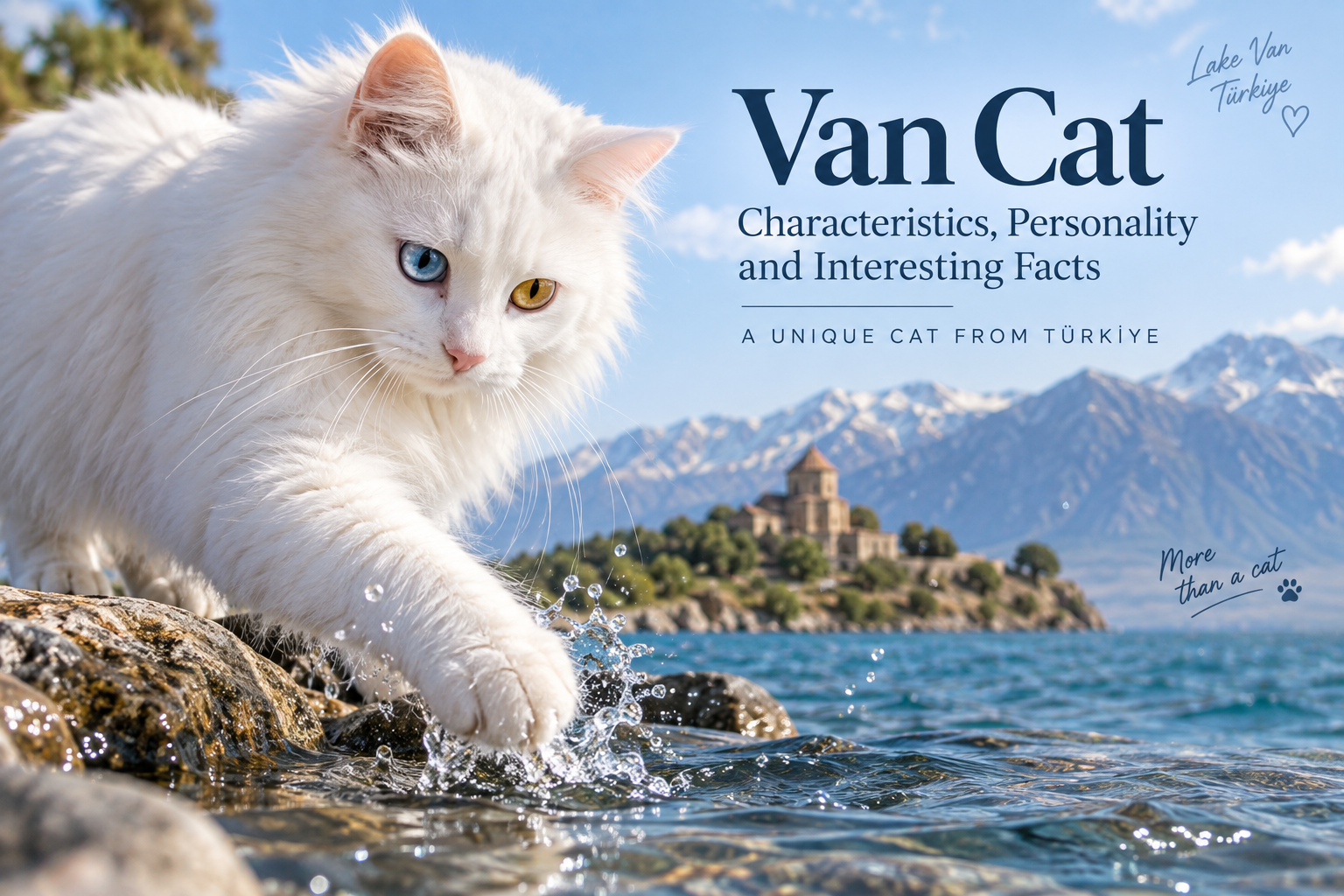
With its silky white coat, striking blue and amber eyes, active personality and unusual interest in water, the Van cat is one of Türkiye’s most recognizable native cat breeds.
Originating from the Lake Van region in eastern Türkiye, the Van cat has become closely associated with the city and its surrounding landscape. Although it is often recognized by having one blue eye and one amber eye, not every Van cat has different-colored eyes.
There is much more to this remarkable cat than its appearance.
Why Did We Find the Van Cat Interesting?
What makes the Van cat especially interesting is that it combines a distinctive appearance with an equally distinctive personality.
It is associated with the Lake Van Basin, is known for its silky coat and impressive eyes, and has long been described as playful, agile and closely attached to people.
One of the most surprising facts is that odd-colored eyes are not required for a Van cat.
Van cats may have:
- Two blue eyes
- Two amber eyes
- One blue eye and one amber eye
Their famous interest in water is another characteristic that has helped make them known far beyond Türkiye.
Van Cat at a Glance
| Feature | Van Cat |
|---|---|
| Origin | Lake Van Basin, Türkiye |
| Coat | Silky and soft |
| Eye colors | Blue, amber or odd-eyed |
| Personality | Active, curious and playful |
| Relationship with people | Can form strong bonds |
| Famous for | Eyes and interest in water |
| Body | Strong and well-balanced |
| Grooming | Regular brushing recommended |
Where Does the Van Cat Come From?
The Van cat is traditionally associated with the Lake Van Basin in eastern Türkiye.
The breed has become one of the best-known symbols of Van and is considered an important native animal breed in Türkiye.
Van Yüzüncü Yıl University operates a dedicated Van Cat Research Center, where efforts are made to preserve, study and promote the breed.
The official Turkish breed registration identifies the Lake Van Basin as its area of origin and distribution.
What Does a Van Cat Look Like?
The traditional Van cat is especially famous for its light-colored appearance and expressive eyes.
Common characteristics include:
- Soft, silky fur
- A strong, medium-length body
- A broad chest
- Large and noticeable eyes
- Pink nose
- Pink inner ears
- A proportionate, fluffy tail
Male Van cats are generally larger than females.
White-coated individuals are particularly famous, although the official Turkish description also recognizes cats with reddish-yellow markings on areas such as the head, back, legs, ears or tail.
Why Do Van Cats Have Different-Colored Eyes?
The Van cat is widely known for having one blue eye and one amber eye.
This condition, where the eyes have different colors, is commonly known as heterochromia.
However, one of the biggest misconceptions about Van cats is that every individual must have two different-colored eyes.
According to the official Van cat description, three main eye-color combinations occur:
- Both eyes blue
- Both eyes amber
- One blue eye and one amber eye
Amber shades can also vary from yellowish tones to deeper amber shades.
So a Van cat with two blue eyes or two amber eyes can still be a Van cat.
What Is the Personality of a Van Cat?
Van cats are generally described as active, agile and playful.
They can become very attached to the people they live with and often enjoy interacting with their families.
Many are curious about what is happening around them and may follow household activity closely.
They are also traditionally known for their hunting ability and energetic nature.
Van Yüzüncü Yıl University describes the breed as affectionate, playful, intelligent and capable of developing a close relationship with its owner.
Of course, every cat is an individual.
Personality can vary depending on genetics, socialization, environment, age and previous experiences.
Do Van Cats Really Like Water?

This is probably one of the most famous questions about the breed.
Van cats are well known for their unusual interest in water.
Some may investigate running taps, play with water bowls or show curiosity around shallow water. Historical descriptions of the breed also associate Van cats with playing in and entering water.
However, this does not mean that every Van cat wants to swim.
A cat should never be forced into water. Individual experiences and personality greatly influence how comfortable a cat feels around it.
Interestingly, the internationally recognized Turkish Van is also famous for an affinity with water, and the Cat Fanciers’ Association notes that some individuals enjoy playing in water.
Are the Van Cat and Turkish Van the Same?
This is where things become a little complicated.
In Türkiye, Van cat generally refers to the native cats associated with the Van region, particularly the famous white-coated cats with blue, amber or odd-colored eyes.
International cat registries may use the name Turkish Van for a breed with a somewhat different show standard.
The Cat Fanciers’ Association describes the Turkish Van as a semi-longhaired cat with a predominantly white body and colored markings concentrated mainly on the head and tail.
This means that when you search for “Turkish Van” online, you may see cats that look noticeably different from the white Van cats commonly associated with the city of Van in Türkiye.
The naming overlap is one reason photographs and breed descriptions found online can sometimes appear contradictory.
Are Van Cats Playful?
Yes, Van cats are generally known for being active and playful.
They may enjoy:
- Interactive toys
- Balls
- Climbing areas
- Chasing games
- Exploring different parts of the home
Providing opportunities for both physical activity and mental stimulation can help keep an indoor cat engaged.
Rather than relying on one type of toy, rotating different toys can make playtime more interesting.
Can a Van Cat Live Indoors?
Yes.
A Van cat can adapt to indoor living when provided with a safe and stimulating environment.
Useful precautions include:
- Securing windows and balconies
- Providing scratching areas
- Offering interactive toys
- Keeping fresh water available
- Maintaining a clean litter area
- Scheduling regular veterinary care
Because Van cats can be active and curious, having safe spaces to climb, explore and play can be particularly beneficial.
How Do You Groom a Van Cat?
Van cats are known for their soft, silky coats.
Regular brushing can help remove loose hair and prevent tangles, particularly during seasonal coat changes.
Introducing grooming gradually when the cat is young can make brushing easier later in life.
Frequent bathing is usually unnecessary for a healthy indoor cat unless there is a specific reason for it.
What Should a Van Cat Eat?
A Van cat should be fed a complete and balanced diet appropriate for cats.
The ideal amount and type of food depend on factors such as:
- Age
- Body weight
- Activity level
- Neuter status
- Overall health
Fresh drinking water should always be available.
Kittens, senior cats and cats with medical conditions may have different nutritional needs, so individual feeding advice should be discussed with a veterinarian.
Interesting Facts About the Van Cat
1. Not Every Van Cat Has Two Different-Colored Eyes
Some have two blue eyes, while others have two amber eyes. Odd-eyed Van cats have one eye of each color.
2. The Breed Is Closely Associated With Lake Van
Its traditional distribution area is the Lake Van Basin in eastern Türkiye.
3. Van Cats Are Famous for Their Interest in Water
Playing with water is one of the behaviors historically associated with the breed.
4. The Van Cat Is Officially Registered in Türkiye
Its characteristics were officially registered as a national breed in Türkiye in 2006.
5. They Can Form Strong Bonds With People
Van cats have traditionally been described as affectionate cats that enjoy living closely with humans.
6. Males Are Usually Larger Than Females
The official breed description notes that males generally have a larger body structure than females.
7. “Turkish Van” Can Mean Something Different Internationally
International cat organizations commonly recognize the Turkish Van with the distinctive Van pattern, featuring colored areas primarily around the head and tail.
Why Is the Van Cat So Special?
The Van cat is special for more than its beautiful eyes.
It represents a living connection between an animal breed and the region where it developed.
Its silky coat, unusual eye colors, playful personality and historical association with water have made it one of Türkiye’s most recognizable native cats.
For the people of Van, the cat is more than simply an attractive pet.
It has become part of the region’s cultural identity.
Frequently Asked Questions About Van Cats
Do all Van cats have one blue eye and one amber eye?
No. Van cats may have two blue eyes, two amber eyes, or one blue and one amber eye.
Do Van cats really swim?
Some Van cats show an unusual interest in water and the breed is historically associated with playing in water. However, individual cats vary and should never be forced to swim.
Are Van cats always white?
White Van cats are the most famous, but the official Turkish breed description also recognizes individuals with reddish-yellow markings on parts of the body.
Is a Van cat the same as a Turkish Angora?
No. The Van cat and Turkish Angora are separate native cat breeds associated with different regions and different breed characteristics.
Is the Van cat the same as the Turkish Van?
The names are often used interchangeably, but the traditional Van cat description in Türkiye and the Turkish Van standards used by international cat associations are not identical.
Are Van cats good indoor cats?
They can adapt well to indoor life when provided with enough play, environmental enrichment and safe places to explore.
Are Van cats affectionate?
Many Van cats form strong bonds with their owners and enjoy interaction, although temperament always varies between individual cats.
Final Thoughts
With its striking eyes, silky coat, energetic personality and fascinating connection with the Lake Van region, the Van cat is one of Türkiye’s most distinctive native cat breeds.
But describing it simply as “the white cat with one blue eye and one amber eye” misses much of what makes the breed special.
Its history, personality, relationship with humans and association with the Van region have made the Van cat a living symbol of eastern Türkiye — and a cat worth knowing far beyond its famous appearance.
Source Information
Key breed information in this article is based on material published by Van Yüzüncü Yıl University Van Cat Research Center and, where the international Turkish Van standard is discussed, information published by the Cat Fanciers’ Association (CFA).
Bir Cevap Yazın