
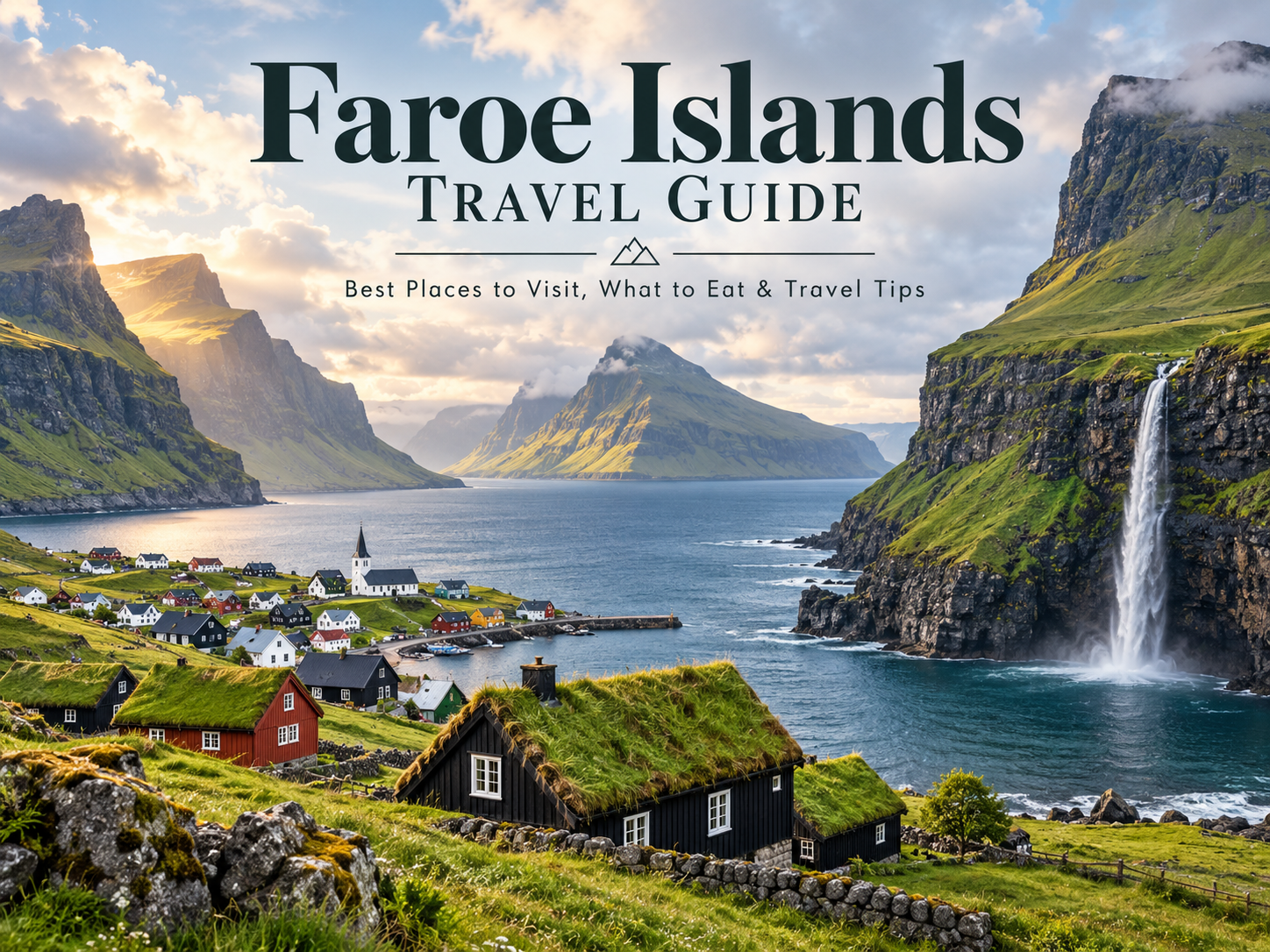
Green mountains dropping almost vertically into the North Atlantic, waterfalls falling directly toward the sea, tiny villages beneath enormous cliffs and roads disappearing into mountain tunnels — the Faroe Islands feel dramatically different from most European destinations.
Located between Scotland and Iceland, this self-governing archipelago within the Kingdom of Denmark consists of 18 volcanic islands. Despite its remote appearance, the Faroe Islands are surprisingly accessible and compact enough to explore on a single trip.
This Faroe Islands travel guide covers the best places to visit, when to go, how to get around, what to eat and the practical details you should know before planning your journey.
Faroe Islands at a Glance
Capital: Tórshavn
Number of islands: 18
Currency: Faroese króna / Danish krone (DKK)
Main language: Faroese
Also spoken: Danish and widely spoken English
International airport: Vágar Airport (FAE)
Best time for most visitors: May to September
Ideal trip length: 5–7 days
The official tourism board recommends around five to seven days for travellers who want to experience several islands without rushing.
Where Are the Faroe Islands?
The Faroe Islands lie in the North Atlantic Ocean, roughly halfway between Scotland and Iceland.
Although politically connected to Denmark, the islands have their own government, language and distinct cultural identity. They are outside both the European Union and the Schengen Area.
The landscape is remarkably concentrated: dramatic cliffs, fjords, waterfalls, mountain passes and villages are often only a short drive apart.
That means you do not need to cover huge distances to experience very different scenery.
Best Places to Visit in the Faroe Islands
1. Tórshavn
Begin your journey in Tórshavn, the Faroese capital.
It may be one of the world’s smaller capitals, but it feels more like a historic Nordic harbour town than simply a base for exploring the islands.
The most atmospheric area is Tinganes, where red wooden buildings with traditional grass roofs stand beside the harbour. Nearby á Reyni, the Old Town, is filled with narrow lanes and black-tarred wooden houses, some dating back centuries.
Don’t miss:
- Tinganes
- Old Town — á Reyni
- Tórshavn harbour
- Skansin fortress
- Tórshavn Cathedral
- The National Gallery
- Local cafés and Faroese restaurants
Allow at least one full day if this is your first visit.

2. Gásadalur and Múlafossur Waterfall
Few places capture the visual drama of the Faroe Islands better than Gásadalur.
The tiny village sits between mountains on Vágar, while nearby Múlafossur Waterfall plunges from a green cliff toward the Atlantic.
For many years, Gásadalur was one of the most isolated settlements in the islands. A road tunnel completed in 2004 finally connected the village more easily with the rest of Vágar.
Today it is one of the most recognisable Faroe Islands photography locations.
But don’t simply take the famous photograph and leave. Spend some time walking around the village and looking toward Mykines on a clear day.

3. Sørvágsvatn and Trælanípa
The famous view of Sørvágsvatn appears almost impossible.
From the Trælanípa viewpoint, perspective makes the lake look as though it is floating high above the ocean.
It is one of the most popular hiking experiences in the Faroe Islands and an excellent example of how unusual the Faroese landscape can look from different angles.
Weather matters here. Clear visibility can completely transform the experience, while fog may hide the view altogether.
Some Faroese hiking areas cross privately managed land and may require an access fee or specific arrangements, so always check the current rules before setting out.

4. Saksun
Surrounded by mountains and overlooking a tidal lagoon, Saksun feels unusually secluded even by Faroese standards.
The historic settlement includes a traditional church and Dúvugarðar, an old farm that also functions as a museum.
When tides and conditions allow, the lagoon area creates one of the country’s most distinctive coastal landscapes. Visitors should remain on designated routes because the surrounding area includes working farmland.
Saksun is particularly beautiful when low cloud hangs over the surrounding mountains.

5. Tjørnuvík
At the end of a narrow valley on northern Streymoy lies Tjørnuvík, a small village facing a dark-sand beach.
Across the water you can see the famous sea stacks Risin and Kellingin, often translated as the Giant and the Witch.
Rather than planning dozens of activities here, give yourself time to walk along the shore and enjoy the surrounding landscape.
In the Faroe Islands, sometimes the destination itself is the activity.

Other Beautiful Places to Visit in the Faroe Islands
If you have more time, there are several other places worth adding to your Faroe Islands itinerary.
Gjógv is a picturesque village on Eysturoy, known for its natural sea-filled gorge, colourful houses and surrounding mountain scenery.
Mykines is one of the best-known islands for birdwatching, particularly during the summer seabird season. It is especially famous for puffins, although ferry access can depend heavily on weather conditions.
Kalsoy offers dramatic mountain landscapes, tiny villages and the scenic area around Kallur Lighthouse. It is a good choice for travellers looking for a quieter island experience.
Vestmanna is best known for boat trips beneath towering sea cliffs, where visitors can experience the Faroese coastline from sea level.
Drangarnir is one of the most recognisable natural formations in the archipelago, with a huge sea arch rising from the Atlantic near Vágar. Access to the hiking route is restricted, so travellers should check current rules or consider seeing it by boat.
These places are excellent additions for travellers spending seven days or longer in the Faroe Islands, but they do not all need to be included in a first-time itinerary. Choosing just one or two according to the weather and your interests will usually make the trip more enjoyable.
Best Things to Do in the Faroe Islands
The Faroes are not really a destination built around conventional attractions. The landscape itself is the main reason to travel here.
Some of the most memorable experiences include:
- Hiking between mountains and historic villages
- Watching waterfalls fall toward the ocean
- Taking a boat trip beneath sea cliffs
- Visiting remote Faroese villages
- Photographing turf-roofed houses
- Looking for puffins and other seabirds
- Exploring Tórshavn’s historic streets
- Driving through mountain and subsea tunnels
- Trying traditional Faroese cuisine
- Experiencing a local Heimablídni home dinner
Most importantly, leave empty space in your itinerary. Faroese weather frequently changes plans.
Hiking in the Faroe Islands
Hiking is one of the biggest reasons to visit, but the landscape should not be underestimated.
Weather can change rapidly, fog can dramatically reduce visibility and strong wind can become dangerous near cliffs. The official tourism board specifically advises hikers to check weather conditions, avoid starting in fog or darkness and stay well away from exposed cliff edges during strong winds.
Good hiking preparation should include:
- Waterproof hiking boots
- Waterproof outer layers
- Warm layers even in summer
- Fully charged phone
- Food and water
- Offline route information
- Awareness of private land and access restrictions
Never assume that a route visible on social media is automatically open to unrestricted hiking.
Some routes require payment, landowner permission or a local guide.
When Is the Best Time to Visit the Faroe Islands?
For most first-time travellers, May to September is the easiest period to visit.
Longer daylight hours, greener landscapes, more frequent excursions and better access to outdoor activities make these months particularly convenient. Late May to early September is also generally the best period for hiking.
June to August
Best for first-time visitors, long days, hiking, boat trips and birdlife.
It is also the busiest period, so accommodation and popular excursions should be booked earlier.
April to May
A good choice for travellers who prefer quieter landscapes.
Spring weather remains unpredictable, but the days are getting longer and seabirds begin returning.
September to October
Expect fewer visitors and moodier North Atlantic scenery.
Autumn can be beautiful for photography, although rainfall and wind become increasingly important when planning outdoor activities.
November to March
Winter brings short days, powerful weather and far fewer tourists.
It can be atmospheric, but this is not the easiest season for a first visit focused on hiking and island hopping.
What Is the Weather Like?
Forget the idea of packing for one season.
Faroe Islands weather can move between sunshine, fog, drizzle and wind surprisingly quickly.
Average summer temperatures are generally around 10–13°C, while winter temperatures commonly sit around 3–7°C. Wind is common throughout the year.
Even during summer, pack:
- A waterproof jacket
- Waterproof shoes
- Warm mid-layers
- Hat
- Light gloves
- Quick-drying trousers
An umbrella is usually far less useful than a proper waterproof jacket when the wind picks up.
How to Get to the Faroe Islands
By Plane
Most international visitors arrive at Vágar Airport (FAE).
Direct services connect the Faroe Islands with several European and Nordic destinations, with Copenhagen providing the most frequent connections. Atlantic Airways is the national carrier, while Icelandair, SAS and Widerøe also operate routes; some services are seasonal.
If you cannot find a convenient direct flight, Copenhagen is one of the easiest connecting points.
By Ferry
Travellers who prefer slow travel can arrive aboard Smyril Line’s Norröna ferry.
It operates between northern Denmark and the Faroe Islands, with connections continuing toward Iceland during parts of the year. The ship arrives directly in Tórshavn.
This option can be particularly interesting for travellers bringing their own vehicle.
Getting Around the Faroe Islands
Despite their rugged geography, the Faroes have an impressive network of roads, bridges, ferries and subsea tunnels.
Rental Car
For most first-time visitors, renting a car offers the greatest flexibility.
Distances are short, but don’t judge driving time purely by kilometres. Narrow roads, tunnels, weather and spontaneous photo stops can slow you down.
Buses and Ferries
Travelling without a car is possible.
Public buses and ferries connect many communities, and multi-day transport options are available. Some remote routes operate relatively infrequently, so careful timetable planning is important.
Helicopters
Helicopters are part of the Faroese transport network, particularly for remote communities.
However, subsidised helicopter transport primarily exists for residents rather than as a tourist sightseeing system. Tourist use has restrictions, so it should not be treated as an ordinary hop-on island transport option.
What to Eat in the Faroe Islands
Faroese cuisine reflects centuries of life in an isolated North Atlantic environment.
Fish, lamb and preservation techniques remain important elements of traditional cooking.
One of the most distinctive concepts is ræst, a traditional process in which meat or fish develops characteristic flavours through air drying and fermentation.
Foods worth discovering include:
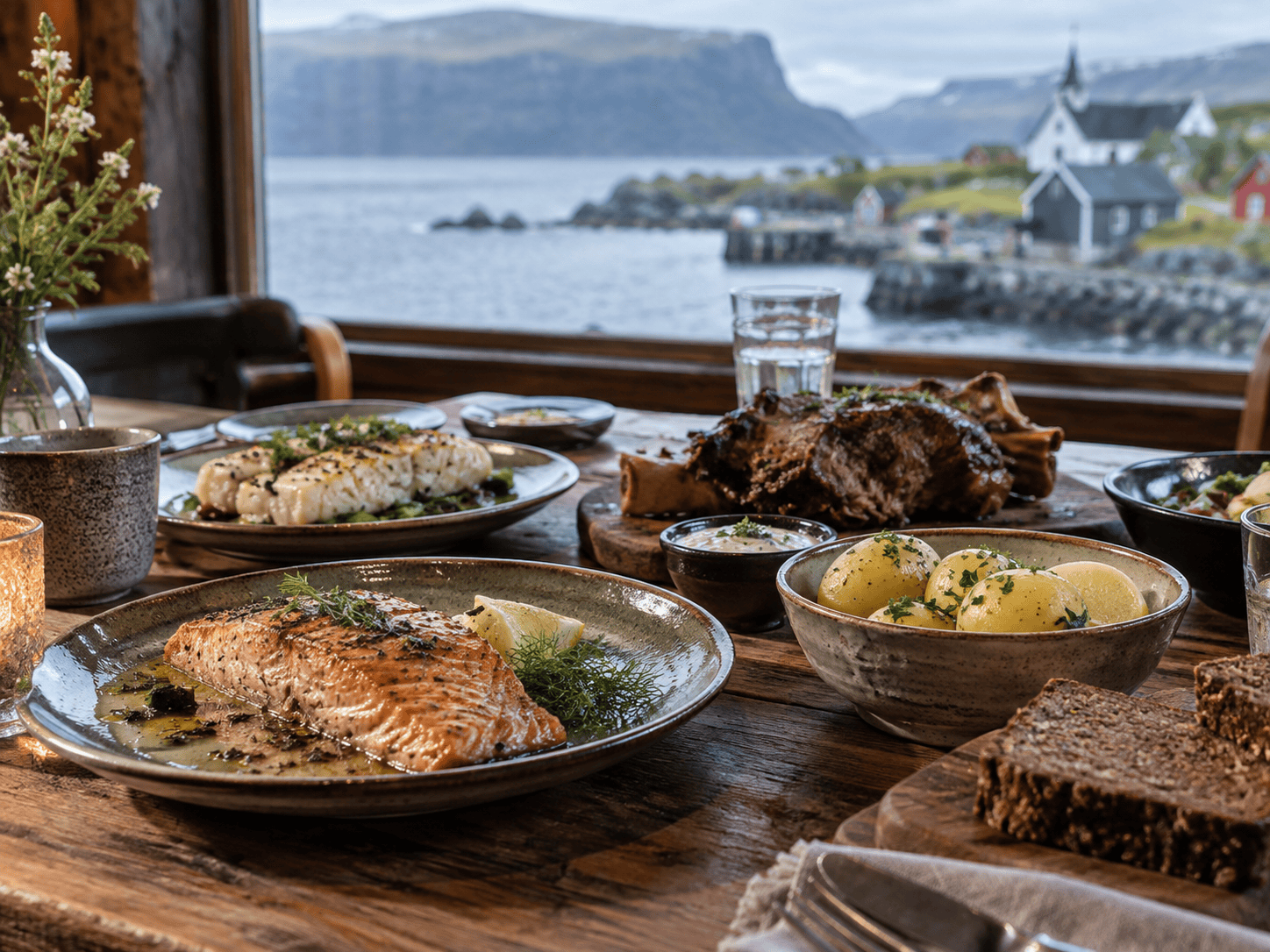
Skerpikjøt: wind-dried and fermented mutton.
Ræst kjøt: fermented lamb, traditionally cooked before serving.
Fresh seafood: cod, salmon and other North Atlantic seafood appear frequently.
Faroese lamb: one of the ingredients most strongly associated with local cuisine.
Local pastries and bakery products: an easier introduction if fermented flavours aren’t for you.
Traditional Faroese food can be powerful and unfamiliar, but that is precisely what makes it interesting from a culinary perspective.
Try Heimablídni
One experience deserves special attention: Heimablídni, meaning roughly “home hospitality.”
Instead of visiting a conventional restaurant, travellers are welcomed into a Faroese home for a meal and an opportunity to experience local food and conversation in a more personal setting.
For travellers interested in culture rather than simply sightseeing, this can be one of the most memorable parts of a Faroe Islands trip.
A 5-Day Faroe Islands Itinerary
Day 1 – Tórshavn
Explore Tinganes, á Reyni, the harbour and Skansin. End the day with Faroese food in the capital.
Day 2 – Vágar
Visit Sørvágsvatn and Trælanípa, followed by Bøur and Gásadalur for Múlafossur.
Day 3 – Northern Streymoy and Eysturoy
Combine Saksun, Tjørnuvík and Gjógv, allowing extra time for scenic stops.
Day 4 – Mykines or Vestmanna
Choose a birdwatching excursion to Mykines or a boat journey to the Vestmanna cliffs depending on weather and seasonal availability.
Day 5 – Kalsoy and Klaksvík
Travel north to Klaksvík before continuing toward Kalsoy and the dramatic scenery around Kallur.
If you have seven days, keep at least one additional flexible day rather than filling every morning and afternoon with fixed reservations.
Responsible Travel in the Faroe Islands
The spectacular landscapes travellers come to see are also working farmland, wildlife habitat and home to small communities.
Visitors should:
- Stay on designated paths
- Close gates behind them
- Keep away from nesting birds
- Avoid disturbing sheep
- Never approach cliff edges for photographs
- Respect private property
- Follow local hiking restrictions
- Avoid removing rocks, plants or other natural material
- Take rubbish away
- Change plans when the weather becomes unsafe
Official visitor guidance specifically emphasises staying on paths, respecting wildlife and remembering that these villages are people’s homes rather than tourist sets.
Why We Found It Interesting
What interested us most about the Faroe Islands was not one famous waterfall or one Instagram viewpoint.
It was the scale of the contrast.
A tiny village can sit beneath a mountain that looks impossibly large. A road can disappear into a dark tunnel and emerge minutes later beside another fjord. Grass grows across house roofs, waterfalls drop from cliffs into the Atlantic and some communities still rely on ferries to connect with neighbouring islands.
Yet the Faroe Islands do not feel like an empty wilderness created for visitors.
People live and work among these landscapes. Old village paths remain part of local history, traditional food is still shaped by the climate, and even the capital retains a remarkably intimate relationship with the sea.
Perhaps that is what makes the islands most interesting: the dramatic landscape has not replaced everyday life — everyday life has adapted to the dramatic landscape.
And unlike destinations where the goal is to race from one landmark to another, the Faroes almost force you to slow down.
Fog may hide the mountain you came to photograph. Wind may cancel the boat you planned to catch. A viewpoint may disappear behind clouds.
Then half an hour later, the sky opens.
For us, that unpredictability is not a flaw in the Faroe Islands experience.
It is part of the reason to go.
Practical Faroe Islands Travel Tips
The local currency is the Faroese króna, equal in value to the Danish krone. Danish currency is also accepted, and cards are widely used throughout the islands.
Faroese is the national language, Danish is also used officially, and English is widely spoken, so international visitors generally have little difficulty communicating.
Mobile coverage is extensive, but visitors should check roaming conditions carefully because the Faroe Islands may not be included in every European roaming package.
Do You Need a Visa for the Faroe Islands?
This point deserves attention because the rules can be misunderstood.
The Faroe Islands are outside the Schengen Area. A visa that permits entry to Denmark or another Schengen country does not automatically provide permission to enter the Faroe Islands when a Faroese visa is required. Travellers who require visas should ensure their documentation specifically covers the Faroe Islands.
Because requirements depend on nationality and can change, check the official immigration rules before booking your journey.
Is the Faroe Islands Expensive?
Travellers should expect costs closer to Nordic destinations than to budget European destinations.
Accommodation, restaurants, rental cars, tunnel charges and guided excursions can add up quickly.
You can control the budget by:
- Booking accommodation early
- Mixing restaurants with supermarket meals
- Using public transport for selected day trips
- Grouping nearby attractions into the same day
- Avoiding unnecessary daily car rental if staying mainly in Tórshavn
- Reserving only the excursions that truly add something to your trip
The Faroe Islands are better approached as a shorter, well-planned trip than as a destination where you try to do everything.
Frequently Asked Questions About the Faroe Islands
How many days do you need in the Faroe Islands?
Five to seven days is ideal for a first visit. Three or four days can work if you focus mainly on Vágar, Streymoy and nearby areas rather than trying to see the entire archipelago.
What is the best month to visit the Faroe Islands?
June, July and August offer long daylight hours and good access to hiking and excursions. May and September can be excellent alternatives for travellers who prefer fewer visitors.
Do you need a car in the Faroe Islands?
No, but a rental car provides considerably more flexibility. Public buses and ferries can still be used for many routes.
Can you see puffins in the Faroe Islands?
Yes. Mykines is particularly well known for puffins and other seabirds during the summer breeding season.
Is the Faroe Islands good for hiking?
Yes. Hiking is one of the main reasons to visit, but conditions can change quickly and some trails require fees, permission or guides. Always check current access and weather information before starting.
Is English spoken in the Faroe Islands?
Yes. Faroese is the national language, but English is widely spoken.
Are the Faroe Islands part of Denmark?
The Faroe Islands are a self-governing part of the Kingdom of Denmark, with their own government, parliament, language and many domestic responsibilities.
Final Thoughts
The Faroe Islands are not a destination that needs dozens of attractions to justify the journey.
A road beside a fjord, a small grass-roofed house beneath the mountains, a waterfall appearing through the mist or a quiet harbour can become the strongest memory of the trip.
For travellers drawn to wild landscapes, photography, hiking, Nordic culture and remote villages, the archipelago offers something increasingly difficult to find: a place where nature still determines the rhythm of the day.
Plan carefully, but don’t plan every minute.
In the Faroe Islands, the weather — and sometimes the island itself — may have a better idea.
Bir Cevap Yazın