

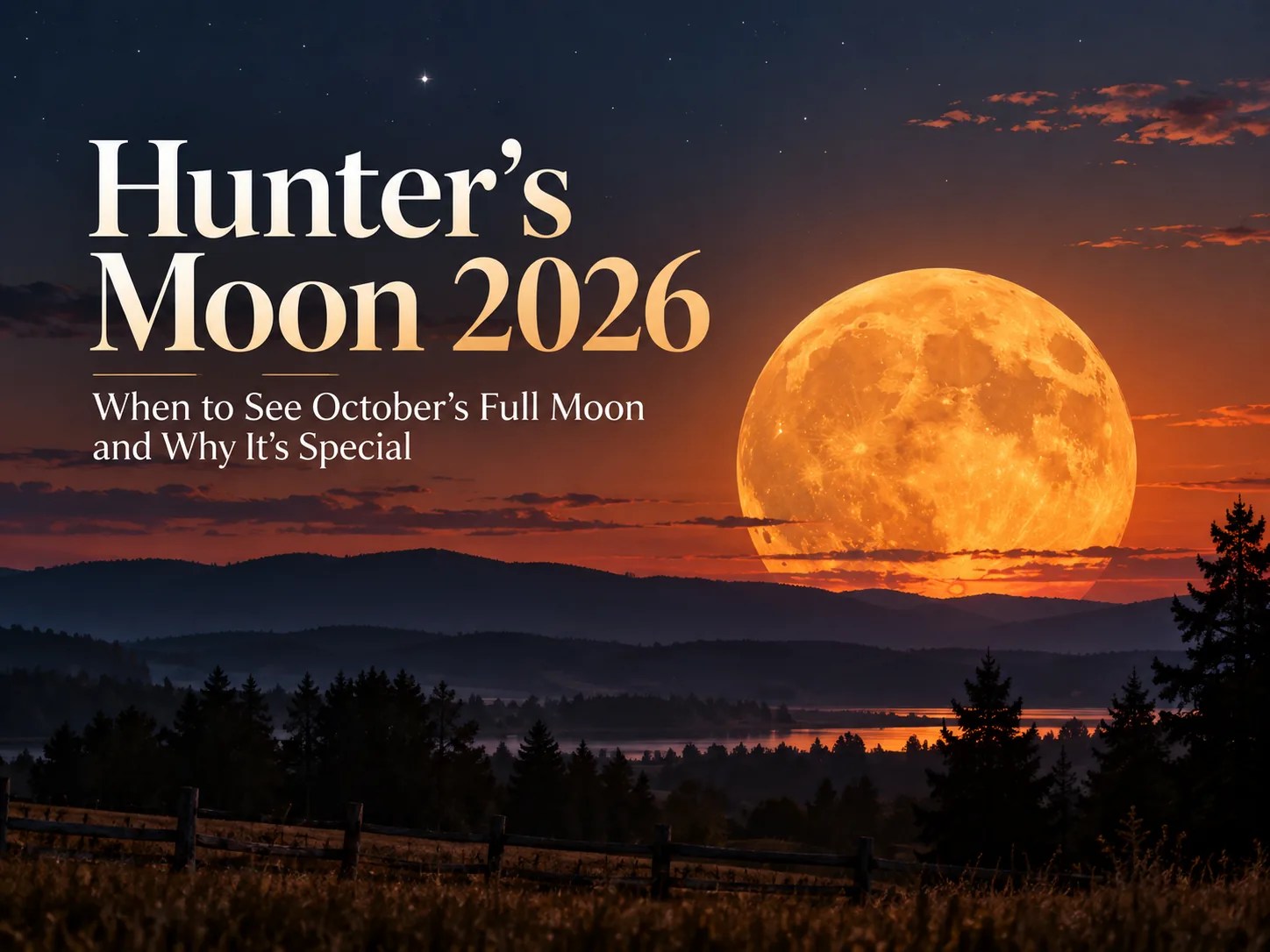
When is the Hunter’s Moon in 2026? The October full Moon arrives on Monday, October 26, 2026, at approximately 04:11 UTC. Also known as the Hunter’s Moon, this seasonal event will appear bright and nearly round on the evenings surrounding its exact full phase. You will not need a telescope to enjoy it—just a clear view of the sky.
For many observers, the most memorable moment will be moonrise near sunset, when the Moon may look unusually large and take on a warm golden or orange tint. That appearance is part of the excitement, but the name “Hunter’s Moon” does not mean the Moon physically changes color.
Hunter’s Moon 2026: Date and Exact Time
The full Moon is a specific astronomical instant: the Moon is nearly opposite the Sun as seen from Earth, so the hemisphere facing us is illuminated. The instant is the same worldwide, but the calendar date and clock time depend on your time zone. Some ephemerides differ by about a minute because of rounding and calculation conventions.
| Location | Full Moon time (local) |
|---|---|
| Coordinated Universal Time (UTC) | October 26, approximately 04:11 |
| New York (EDT) | October 26, approximately 12:11 a.m. |
| Los Angeles (PDT) | October 25, approximately 9:11 p.m. |
| London (GMT) | October 26, approximately 4:11 a.m. |
| Istanbul (TRT, UTC+3) | October 26, approximately 7:11 a.m. |
These are full-phase times, not moonrise times. Your best viewing time depends on local sunset, moonrise, weather and an unobstructed horizon. The Moon will appear almost fully illuminated on both October 25 and October 26.
Best Time to See the October 2026 Full Moon
A full Moon generally rises around sunset and remains visible through much of the night. If you want to photograph it beside buildings, hills or trees, watch for the first hour after your local moonrise. For detailed views of lunar surface features, binoculars are useful, although the strong, direct lighting at full Moon makes some craters appear less shadowed than at quarter phase.
- October 25: An excellent evening to look for a nearly full Moon rising, especially in the Americas, where the full-phase instant occurs late that night or shortly after midnight.
- October 26: The official full-Moon date; an excellent viewing evening in Europe, Türkiye and many other regions if skies are clear.
- Istanbul example: The Moon is predicted to rise at around 5:55 p.m. local time on October 26. Exact times vary by location and viewing conditions.
- Where to look: Choose an open eastern horizon for moonrise. The Moon moves across the sky overnight; a tall building or mountain can delay when you first see it.
Why Is It Called the Hunter’s Moon?
The Hunter’s Moon is a traditional Northern Hemisphere name for the full Moon following the Harvest Moon. The name is connected with autumn hunting and food preparation ahead of winter. As crops were gathered and fields became more open, bright evening moonlight could help people work and travel after sunset.
Moon names are cultural traditions rather than different kinds of astronomical objects. Not all cultures use the same names, and there is no special physical transformation that turns the October Moon into a “Hunter’s Moon.” In 2026, the Harvest Moon falls in September and the following October full Moon is the Hunter’s Moon.
Will the Hunter’s Moon Be Orange, Red or Extra Large?
It can look orange near the horizon, but it is not guaranteed to be orange. Moonlight passes through more of Earth’s atmosphere when the Moon is low. Shorter blue wavelengths are scattered more strongly, so the remaining light may appear yellower, orange or red. Dust, haze, smoke and atmospheric conditions can intensify that effect.
The apparent giant Moon at the horizon is also connected with the Moon illusion: human perception makes it seem larger near familiar foreground objects. According to NASA, the atmosphere does not magnify the Moon in the way people sometimes assume. The striking giant Moon in our cover is an artistic illustration, not a scientifically scaled photograph.
The Hunter’s Moon is not a lunar eclipse, and the traditional name is not evidence of a “blood moon.” Nor does October 26 qualify as a supermoon on commonly used 2026 calendars; the particularly close full Moons this year occur at other dates. The Moon can still make a spectacular sight without either event.
A Bonus Sky Event: The Moon Meets the Pleiades on October 27
There is another reason to keep watching the late-October sky. On October 27, 2026, the waning gibbous Moon will appear close to the Pleiades star cluster, also called the Seven Sisters, in the direction of the Taurus constellation. This is a sky-position pairing: the stars and Moon are only near each other from our point of view, not physically close in space.
The Moon’s glare may make the fainter Pleiades stars harder to distinguish. A pair of binoculars, a dark location and a clear sky may help. In Türkiye, TÜBİTAK notes that the pair will rise around 7 p.m. on October 27; precise times and positions vary worldwide.
How to Photograph the Hunter’s Moon With a Phone or Camera
- Plan ahead: Check local moonrise and the weather forecast; include a clear eastern horizon in your composition.
- Stabilize your device: Use a tripod or support and a short timer to reduce shake.
- Lower the exposure: A bright Moon often becomes a featureless white circle when a phone exposes for the dark sky.
- Include a foreground: A distant tree, ridge or skyline can give your image a memorable composition.
- Avoid digital zoom: Use an optical telephoto camera or lens if available and keep expectations realistic; the Moon is a small subject in a typical phone’s wide-angle frame.
- Try more than one evening: October 25 and 26 both offer almost full-looking lunar views.
Hunter’s Moon 2026: Quick Answers
Can I see the Hunter’s Moon without a telescope?
Yes. A full Moon is easily visible to the naked eye in clear conditions. Binoculars can reveal broad dark lunar plains and brighter highlands.
Is the Hunter’s Moon visible everywhere?
The full-Moon phase is global, but local viewing depends on whether the Moon is above the horizon, daylight, geography and weather. Countries do not all see moonrise at the same moment.
Is October’s Hunter’s Moon a lunar eclipse?
No. A lunar eclipse requires the Moon to pass through Earth’s shadow. That is not the event taking place on October 26, 2026.
Does the full Moon affect human behavior?
Popular folklore often links full Moons with changes in mood or behavior, but the name Hunter’s Moon is cultural, not a medical or psychological claim. Claims about human effects require separate, carefully designed scientific evidence.
The Bottom Line
Mark October 25–26, 2026 for the bright Hunter’s Moon, especially near moonrise, and keep an eye on the Moon–Pleiades pairing on October 27. The science is simple, the seasonal story is fascinating, and no special equipment is needed to enjoy one of October’s most beautiful sights.
Bir yanıt yazın