

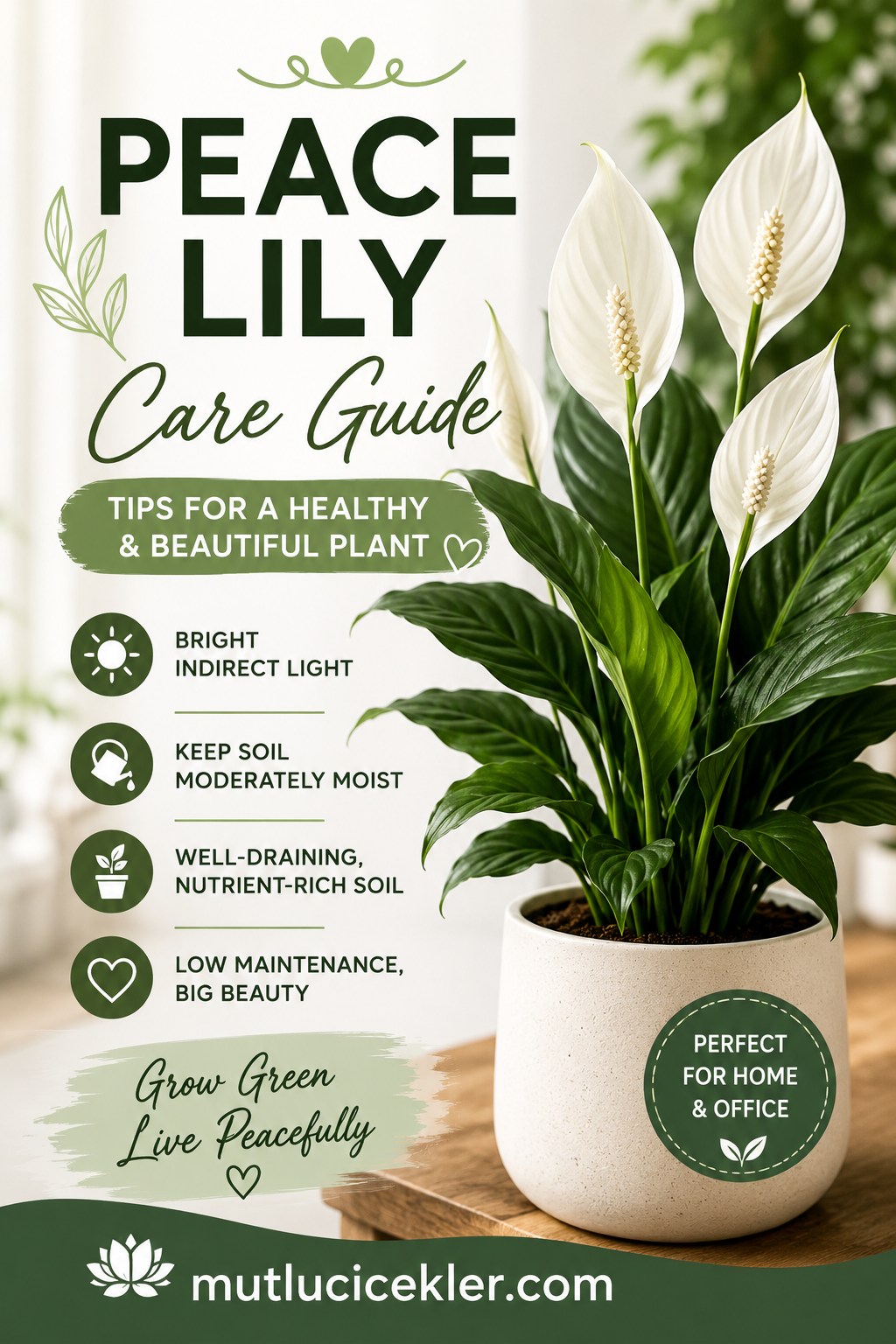
The Peace Lily (Spathiphyllum) is one of the most elegant and popular houseplants, loved for its glossy green leaves and graceful white blooms. Despite its delicate appearance, it is relatively easy to care for when its basic needs are understood.
Peace Lilies are especially popular as indoor plants because they adapt well to typical home environments and can tolerate lower light levels than many flowering houseplants.
However, there is an important difference between a Peace Lily simply surviving and truly thriving. Proper watering, suitable light, good drainage, humidity, and occasional feeding can make the difference between a plant that merely stays alive and one that produces lush foliage and beautiful flowers year after year.
Here is a complete guide to growing a healthy and beautiful Peace Lily indoors.
🌱 Peace Lily at a Glance
- Botanical name: Spathiphyllum spp.
- Common name: Peace Lily
- Family: Araceae
- Plant type: Tropical perennial
- Light: Bright, indirect light
- Water: Keep moderately moist but never waterlogged
- Soil: Rich, loose and well-draining
- Humidity: Moderate to high
- Flower color: White to creamy white, eventually turning green
- Difficulty: Easy to moderate
- Pet friendly: No
- Propagation: Division
Although commonly called a “lily,” the Peace Lily is not a true lily from the genus Lilium. It belongs to the Araceae family.
☀️ How Much Light Does a Peace Lily Need?
Peace Lilies tolerate lower-light environments, which has helped make them popular indoor plants.
However, bright, indirect light is generally best if you want healthy foliage and regular flowering.
Place your Peace Lily close to a bright window where it receives plenty of filtered light without being exposed to intense direct sunlight for long periods.
Strong direct sun can scorch the leaves and cause brown or faded areas.
🌤️ Can Peace Lilies Grow in Low Light?
Yes, but there is a catch.
A Peace Lily may remain alive and maintain attractive foliage in relatively low light, but flowering can become less frequent.
If your plant looks healthy but refuses to bloom, insufficient light should be one of the first things you investigate.
💧 How Often Should You Water a Peace Lily?
Unlike drought-tolerant plants such as Snake Plants, Peace Lilies prefer their soil to remain moderately and consistently moist.
However, they should never sit in soggy soil.
Instead of watering according to a strict calendar, check the soil.
When the upper layer begins to feel somewhat dry, it is usually time to water again.
💦 The Best Watering Method
- Check the top layer of soil with your finger.
- If it feels slightly dry, water thoroughly.
- Continue until excess water drains from the bottom of the pot.
- Allow the pot to drain completely.
- Empty any water collected in the saucer or decorative outer container.
Never leave the roots permanently standing in water.
⚠️ Don’t Rely Only on Drooping
Peace Lilies are famous for dramatically drooping when they become thirsty.
Although they often recover quickly after watering, repeatedly allowing the plant to wilt severely is not an ideal long-term watering strategy.
Check the soil rather than waiting for the plant to collapse.
🪴 Best Soil for Peace Lilies
Peace Lilies appreciate a potting mixture that retains some moisture while still allowing excess water to drain.
A quality indoor potting mix rich in organic matter works well.
The soil should be:
- Loose
- Nutrient-rich
- Moisture-retentive without becoming waterlogged
- Well-draining
- Well-aerated
Adding materials such as perlite can improve drainage and reduce the risk of compacted, constantly wet soil.
🏺 Choosing the Right Pot
A drainage hole is essential.
Decorative containers without drainage can trap water around the roots and greatly increase the risk of root problems.
Peace Lilies do not need enormous pots.
When repotting, move the plant into a container only slightly larger than its current one.
🌱 When Should You Repot a Peace Lily?
Consider repotting when:
- Roots are tightly filling the container.
- Water runs through unusually quickly.
- The plant requires watering much more frequently than before.
- Roots emerge through drainage holes.
- Growth has slowed despite otherwise good conditions.
- The potting mixture has become compacted or degraded.
Repotting is usually best done during the active growing period.
💦 Does a Peace Lily Need High Humidity?
Peace Lilies originate from tropical environments and generally appreciate moderate to higher humidity.
They can adapt to ordinary household humidity, but extremely dry indoor air may contribute to brown leaf edges or tips.
You can support humidity by:
- Keeping the plant away from heating vents.
- Avoiding strong air-conditioning drafts.
- Grouping compatible houseplants together.
- Using a humidifier when indoor air is extremely dry.
Good airflow is also important, so avoid creating permanently stagnant, excessively humid conditions.
🌡️ Best Temperature for Peace Lilies
Peace Lilies prefer warm, stable indoor temperatures.
Protect them from:
- Cold drafts
- Frost
- Sudden temperature changes
- Air-conditioning vents
- Very cold windows during winter
- Direct heat from radiators or heaters
If you feel comfortable in the room and the plant is protected from temperature extremes, your Peace Lily will usually be comfortable too.
🌿 How to Fertilize a Peace Lily
Peace Lilies benefit from occasional feeding during periods of active growth, but more fertilizer is not always better.
Excess fertilizer can contribute to salt buildup in the soil and may damage roots or cause brown leaf tips.
Use a balanced houseplant fertilizer at a diluted strength during the growing season.
Reduce or stop fertilizing during periods when growth has significantly slowed.
⚠️ Fertilizer Tip
If you notice crusty deposits on the soil or pot and you fertilize frequently, excess mineral salts may be accumulating.
Avoid trying to force flowers by dramatically increasing fertilizer.
🌸 How to Make a Peace Lily Bloom
The beautiful white structures commonly called Peace Lily “flowers” are actually composed of a central spadix surrounded by a modified leaf called a spathe.
Healthy Peace Lilies can flower repeatedly under suitable conditions.
If your Peace Lily refuses to bloom, consider:
☀️ Insufficient Light
This is one of the most common reasons.
Move the plant gradually to a brighter location with indirect light.
🌿 Plant Maturity
Very young or recently divided plants may need time before flowering reliably.
🌱 Nutrient Problems
A plant that has remained in depleted soil for a very long time may benefit from appropriate feeding.
🌡️ Environmental Stress
Cold temperatures, poor roots, severe watering fluctuations or other stress can interfere with flowering.
🌼 Why Are Peace Lily Flowers Turning Green?
Don’t panic.
Peace Lily blooms naturally change as they age.
The white spathe can gradually develop a green coloration before eventually fading.
This is part of the flower’s natural life cycle and does not necessarily mean something is wrong with your plant.
Once a bloom has become old and unattractive, you can remove the entire flower stalk near its base using clean pruning tools.
💛 Why Are My Peace Lily Leaves Turning Yellow?
A single older leaf occasionally turning yellow can simply be part of the plant’s natural aging process.
However, widespread yellowing deserves attention.
Possible causes include:
- Overwatering
- Poor drainage
- Root stress
- Insufficient light
- Environmental stress
- Natural aging
- Nutrient problems
Start by checking the soil.
If it remains constantly wet and several leaves are yellowing simultaneously, overwatering or poor drainage becomes a strong possibility.
🤎 Why Does My Peace Lily Have Brown Tips?
Brown leaf tips are another common Peace Lily complaint.
Possible causes include:
- Very dry indoor air
- Inconsistent watering
- Allowing the plant to become excessively dry
- Excess fertilizer
- Mineral or salt accumulation
- Environmental stress
- Too much direct sunlight
Do not automatically assume that brown tips mean the plant needs more water.
Check the entire growing environment first.
🥀 Why Is My Peace Lily Drooping?
Peace Lilies are famous for their dramatic drooping.
Dry soil is a common reason, but drooping does not always mean “add water.”
A Peace Lily can also wilt because roots have been damaged by excessive moisture.
Before watering, touch the soil.
If the soil is dry:
Water the plant thoroughly and allow excess water to drain.
If the soil is already very wet:
Do not add more water. Check drainage and consider whether the roots may be stressed.
This simple check can prevent accidental overwatering.
🦠 Root Rot in Peace Lilies
Root problems typically develop when the growing medium remains waterlogged for extended periods.
Possible warning signs include:
- Persistent yellow leaves
- Severe drooping despite wet soil
- Soft or dark roots
- Unpleasant smell from the potting mixture
- Slow or declining growth
If you suspect root rot, carefully remove the plant from its pot and inspect the roots.
Healthy roots should generally feel firm.
Remove severely damaged roots with clean tools and repot the healthy portion into fresh, well-draining soil.
Then adjust your watering routine.
✂️ How to Prune a Peace Lily
Peace Lilies do not require complicated pruning.
Remove:
- Completely yellow leaves
- Dead leaves
- Severely damaged foliage
- Spent flower stalks
Cut unwanted leaves or flower stalks close to the base using clean scissors or pruning shears.
Avoid removing large amounts of healthy green foliage unnecessarily.
🌱 How to Propagate a Peace Lily
The easiest and most reliable way to propagate Peace Lilies is division.
Unlike some houseplants, Peace Lilies are not normally propagated from ordinary leaf cuttings.
🌿 Propagation by Division
- Carefully remove the mature plant from its container.
- Gently loosen the root ball.
- Identify natural sections or crowns with their own roots.
- Separate them carefully.
- Plant each division into an appropriately sized container.
- Water lightly and keep the divisions in bright, indirect light while they establish.
Division is particularly convenient when repotting an overcrowded mature plant.
🧹 Should You Clean Peace Lily Leaves?
Yes.
Their large glossy leaves easily collect household dust.
Gently wipe each leaf with a soft, damp cloth from time to time.
This keeps the plant attractive and gives you an opportunity to inspect for pests.
There is usually no need to apply commercial leaf-shine products.
🐛 Common Peace Lily Pests
Peace Lilies are relatively resilient, but indoor plants can occasionally attract pests.
Watch for:
- Mealybugs
- Spider mites
- Scale insects
Inspect the undersides of leaves and the points where leaves emerge from the base.
Early detection makes pest problems much easier to manage.
🐾 Is Peace Lily Toxic to Cats and Dogs?
Yes.
Peace Lilies contain insoluble calcium oxalate crystals and should not be considered pet-safe.
If chewed, the crystals can irritate the mouth and digestive tract.
Possible symptoms in cats and dogs include:
- Oral irritation
- Drooling
- Pawing at the mouth
- Vomiting
- Difficulty swallowing
⚠️ Important Distinction
Despite its common name, Peace Lily is not a true lily.
True lilies belonging to Lilium and Hemerocallis can cause severe, potentially fatal kidney injury in cats.
Peace Lily (Spathiphyllum) has a different toxicity mechanism involving calcium oxalate crystals.
Nevertheless, it should still be kept away from pets and small children.
If your pet chews a Peace Lily and develops symptoms, contact a veterinarian or animal poison-control service.
🌬️ Does Peace Lily Really Purify Indoor Air?
Peace Lilies are frequently included on lists of “air-purifying houseplants.”
This idea largely comes from controlled laboratory research showing that plants can interact with certain airborne compounds.
However, conditions inside an ordinary home are very different from controlled experimental chambers.
A few potted Peace Lilies should therefore not be considered substitutes for proper ventilation or dedicated air-filtration systems.
Enjoy Peace Lilies primarily for their beautiful foliage, elegant flowers and decorative value.
❌ Common Peace Lily Care Mistakes
Avoiding a few common mistakes can dramatically improve the health of your plant:
- Watering on a rigid schedule without checking the soil
- Leaving the pot standing in water
- Using containers without drainage holes
- Exposing the plant to strong direct sunlight
- Keeping it in extremely dark conditions
- Overfertilizing
- Allowing severe wilting repeatedly
- Placing it directly beside heaters or air-conditioning vents
- Assuming every yellow leaf means the plant needs fertilizer
- Assuming every drooping plant needs more water
The key is balance rather than constant intervention.
🏠 Is Peace Lily Good for Beginners?
Yes.
Peace Lilies are generally beginner-friendly once their watering needs are understood.
They are particularly attractive for:
- Living rooms
- Bedrooms
- Offices
- Apartments
- Sheltered indoor spaces
- People who enjoy flowering houseplants
Their combination of glossy foliage and elegant white blooms makes them attractive even when they are not flowering.
❓ Frequently Asked Questions About Peace Lily Care
How often should I water a Peace Lily?
Do not rely on a fixed weekly schedule. Check the soil and water when the upper layer begins to feel somewhat dry. The exact frequency changes according to temperature, light, humidity, pot size and season.
Can Peace Lilies grow in low light?
Yes, they tolerate relatively low light. However, bright indirect light generally encourages healthier growth and better flowering.
Why isn’t my Peace Lily flowering?
Insufficient light is a common reason. Plant maturity, nutrition and environmental stress can also influence flowering.
Should I mist my Peace Lily?
Peace Lilies appreciate humidity, but misting is not essential. Maintaining appropriate overall humidity and good airflow is more important.
Why does my Peace Lily droop?
Dry soil is a common cause, but root problems from excessive moisture can also produce wilting. Always check the soil before watering.
Can I propagate Peace Lily from a leaf?
Division is the preferred method. Mature plants naturally form sections that can be separated with their roots attached.
Are Peace Lilies toxic to cats?
Yes. Peace Lilies contain insoluble calcium oxalate crystals and can cause painful mouth irritation, drooling, vomiting and difficulty swallowing if chewed.
Is Peace Lily a true lily?
No. Peace Lily belongs to the genus Spathiphyllum and the Araceae family. It is different from true lilies in the genus Lilium.
Why are Peace Lily flowers turning green?
This can occur naturally as the spathe ages. Older blooms often gradually change from white to green before declining.
Should I cut off dead Peace Lily flowers?
Yes. Once a flower has faded, its stalk can be cut near the base with clean pruning tools.
🌿 Final Thoughts
The Peace Lily (Spathiphyllum) is a beautiful indoor plant that combines lush tropical foliage with elegant white blooms.
Its care is not difficult once you understand its most important requirements: bright indirect light, consistently but moderately moist soil, good drainage, warm conditions and sensible fertilization.
Pay particular attention to watering. Peace Lilies enjoy more moisture than drought-tolerant houseplants, but constantly saturated soil can still damage their roots.
Learn to check the soil rather than relying entirely on a calendar or waiting for dramatic wilting.
With the right balance of light, moisture and care, your Peace Lily can remain a beautiful part of your indoor plant collection for many years. 🌿
For more practical houseplant care guides, growing tips and plant inspiration, keep exploring mutlucicekler.com.


Bir yanıt yazın