

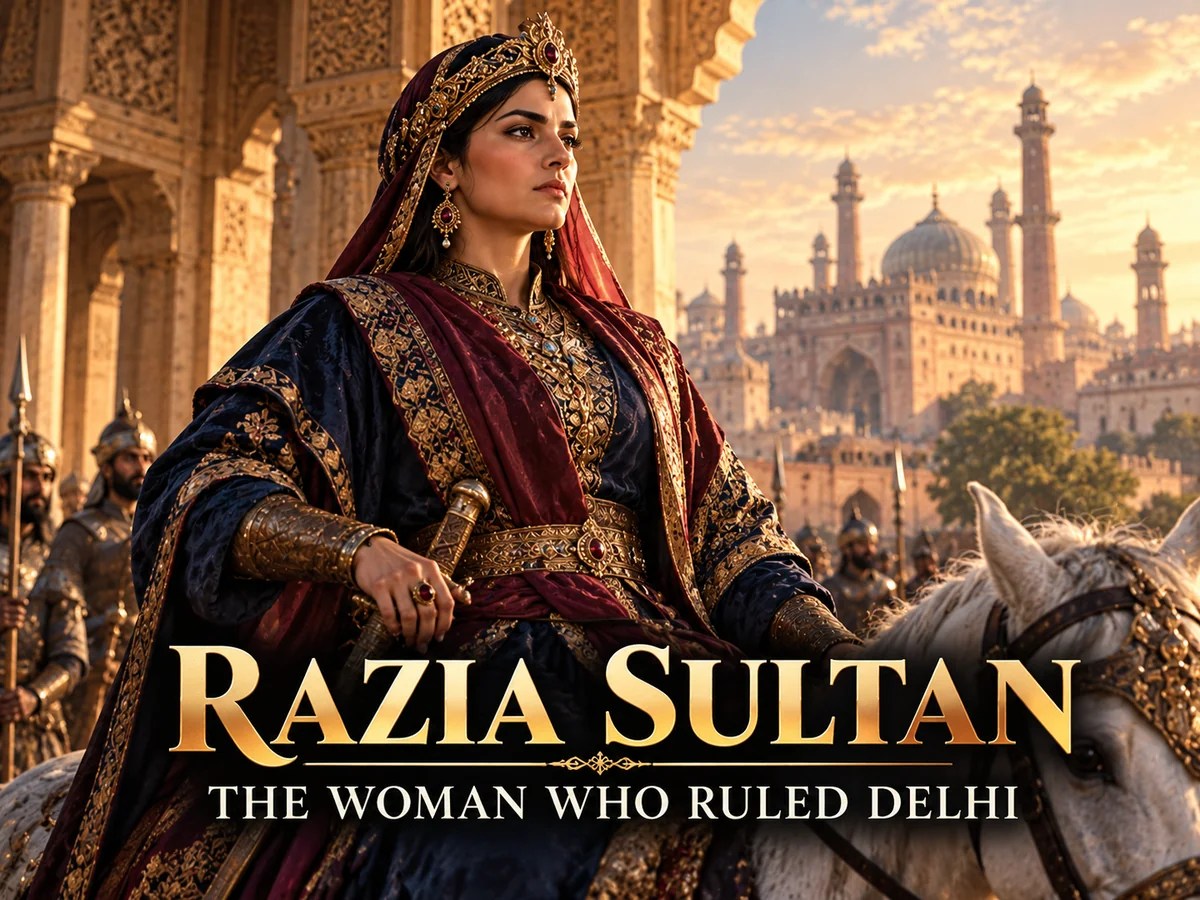
Razia Sultan—also known as Razia Begum, Raziya, or Raziyya—ruled the Delhi Sultanate from 1236 to 1240. She remains its first and only female sovereign. Her reign took place in a turbulent medieval state where military commanders, provincial governors, and court aristocrats competed for power. Her story is therefore not simply a tale of a woman breaking a barrier: it is a remarkable chapter in the political history of northern India.
Chosen as a possible successor by her father, Sultan Shams ud-Din Iltutmish, Razia eventually took the throne after a succession crisis. She tried to exercise royal authority in her own right, but faced resistance from influential Turkic nobles. The struggles that followed culminated in her defeat and death in 1240. This updated guide separates documented events from later legends, including popular claims about her relationships, reforms, and poetry.
Razia Sultan at a glance
- Full name: Commonly Razia Sultan or Razia Begum; also recorded as Radiyya or Raziyya.
- Dynasty: The early Mamluk, or Slave, dynasty of the Delhi Sultanate.
- Father: Shams ud-Din Iltutmish, a major consolidator of the Delhi Sultanate.
- Reign: 1236–1240.
- Historical distinction: The first and only woman to rule the Delhi Sultanate as sovereign.
- Death: October 1240, associated with the Kaithal region in present-day Haryana, India.
Who was Razia Sultan? Early life and education
Razia was born into Iltutmish’s royal household. Her exact birth date is not firmly documented, although around 1205 is often given in later accounts. Medieval and modern historians describe her as an educated, politically perceptive daughter who acquired experience of court life and administration. Detailed records of her childhood are scarce, so claims about a precisely reconstructed early life should be treated with care.
The Delhi Sultanate had developed from the conquests of the late twelfth and early thirteenth centuries. Qutb ud-Din Aibak established an independent sultanate in 1206, while Iltutmish subsequently strengthened its institutions and authority. It would be misleading to credit Razia’s father with founding every part of the state from scratch; his importance lies especially in its consolidation.
In 1231, when Iltutmish went on a campaign toward Gwalior, he entrusted the administration of Delhi to Razia. After seeing her capabilities, he reportedly nominated her as his successor despite having surviving sons. This decision was exceptional, but it did not guarantee an uncontested accession: powerful officers and nobles still influenced succession.
How did Razia become ruler in 1236?
When Iltutmish died in 1236, leading figures at court supported his son Rukn ud-Din Firuz Shah instead of Razia. Rukn ud-Din’s lack of interest in administration and the growing influence of his mother, Shah Turkan, helped spark unrest. Political opposition in Delhi grew, and support from the capital and part of the military enabled Razia to ascend the throne later that year.
Razia did not merely govern as a queen consort or regent. She occupied the sovereign’s position and acted with royal authority. Historical sources record her use of the title malika (queen or female ruler), while her coinage carried imperial titles that expressed her legitimacy. The familiar English name “Razia Sultana” should not obscure the key point: she ruled the Delhi Sultanate in her own right.
Razia Sultan’s reign: Government, military power, and court politics
Her reign was not an uninterrupted golden age. She inherited serious tensions among court officers and provincial elites, and revolts occupied much of her time. In March 1237, a violent movement associated with the Qarmatians caused bloodshed in Delhi before it was suppressed. Razia also faced opposition from former senior officials, including the vizier Nizam al-Mulk Junaidi.
Razia sought to restore order, continue elements of Iltutmish’s administration, and appoint officials she trusted. She also responded to challenges in provincial territories, including Gwalior in 1238 and the governor of Lahore in 1239. These episodes show that she was an active ruler, not a ceremonial figure.
Stories often credit her with sweeping modern-style women’s rights laws, large-scale commercial reforms, and an unprecedented programme of religious equality. Such claims are not securely demonstrated by the surviving evidence. Her documented achievement was the more demanding task of trying to exercise central authority while surrounded by rival military elites.
Why did Turkic nobles oppose her? The role of Jamal ud-Din Yaqut
The Sultanate’s powerful Turkic military aristocracy possessed considerable influence over appointments, territory, and the army. Razia tried to preserve her independence from this circle by promoting officers who could support her position. One important figure was Jamal ud-Din Yaqut, an officer of Abyssinian or Habshi origin who became amir-i akhur, a high-ranking official responsible for the royal stables.
Yaqut’s elevation upset some commanders. Gender bias undoubtedly shaped the criticism Razia faced, but the conflict was also about patronage, military rank, and who would control the throne. Popular retellings sometimes present Yaqut and Razia as lovers; the surviving accounts do not establish the nature of their personal relationship with certainty. A dramatic romance is not a substitute for historical proof.
The rebellion of Altunia and Razia’s fall in 1240
In 1240, Ikhtiyar ud-Din Altunia, governor of Tabarhinda (usually associated with the Bathinda region), rose against Razia. She marched to confront the rebellion, but her position deteriorated quickly. Yaqut was killed by hostile commanders, and Razia was captured and imprisoned at Tabarhinda.
When news reached Delhi, the opposition installed another son of Iltutmish, Muiz ud-Din Bahram Shah, on the throne. Razia later married Altunia, and the two formed an alliance to reclaim Delhi. Their attempt failed against Bahram Shah’s forces, even after they gathered supporters opposed to the new regime.
How and when did Razia Sultan die?
Razia and Altunia were defeated during the campaigns around Kaithal in October 1240. The TDV Encyclopaedia of Islam and the Turkish literary reference work TEİS give 14 October 1240 as the date of their deaths. Accounts of exactly how they were killed differ: some describe capture and execution, while later traditions tell of an attack during their flight. The precise circumstances should therefore be described as contested rather than certain.
The end of Razia’s reign came only about four years after her accession. Nevertheless, this short rule has attracted sustained attention because of the unusually clear intersection of succession politics, gender, court opposition, and the central government’s struggle for control.
Was Razia Sultan also a poet?
Literary scholarship attributes Persian verses to Razia under the pen names Shirin-i Dihlavi (Dehlavi) and Shirin-i Ghuri. The Türk Edebiyatı İsimler Sözlüğü, in an entry by Prof. Fatma Sabiha Kutlar Oğuz, discusses verses associated with her and notes that a claimed collected divan has not been located as a verifiable surviving manuscript. It would therefore be inaccurate to say that all of Razia’s poetry survives or that every poem circulating online was written by her.
A Persian couplet attributed to Razia
Der-dehân-ı hod dârem andelîb-i hoş-elhân
Pîş-i men sohan-gûyan zâg der-dehen dârend
Approximate English sense: The speaker compares her own eloquence to the melodious voice of a nightingale, while likening the speech of rival poets to the call of a crow. This is an editorial paraphrase of a couplet preserved in literary studies, not evidence that every modern poem published under her name is authentic.
The well-known modern English verse beginning “My name rises to the sky” has no demonstrated medieval attribution in the historical and literary references used for this article. For that reason, it is not reproduced as a genuine poem by Razia.
Where is Razia Sultan buried?
Two locations figure prominently in the traditions surrounding her grave: a burial site near Turkman Gate in Old Delhi and a site in Kaithal, Haryana. Delhi’s tourism materials acknowledge the local Delhi attribution, while the Haryana government’s tourism department describes a tomb associated with Razia near Kaithal.
Haryana Tourism explains that the surviving structure at Kaithal is later than Razia’s lifetime, probably from the late sixteenth century. The existence of competing traditions means that a claimed memorial should not automatically be presented as a conclusively identified thirteenth-century tomb.
Why Razia Sultan matters in Indian history
Razia’s significance goes beyond the simple phrase “first woman ruler.” She was not the first woman ever to exercise power anywhere in the Indian subcontinent; rather, she was the first and only woman to occupy the throne of the Delhi Sultanate as sovereign. Her career reveals both the possibilities and severe limits of female political authority in a thirteenth-century military monarchy.
Her reputation should be understood without imposing present-day reforms on medieval evidence. The documented story is already exceptional: a ruler selected for ability by her father, accepted in a moment of crisis, and determined to direct the government despite formidable opposition. That combination makes Razia an essential figure in the history of medieval India and the Delhi Sultanate.
Timeline: Major events in Razia Sultan’s life
- 1231: Iltutmish entrusts Razia with Delhi’s administration during his Gwalior campaign.
- 1236: Iltutmish dies; Rukn ud-Din Firuz Shah briefly rules before Razia takes the throne.
- 1237: Razia faces and suppresses a serious uprising in Delhi.
- 1238–1239: Military and political challenges emerge in Gwalior and Lahore.
- April 1240: Altunia rebels; Yaqut is killed and Razia is imprisoned.
- October 1240: Razia and Altunia lose the attempt to recover the throne and are killed.
Frequently asked questions
Was Razia Sultan the first female ruler of India?
She was the first and only woman to reign over the Delhi Sultanate as sovereign. Calling her the first female ruler of all India is too broad: other women had exercised royal power in different regions and periods.
Who succeeded Razia Sultan?
After she was deposed in 1240, her half-brother Muiz ud-Din Bahram Shah was installed as ruler in Delhi.
Was Jamal ud-Din Yaqut Razia’s husband?
No reliable account establishes Yaqut as her husband. She married Altunia after he had initially opposed and imprisoned her.
Sources and editorial note
The article was reviewed and substantially expanded on 18 October 2026. Its historical claims are based on specialist historical and literary studies. Where medieval chronicles disagree or later traditions are unverified, those uncertainties have been identified rather than presented as settled facts.
- Cengiz Tomar, “Radiyye Begüm,” TDV Encyclopaedia of Islam — succession, court politics, reign, and death.
- Patit Paban Mishra, “Razia Sultan,” World History Encyclopedia (2025) — accessible historical overview.
- Fatma Sabiha Kutlar Oğuz, “Şîrîn,” Türk Edebiyatı İsimler Sözlüğü — Persian verse attribution and biography.
- Haryana Tourism, “Tomb of Razia Sultan” — the Kaithal memorial.
- Delhi Tourism, “Mehrauli” — the Delhi burial tradition.
Also available in Turkish: Raziye Begüm Kimdir? Delhi Sultanlığı’nın İlk ve Tek Kadın Hükümdarı.

Bir yanıt yazın