
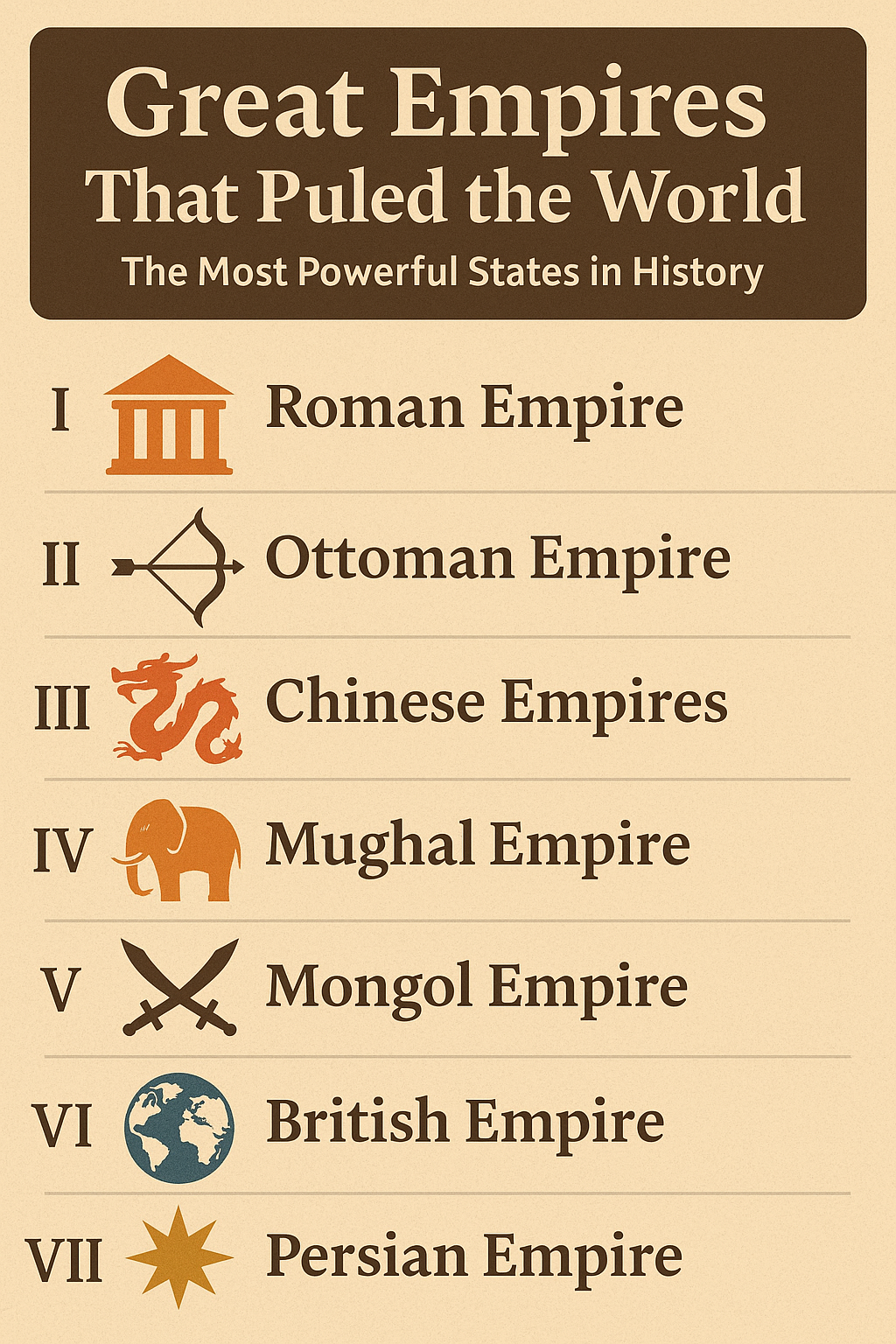
Throughout human history, countless empires have risen across different regions, leaving deep marks on civilization. These empires shaped the world not only with their military strength but also through their cultural heritage, trade networks, and political systems. Let’s take a closer look at the greatest empires that defined history.
🏛 1. Roman Empire
The Roman Empire was one of the most powerful empires of the ancient world. Stretching across Europe, Africa, and Asia, it left a lasting legacy in law, architecture, and governance. The Colosseum, aqueducts, and road systems symbolize its role in advancing civilization.
🏹 2. Ottoman Empire
From 1299 to 1922, the Ottoman Empire was one of the longest-lasting empires in world history, ruling lands across three continents. With the conquest of Constantinople, it marked the end of one era and the beginning of another, leaving behind great contributions in culture, art, science, and architecture.
🐉 3. Chinese Empires
The Qin, Han, Tang, and Ming dynasties formed the backbone of China’s long imperial tradition. With inventions such as paper, gunpowder, and the compass, China influenced the entire world. The Silk Road made it a central hub of global trade.
🐘 4. Mughal Empire
Founded by Babur, the Mughal Empire in India created a magnificent blend of culture and architecture. The Taj Mahal remains one of the most iconic monuments of this era. It is notable for blending Islamic and Hindu traditions.
⚔️ 5. Mongol Empire
Led by Genghis Khan, the Mongol Empire became the largest contiguous land empire in history. With its disciplined cavalry and swift military strategies, it stretched from Asia into Europe, creating a massive impact on world history.
🌐 6. British Empire
Known as “the empire on which the sun never sets,” the British Empire was the largest colonial empire in history. Spanning the Americas, Asia, Africa, and Oceania, it played a key role in shaping the modern world.
🌟 7. Persian Empire
The Achaemenid Persian Empire united East and West with its powerful rule. Through the Royal Road, trade and communication flourished. Known for its tolerance and administrative systems, it managed to hold together many different peoples under one authority.
🔮 Conclusion
The great empires of the world shaped humanity not only through warfare but also by contributing to culture, science, architecture, and governance. Even today, we can trace their influence in modern states and global systems.
❓ Frequently Asked Questions (FAQ)
1. What was the largest empire in history?
📌 The Mongol Empire, in terms of land mass, was the largest.
2. Which empire lasted the longest?
📌 The Ottoman Empire lasted for around 600 years.
3. Which empire stood out for inventions and science?
📌 The Chinese Empires, with their inventions like paper, gunpowder, and the compass.
4. Why was the British Empire called “the empire on which the sun never sets”?
📌 Because its colonies were spread across the globe, ensuring that the sun was always shining on at least one part of its territory.
5. How did empires shape the modern world?
📌 Through law, governance, trade, architecture, and cultural exchanges, they laid the foundation for today’s civilizations.
👉 Which empire do you think was the most fascinating? Share your thoughts in the comments.
📌 Follow us for more history and culture articles!












Bir Cevap Yazın