
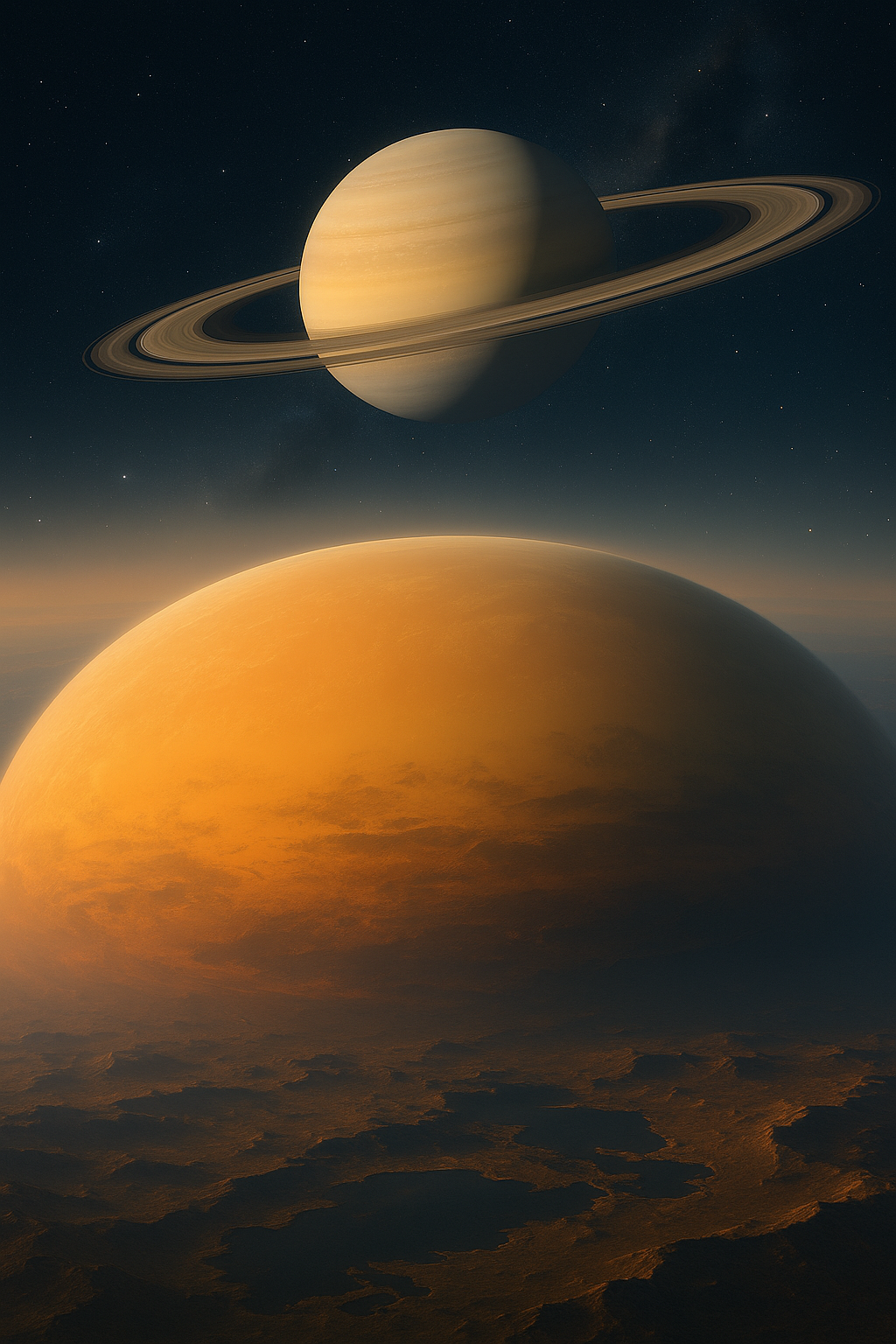
Deep within our Solar System, orbiting the gas giant Saturn, lies a hazy orange world — Titan. It’s one of the most intriguing celestial bodies ever discovered, and for decades scientists have been asking the same question:
👉 “Could there really be life on Titan?”
In this article, we’ll explore everything about Titan — from its atmosphere to its icy surface — and dive into what makes this distant moon one of the top contenders in the search for extraterrestrial life.
🌑 What Is Titan?
Titan is Saturn’s largest moon and the only natural satellite in our Solar System known to have a thick atmosphere.
🔹 It measures about 5,150 kilometers in diameter, making it nearly as big as Mars.
🔹 It was discovered in 1655 by Christiaan Huygens.
🔹 Titan’s surface is completely shrouded by a dense orange haze, hiding it from direct view.
🌫️ Titan’s Unique Atmosphere
Titan’s atmosphere is made primarily of nitrogen and methane, a composition surprisingly similar to that of early Earth billions of years ago.
On Titan, however, things work differently:
- It rains methane and ethane, not water.
- Rivers, lakes, and seas are filled with liquid methane.
- The planet has a methane cycle, just like Earth’s water cycle!
This fascinating feature makes Titan both alien and oddly familiar.

🧬 Could There Be Life on Titan?
Scientists believe Titan has several characteristics that make it a promising candidate for life:
- A thick atmosphere that protects it from cosmic radiation.
- Organic molecules — the building blocks of life — have been detected there.
- Evidence suggests subsurface oceans might exist beneath Titan’s icy crust.
The biggest challenge?
💧 The surface temperature is around –179°C (–290°F) — far too cold for liquid water to exist on the surface.
But some scientists propose that methane-based life could thrive there, in ways very different from life on Earth.
🚀 Scientific Missions and Discoveries
Cassini–Huygens Mission (2004–2017)
NASA and the European Space Agency joined forces for one of the most iconic missions in space history.
🛰️ The Cassini orbiter studied Titan’s atmosphere and surface from orbit, while
🪂 The Huygens probe made a historic landing on Titan’s surface in 2005.
Their findings were astonishing:
- Titan has rivers, lakes, and valleys.
- Complex organic compounds exist in its atmosphere.
- Chemically, it’s one of the most Earth-like places ever found in space.
🌊 The Hidden Ocean Beneath the Ice
Radar and gravitational data suggest that under Titan’s thick icy crust lies an ammonia-water ocean.
This is crucial because — as scientists say —
“Where there’s liquid, there might be life.” 🌍
Titan may not have oceans like Earth’s, but its underground seas could be home to microbial life adapted to extreme environments.

🧠 NASA’s Next Big Hope: The Dragonfly Mission
NASA’s Dragonfly Mission, set to launch in 2027, will explore Titan like never before.
This drone-like spacecraft will:
- Analyze Titan’s surface chemistry,
- Search for signs of microbial life,
- Study how its atmosphere and surface interact.
It’s one of the most ambitious missions in the search for alien life — and could change how we view habitability in the universe.
🌠 Conclusion
Titan is a world of methane lakes, icy landscapes, and golden-orange skies.
It’s harsh and distant — yet it holds clues that could answer one of humanity’s oldest questions:
“Are we alone?”
We can’t yet confirm life exists there, but Titan offers all the right ingredients. And maybe, someday soon, it will become the first place beyond Earth where we find proof that life exists elsewhere in the cosmos. 🚀
❓ FAQ: Frequently Asked Questions
1. Is there water on Titan?
Yes — frozen on the surface and possibly in liquid form beneath its icy shell.
2. Can humans visit Titan?
Not yet. But future missions like NASA’s Dragonfly will bring us closer to that goal.
3. Why is Titan so special?
Because it contains both water and organic compounds — the two key ingredients for life.
Bir Cevap Yazın