

✅ Introduction
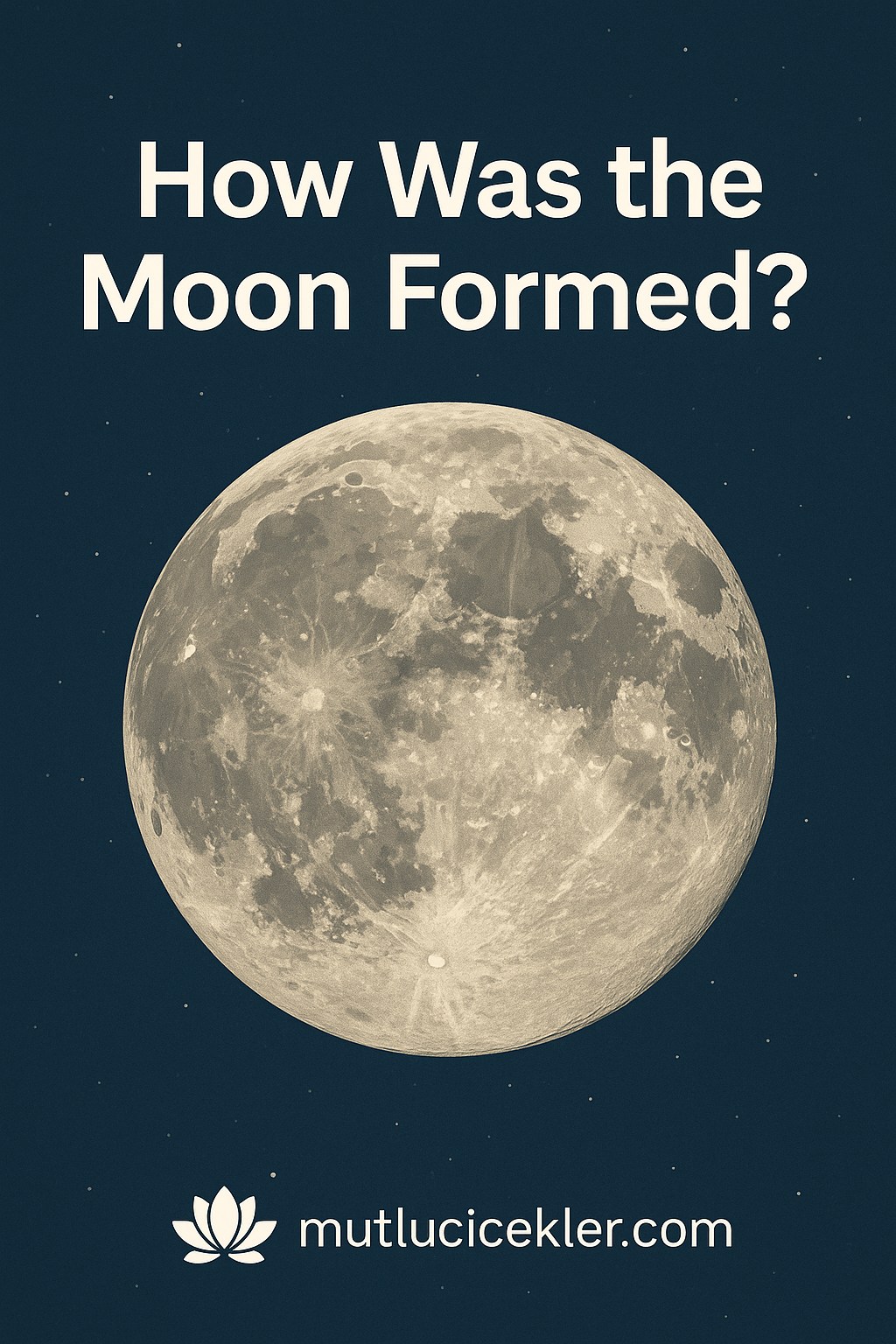
The Moon has fascinated humanity for thousands of years. It lights up our nights, controls the tides, stabilizes Earth’s climate, and holds countless mysteries. But the biggest question remains: How was the Moon actually formed?
Today, the most widely accepted explanation is the Giant Impact Hypothesis. According to this theory, the Moon was formed from the debris of a massive collision between early Earth and a Mars-sized planetary body named Theia.
Let’s dive into this incredible cosmic story.
🌑 How Did the Moon Form? The Giant Impact Hypothesis
✅ 1. Early Earth Was Extremely Chaotic
About 4.5 billion years ago, Earth was still very young. Its surface was filled with molten lava oceans, and the solar system was full of collisions between forming planets.
✅ 2. A Mars-Sized Body Named Theia Crashed Into Earth
A massive protoplanet called Theia is believed to have collided with Earth at high speed.
This collision caused:
• Parts of Earth’s outer layer to break off
• Theia to disintegrate
• Millions of tons of rock and dust to be thrown into space
✅ 3. A Debris Disk Formed Around Earth
After the impact, a ring of molten rock and dust began orbiting Earth. Gravity gradually pulled this material together.
✅ 4. The Material Clumped Together and Formed the Moon
Over time, the debris cooled, merged, and eventually became a single celestial body:
the Moon.
✅ 5. The Moon Slowly Moved Away From Earth
Even today, the Moon continues to drift away at a rate of 3.8 cm per year. This is a natural consequence of gravitational interaction between Earth and the Moon.
🌕 Why Is This Theory Strongly Supported?
Scientists support the Giant Impact Hypothesis because of several key findings:
• Moon rocks brought by Apollo missions match Earth’s mantle composition
• The Moon has a very small iron core (consistent with mantle material)
• Computer simulations confirm that a giant impact could create such a system
• Oxygen isotopes of the Moon and Earth are identical
All of this suggests the Moon formed from Earth itself, not from elsewhere in the solar system.
🌘 What Would Happen If the Moon Didn’t Exist?
The Moon is far more important than most people realize. Without the Moon:
• Tides would be extremely weak
• Earth’s tilt would wobble, causing severe climate instability
• Nights would be darker
• Biological cycles would be different
The Moon plays a vital role in keeping Earth stable and livable.
✅ Conclusion
The Moon’s formation is one of the most dramatic events in Earth’s history. A colossal cosmic impact created the debris that eventually became the Moon. Today, it not only beautifies our night sky but also stabilizes our planet and supports life.
The Moon is not just our satellite.
It is a piece of Earth’s ancient past and a key part of its future.
✅ FAQ (Frequently Asked Questions)
1. Is the Moon made entirely from Earth?
Mostly yes. The Moon formed from Earth’s mantle material mixed with remnants of Theia.
2. Why is the Moon moving away from Earth?
Earth transfers rotational energy to the Moon, pushing it farther away.
3. How old is the Moon?
About 4.5 billion years old.
4. Does the Moon contain material from Theia?
Yes, scientists have found chemical signatures suggesting a mixture of Earth and Theia material.
Bir yanıt yazın