
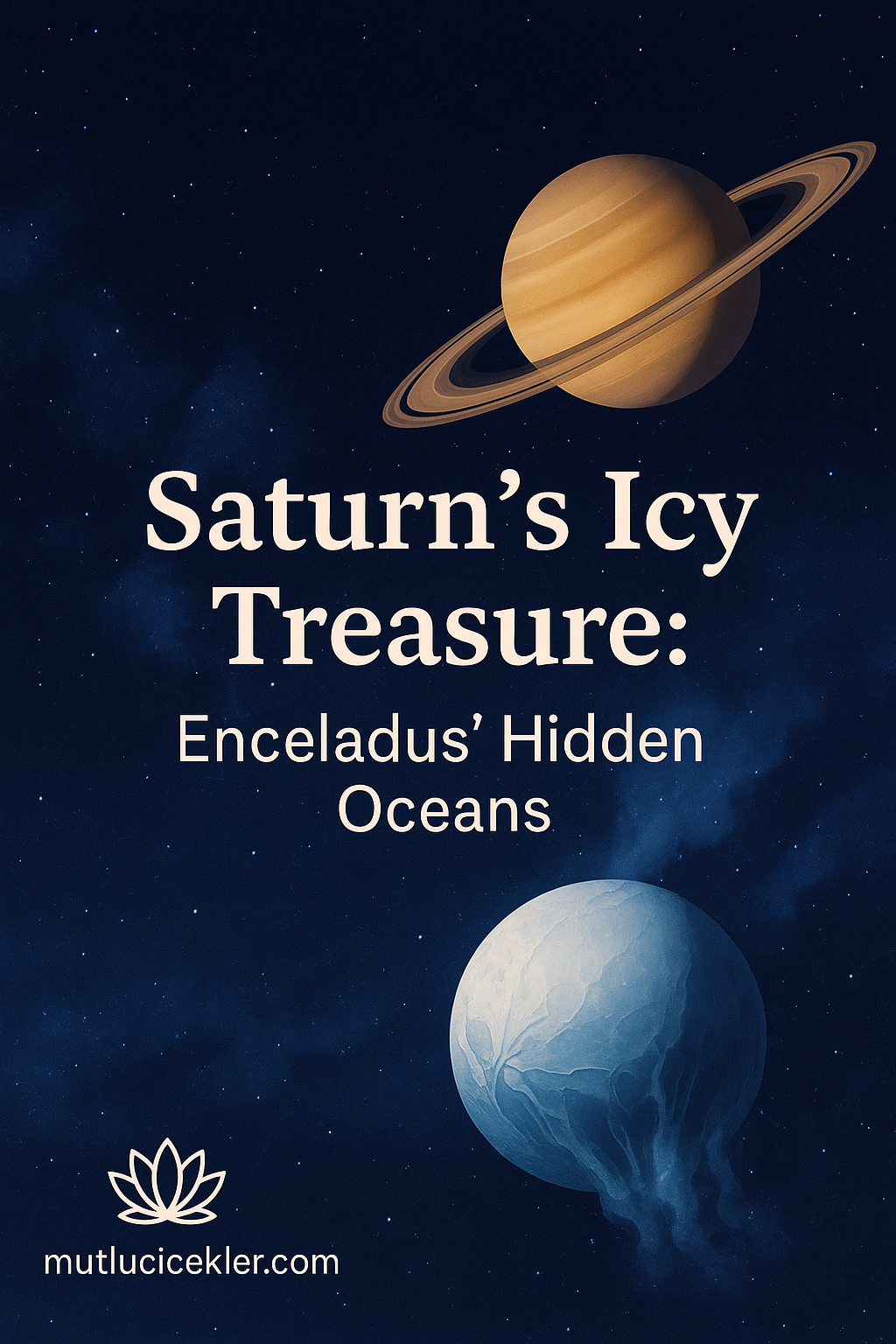
🌊 Introduction: A World Beneath the Ice
Among Saturn’s many moons, Enceladus stands out as one of the most fascinating and mysterious. Though only about 500 kilometers in diameter, this tiny icy world has captured scientists’ attention since NASA’s Cassini spacecraft discovered plumes of water vapor shooting from its surface in 2005 — a sign that a vast subsurface ocean lies hidden beneath its icy crust.
🧊 The Surface and Inner Structure of Enceladus
Enceladus’ surface is a gleaming expanse of frozen water ice, reflecting almost all sunlight that hits it. Yet beneath this frigid exterior lies a deep, global ocean of saltwater, stretching for kilometers under the crust.
The secret to keeping this ocean liquid in the freezing outer Solar System is tidal heating — the immense gravitational pull of Saturn compresses and flexes Enceladus’ rocky core, generating heat from friction.
🔹 Surface temperature: around –200°C
🔹 Estimated ocean depth: ~10 km
🔹 Heat source: Tidal heating (gravitational energy)
🌬️ Cassini’s Discovery: Water Plumes in Space
NASA’s Cassini mission revealed something extraordinary at Enceladus’ south pole — towering jets of water vapor and ice particles erupting into space through fractures known as “tiger stripes.”
The spacecraft flew directly through these plumes and found:
- Water vapor (H₂O)
- Methane (CH₄)
- Carbon dioxide (CO₂)
- Complex organic molecules
These findings suggested that Enceladus could host the key ingredients for life as we know it.
🌍 Could Life Exist in Enceladus’ Ocean?
Beneath its icy shell, Enceladus might harbor hydrothermal vents, similar to those found in Earth’s deep oceans, where life thrives without sunlight. These vents could provide both heat and chemical energy, allowing microbial life forms to exist.
🧬 Potential factors supporting life:
- Presence of liquid water
- Organic molecules
- Heat and chemical energy
- Protective icy shell
Future missions like NASA’s Enceladus Orbilander aim to sample the plumes directly to search for signs of biological activity.
🚀 Future Exploration: Returning to Enceladus
Scientists are planning next-generation probes capable of drilling through the icy crust or sampling the water plumes more closely. Such missions could finally answer one of humanity’s greatest questions:
“Are we alone in the universe?”
🌠 Conclusion: A Blue Hope in the Cold Depths of Space
Though small, Enceladus carries enormous scientific significance. Its hidden ocean beneath layers of ice might be one of the most promising habitats for extraterrestrial life in our Solar System. For astronomers, Enceladus is not just another moon — it’s a symbol of cosmic hope, quietly orbiting Saturn while holding the secrets of life itself.
❓ FAQ (Frequently Asked Questions)
1. Is Enceladus’ ocean really liquid?
Yes. Cassini’s data strongly indicates a liquid water ocean beneath its icy shell.
2. Is it similar to Earth’s oceans?
In some ways — it’s salty water — but the temperature and pressure conditions are very different.
3. Is there confirmed life on Enceladus?
No confirmed life yet, but the ingredients for life are present.
4. Are there future missions planned?
Yes. NASA and ESA are planning new missions to study Enceladus’ plumes in detail.












Bir Cevap Yazın