


Introduction
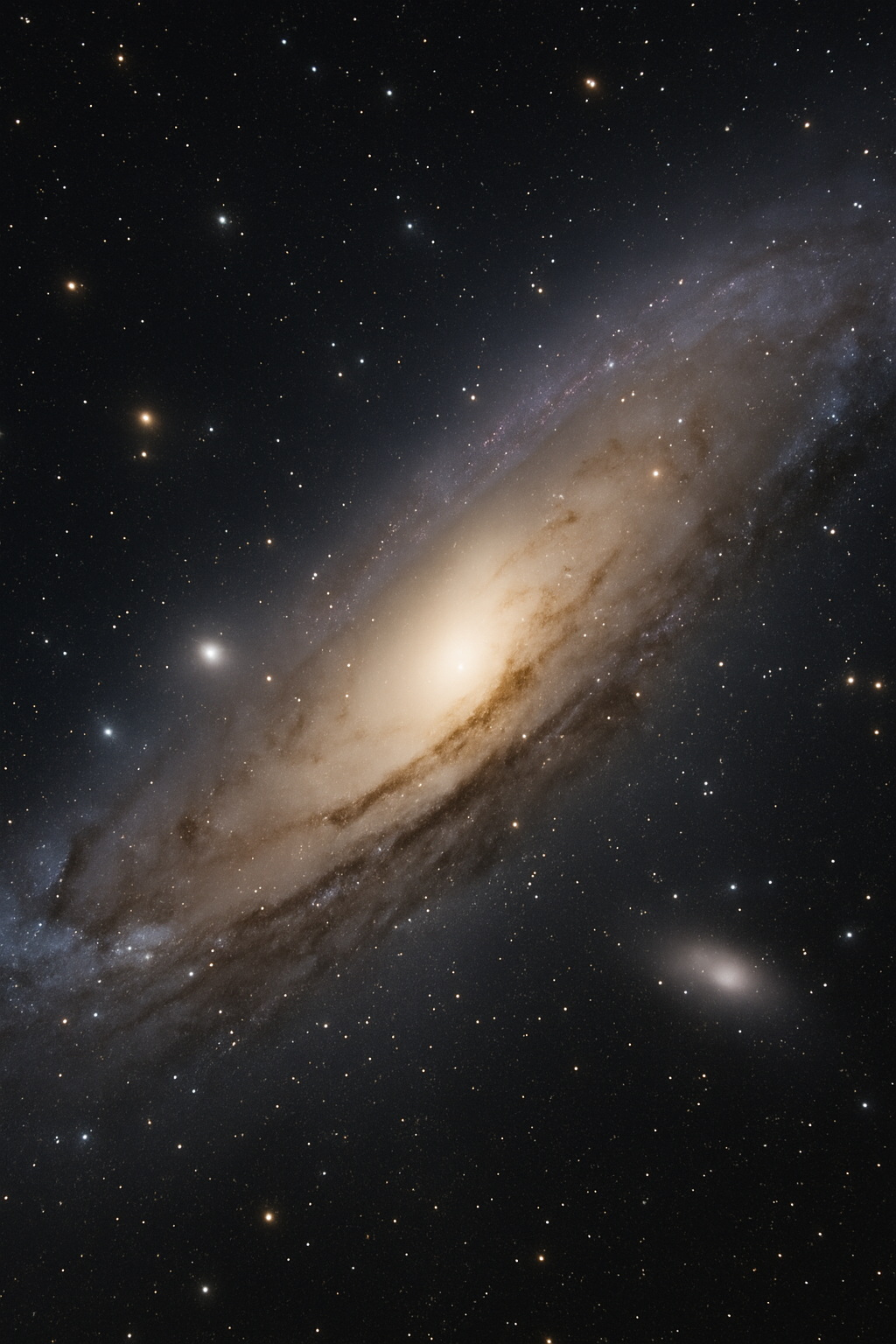
The Andromeda Galaxy (M31) is the closest major galactic neighbor to the Milky Way and one of the most distant objects visible to the naked eye. Located approximately 2.5 million light-years away, this massive galaxy plays a crucial role in helping astronomers understand the structure and evolution of the universe. With its size, brightness, and the fact that it’s moving toward us, Andromeda is a true treasure for sky enthusiasts.
🌠 What Is the Andromeda Galaxy?
Andromeda is a spiral-shaped, gigantic galaxy containing more than twice as many stars as the Milky Way. Its estimated number of stars exceeds 1 trillion, making it one of the largest galaxies known.
Key Features:
- Type: Unbarred spiral galaxy (SA(s)b)
- Distance: 2.54 million light years
- Number of Stars: ~1 trillion
- Diameter: 220,000 light years
- Location: In the constellation Andromeda
🌌 Structure of the Andromeda Galaxy
1. Galactic Core
At its center lies a supermassive black hole, estimated to have a mass more than 100 million times that of the Sun.
2. Spiral Arms
The spiral arms are rich in star-forming regions filled with hot, young, blue stars.
3. Gas and Dust Clouds
Massive hydrogen clouds within the galaxy act as “stellar nurseries,” where new stars are constantly being born.
4. Satellite Galaxies
Andromeda has around 20 satellite galaxies orbiting it.
The most notable ones are:
- M32
- M110
🚀 Andromeda Is Moving Toward the Milky Way!
One of Andromeda’s most fascinating facts is that it’s approaching the Milky Way at 110 km/s.
💥 In 4–5 billion years: The Milky Way and Andromeda Will Collide
This process will likely form a new supergalaxy, which scientists have already named:
⭐ Milkomeda (or Milkdromeda)
Don’t worry—because of the immense distances between stars, this event will not cause direct collisions or immediate harm to life on Earth. However, the Sun’s orbit may be altered.
🔭 How to Observe the Andromeda Galaxy
Andromeda is easy to observe from a dark environment, away from city lights.
- Best location: Constellation Andromeda
- Best viewing period: August – December
- Naked eye: Appears as a faint, blurry patch
- Binoculars: Shows an elongated bright shape
- Telescope: Reveals its central bulge and spiral structure
🔍 Scientific Discoveries About Andromeda
- 1923: Edwin Hubble identified that Andromeda is not a nebula within the Milky Way but a separate galaxy—proving the universe is vastly larger than previously believed.
- Modern telescopes have revealed the galaxy’s black hole, star-forming regions, and gas flows in great detail.
- Collision estimates have been refined with high-precision measurements.
⭐ Interesting Facts About the Andromeda Galaxy
- It is the most distant object visible to the naked eye.
- The name “Andromeda” comes from a princess in Greek mythology.
- It is also a radio source, emitting radio waves detectable by radio telescopes.
- It is considered the Milky Way’s “biggest rival” in cosmic structure.
- Its bright central bulge is much more visible than its spiral arms in long-exposure images.
📌 FAQ (Frequently Asked Questions)
1. Is the Andromeda Galaxy dangerous for Earth?
No. Its approach occurs over billions of years and poses no direct threat.
2. Can humans travel to Andromeda?
Not with current technology—2.5 million light-years is far beyond our capabilities.
3. Will the Milky Way and Andromeda collide?
Yes, they are expected to merge in about 4–5 billion years.
4. Can Andromeda be seen without a telescope?
Yes! It is visible as a small, dim cloud in dark-sky conditions.
🏁 Conclusion
The Andromeda Galaxy is one of the most magnificent structures in the universe. Its massive size, complex structure, and inevitable future collision with the Milky Way make it a favorite topic for astronomers. That faint smudge you see in the night sky is actually a colossal system containing trillions of stars—our enormous cosmic neighbor.
Bir yanıt yazın