
Introduction
Pluto has always been one of the most fascinating members of our Solar System. Since its discovery in 1930, it was accepted as the ninth planet. But as astronomy advanced and new celestial objects were discovered, scientists realized that the classification of planets needed clearer definitions.
In 2006, the International Astronomical Union (IAU) officially reclassified Pluto as a dwarf planet—a decision that sparked global debate.
So, why exactly was Pluto demoted? Let’s explore the full story.
Table of Contents
- Discovery of Pluto 🛰️
- How the Definition of a Planet Changed 📘
- The 2006 IAU Decision ⭐
- Why Pluto Failed to Meet the Criteria 🚫
- Reasons Pluto Is Considered a Dwarf Planet ❄️
- What We Learned from the New Horizons Mission 🚀
- Conclusion 🌌
- FAQ ❓
Discovery of Pluto 🛰️
Pluto was discovered on February 18, 1930 by Clyde Tombaugh. For nearly 76 years, it was proudly listed as the ninth planet of the Solar System.
Its small size, mysterious atmosphere, and distant orbit made it both intriguing and beloved.
How the Definition of a Planet Changed 📘
With the discovery of many Pluto-like objects in the Kuiper Belt, astronomers began questioning whether Pluto truly fit the classical planet definition.
To avoid confusion, scientists needed a consistent set of rules.
The 2006 IAU Decision ⭐
In 2006, the IAU established three criteria an object must meet to be considered a planet:
✔️ 1. It must orbit the Sun.
✔️ 2. It must be massive enough for its gravity to form a nearly round shape.
✔️ 3. It must have “cleared its orbit” of other objects.
This third rule is where Pluto struggled.
Why Pluto Failed to Meet the Criteria 🚫
Pluto satisfies the first two conditions, but it does not satisfy the third:
❌ Pluto does not clear other objects from its orbital path.
It orbits within the Kuiper Belt—an area full of icy bodies similar in size.
Because Pluto cannot dominate or clear its neighborhood, it no longer qualifies as a full planet.
Reasons Pluto Is Considered a Dwarf Planet ❄️
- It shares its orbit with many Kuiper Belt objects
- It is smaller than Earth’s Moon
- Its orbit is highly elliptical and tilted
- It lacks the gravitational dominance required for planet status
- Its mass is not enough to control its orbital region
Therefore, Pluto fits perfectly into the category of dwarf planets.
What We Learned from the New Horizons Mission 🚀
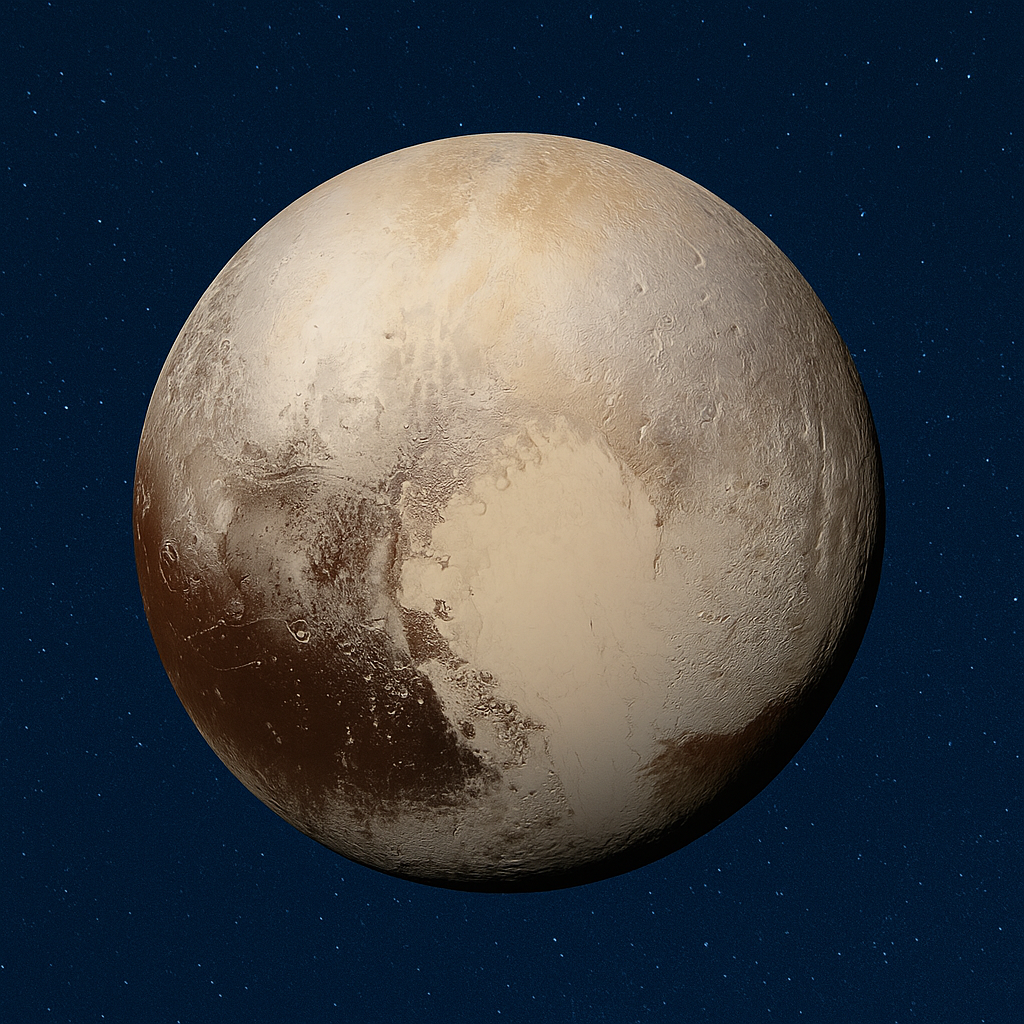
In 2015, NASA’s New Horizons spacecraft reached Pluto, revealing breathtaking details such as:
- Icy mountains
- Nitrogen plains
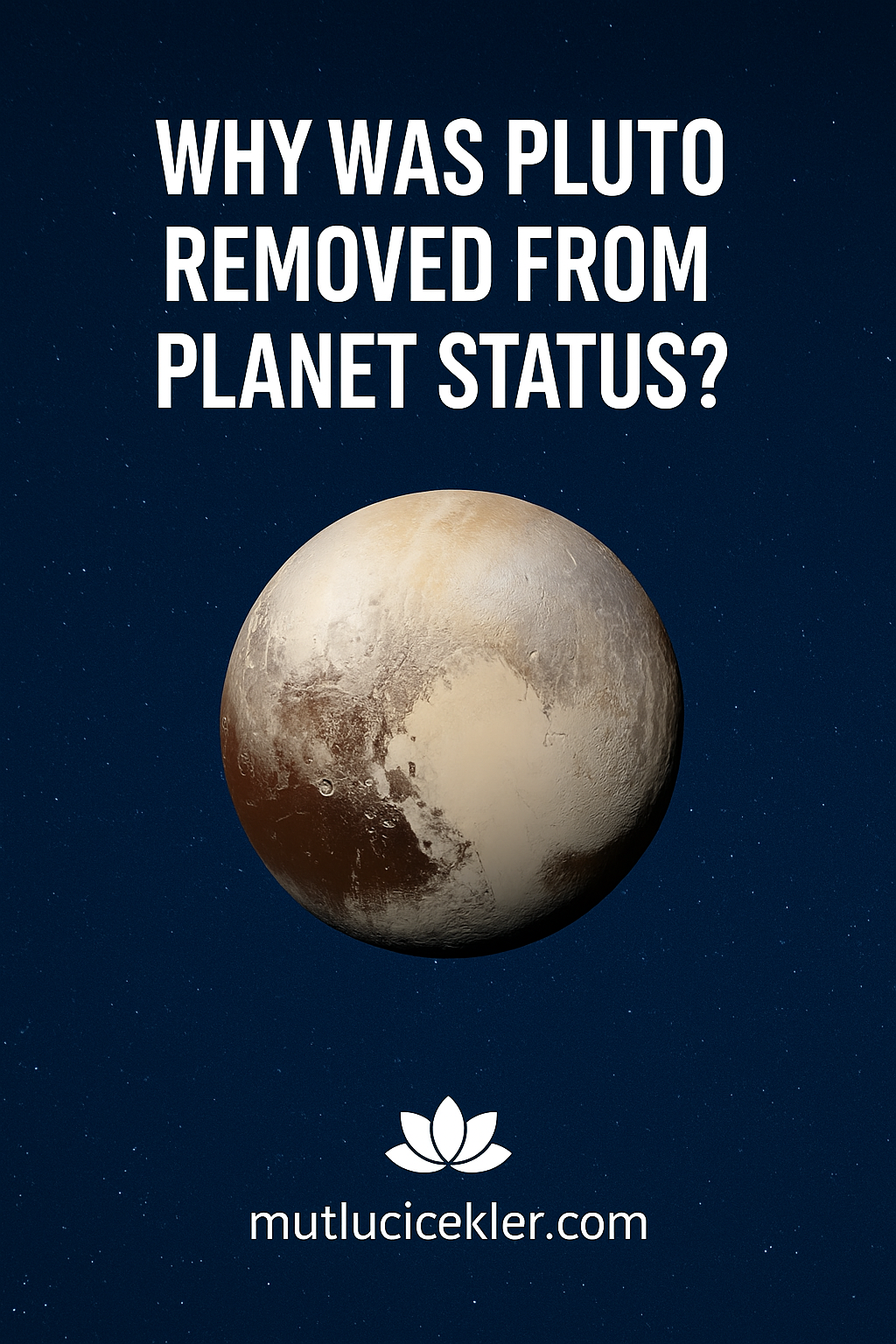
- Heart-shaped region Tombaugh Regio
- Complex atmospheric layers
These discoveries proved that Pluto is incredibly unique and geologically active—
but not enough to change its classification.
Conclusion 🌌
Although Pluto is no longer officially a planet, it remains one of the most fascinating bodies in the Solar System.
Its reclassification helped strengthen scientific definitions and brought more clarity to planetary science.
Pluto may not be the ninth planet anymore,
but it is still the most beloved dwarf planet in our cosmic neighborhood. ❄️💙
FAQ ❓
Will Pluto ever become a planet again?
Only if the official definition of a planet changes in the future.
Is Pluto smaller than the Moon?
Yes — Pluto’s diameter is smaller than Earth’s Moon.
Did the New Horizons mission influence Pluto’s status?
No. The findings were amazing but not related to the classification rules.













Bir Cevap Yazın