
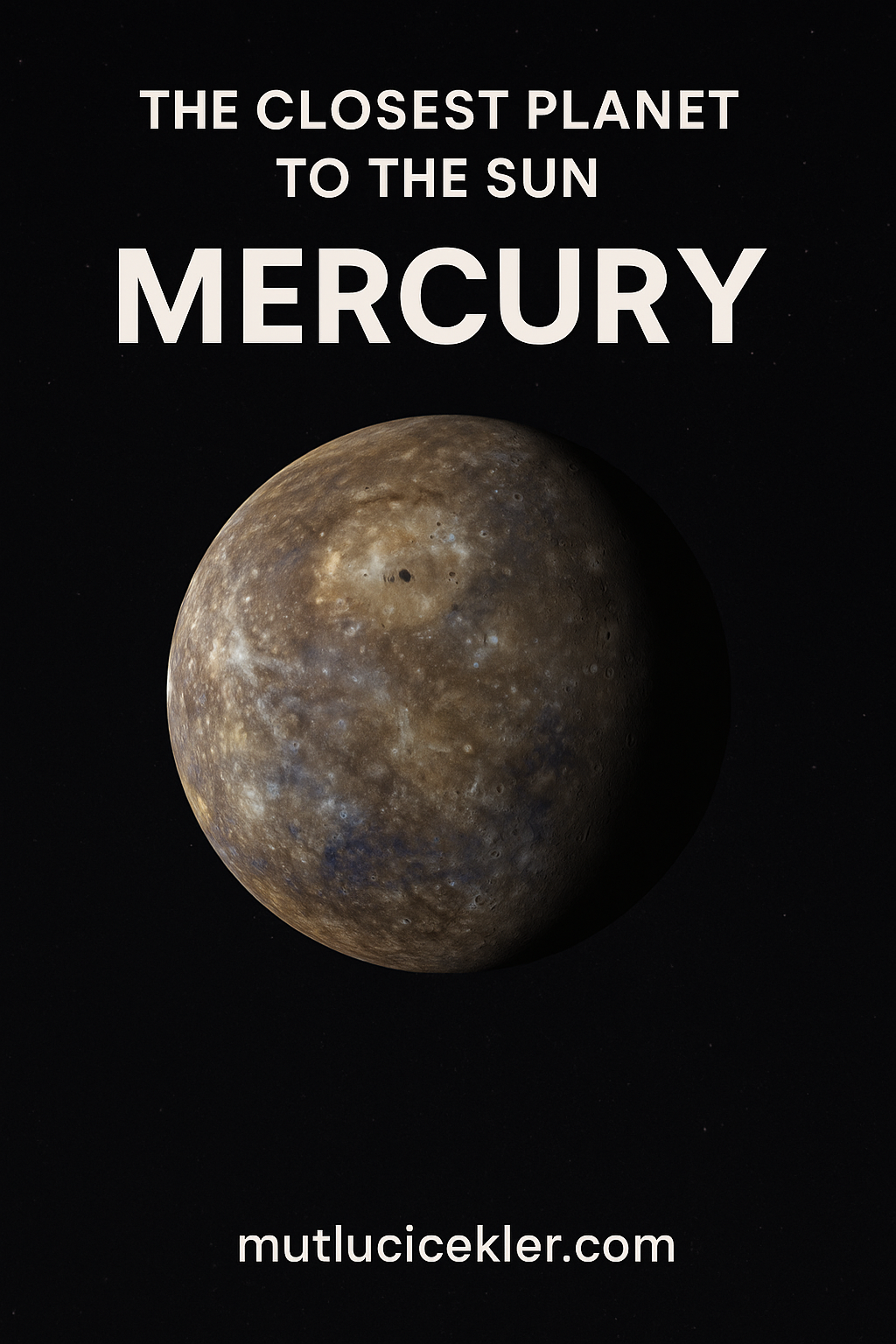
Mercury is the smallest yet one of the most mysterious planets in our Solar System. Known as the closest planet to the Sun, it experiences scorching daytime heat and freezing nighttime cold, making it one of the most extreme worlds ever studied.
In this article, we explore Mercury’s structure, surface, temperature extremes, space missions, and its role in astronomy and astrology.
🌍 What Is Mercury?
Mercury is the closest planet to the Sun and also the smallest planet in the Solar System. It is named after the Roman messenger god Mercury (Hermes in Greek mythology).
- Average distance from the Sun: 57.9 million km
- Diameter: 4,880 km (slightly larger than Earth’s Moon)
- Number of moons: None
- Ring system: None
🔥❄️ Why Does Mercury Have Extreme Temperatures?
Mercury has an extremely thin atmosphere, meaning it cannot trap heat.
- Daytime temperature: up to +430°C
- Nighttime temperature: as low as -180°C
This makes Mercury the planet with the greatest temperature difference in the Solar System.
🌑 What Is Mercury’s Surface Like?
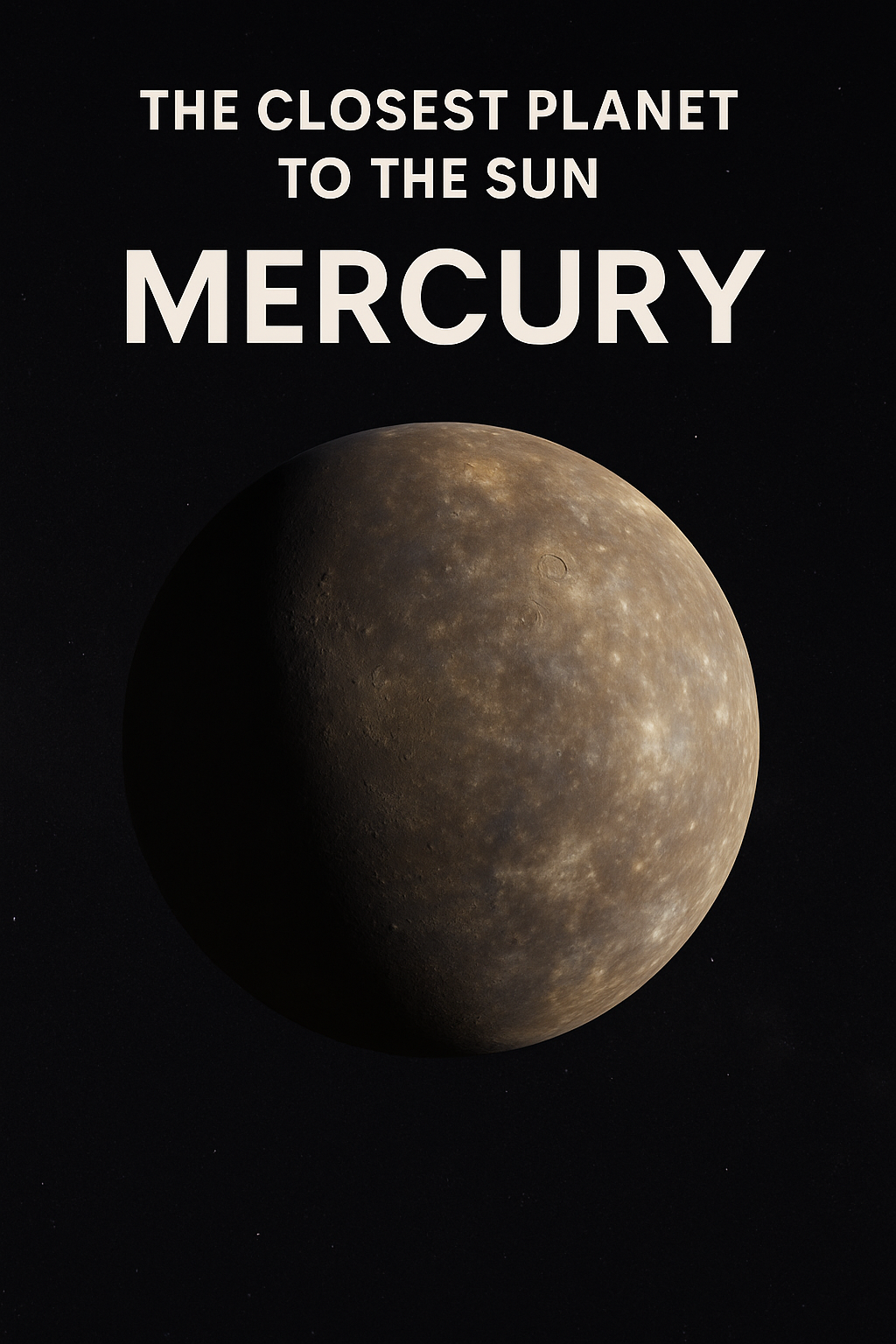
Mercury’s surface closely resembles that of the Moon:
- Heavily covered with impact craters
- Evidence of ancient meteor collisions
- Massive cliffs and surface cracks
- One of its largest craters is the Caloris Basin
As Mercury cooled over time, it shrank, causing gigantic cliffs stretching hundreds of kilometers across its surface.
🛰️ Space Missions to Mercury
Because Mercury lies so close to the Sun, it remained unexplored for a long time.
Major Space Missions:
- Mariner 10 (1974–1975): First spacecraft to photograph Mercury up close
- MESSENGER (2011–2015): First spacecraft to orbit Mercury
- BepiColombo (Launched 2018 – ongoing): Joint mission by ESA and JAXA
These missions revealed:
- Evidence of frozen water at Mercury’s poles
- A weak magnetic field
- Valuable information about Mercury’s chemical composition
🧲 Does Mercury Have a Magnetic Field?
Yes! Despite its small size, Mercury has a weak but active magnetic field, which suggests that part of its core is still molten.
🧠 Mercury in Astrology
In astrology, Mercury represents:
- Intelligence
- Communication
- Logic
- Technology
- Commerce
“Mercury Retrograde” is believed to influence communication problems, misunderstandings, and technical disruptions.
🌌 Is There Life on Mercury?
Scientists agree that life on Mercury is almost impossible due to:
- Extreme temperature differences
- Nearly nonexistent atmosphere
- Intense solar radiation
However, the discovery of water ice in permanently shadowed craters at Mercury’s poles has increased scientific interest in the planet.
📌 Interesting Facts About Mercury
- One day on Mercury lasts 176 Earth days
- One year lasts only 88 Earth days
- It is the fastest-moving planet in the Solar System
- It is very difficult to observe with the naked eye
✅ Conclusion: A Small Planet with Extreme Power
Despite being the smallest planet, Mercury holds the most extreme conditions in our Solar System. With its dramatic temperature swings, cratered surface, magnetic field, and mysterious core, Mercury continues to challenge scientists and fascinate space enthusiasts around the world.
❓ Frequently Asked Questions (FAQ)
Is Mercury the closest planet to the Sun?
Yes, Mercury is the closest planet to the Sun.
Is life possible on Mercury?
Based on current scientific knowledge, life is not possible.
Why is Mercury hard to observe from Earth?
Because it stays very close to the Sun in the sky and is usually visible only briefly at sunrise or sunset.
📣 Follow Us
For more space discoveries, planets, and science content, follow mutlucicekler.com and our social media channels! 🚀✨













Bir Cevap Yazın