


🌊 Introduction
Ebru art is a unique form of traditional Turkish marbling, created by sprinkling and shaping natural pigments on the surface of water and then transferring the patterns onto paper. With roots reaching back to Central Asia and perfected during the Ottoman era, Ebru is admired for its beauty, serenity, and the fact that each artwork is truly one of a kind.
🖌️ The Origins and History of Ebru Art
The word “Ebru” is believed to come from:
- The Persian word “ebr” meaning “cloud,”
- Or the Chagatai word “ebre” meaning “veined or marbled.”
Ebru art:
- Traveled from Central Asia to Iran,
- Reached Anatolia,
- Flourished in the Ottoman Empire from the 15th century onward.
It was often used to decorate manuscripts, books, and calligraphy works.
🎨 How Is Ebru Art Made?
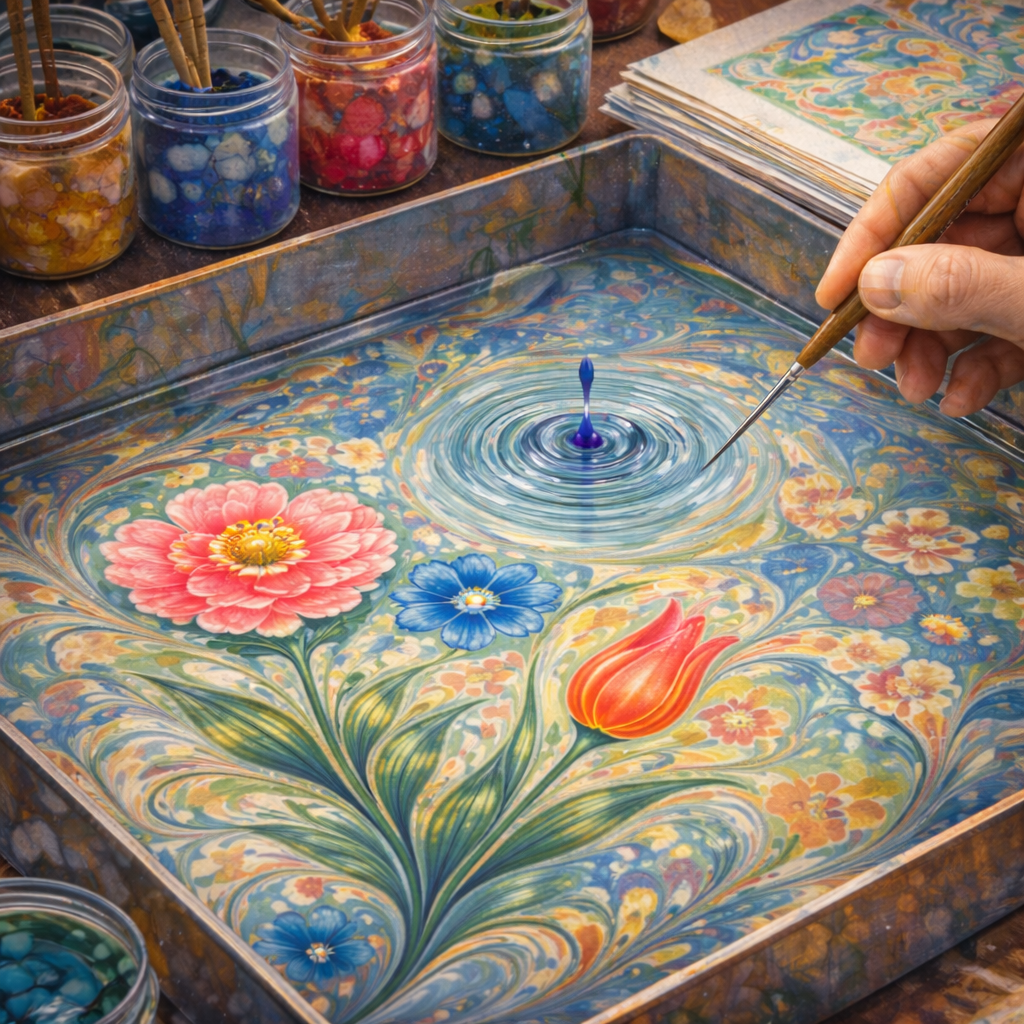
Creating Ebru requires patience and harmony with water. The main steps include:
- Tray (Tekne): A wide container filled with water
- Gum tragacanth (Kitre): Thickens the water
- Natural pigments: Earth-based colors
- Brushes: Traditionally made from rose branches
- Needles/Styli (Biz): For shaping patterns
- Paper: Special absorbent paper for transferring designs
The artist sprinkles colors on the water, shapes them into patterns, and gently lays paper on top to capture the design.
🌸 Types of Ebru Patterns
There are many traditional styles in Ebru art, including:
- Battal Ebru: The basic and classic pattern
- Gel-Git: Wavy, back-and-forth patterns
- Şal Ebru: Looks like fabric textures
- Taraklı: Created using a comb tool
- Floral Ebru: Tulips, roses, carnations 🌷
- Hatip Ebru: More detailed and artistic forms
Each master brings their own style and interpretation.
🧑🎨 What Makes Ebru Art Special?
Ebru stands out because:
- Every piece is unique and cannot be repeated,
- It uses natural materials,
- It requires balance, patience, and focus,
- It has a calming, almost meditative effect. 🧘♂️
For many artists, Ebru is not just art, but a form of spiritual discipline.
🕌 Ebru in the Ottoman Era and Today
In Ottoman times, Ebru was used in:
- Bookbinding and manuscript decoration,
- Calligraphy backgrounds,
- Official documents.
Today, Ebru appears in:
- Art exhibitions and wall art,
- Notebooks, invitations, and gifts,
- Workshops and art courses around the world.
It is also recognized by UNESCO as an Intangible Cultural Heritage of Humanity. 🌍
🌟 Conclusion
Ebru art is a timeless Turkish tradition where water and color come together to create harmony and beauty. Carrying centuries of history and culture, Ebru continues to inspire artists and art lovers alike. Each pattern tells a story — a fleeting moment captured on paper.
❓ FAQ – Frequently Asked Questions
Is Ebru art difficult to learn?
It may seem challenging at first, but with practice, anyone can learn the basics.
Do I need special materials for Ebru?
Yes, natural pigments, kitre, special paper, and tools are essential.
Where is Ebru art used today?
In paintings, book art, decorations, gifts, and modern designs.
Can the same Ebru pattern be repeated?
No. Each design is naturally unique.
👉 For more cultural, artistic, and inspiring content, don’t forget to follow mutlucicekler.com 🌸


Bir yanıt yazın