
🌌 Introduction
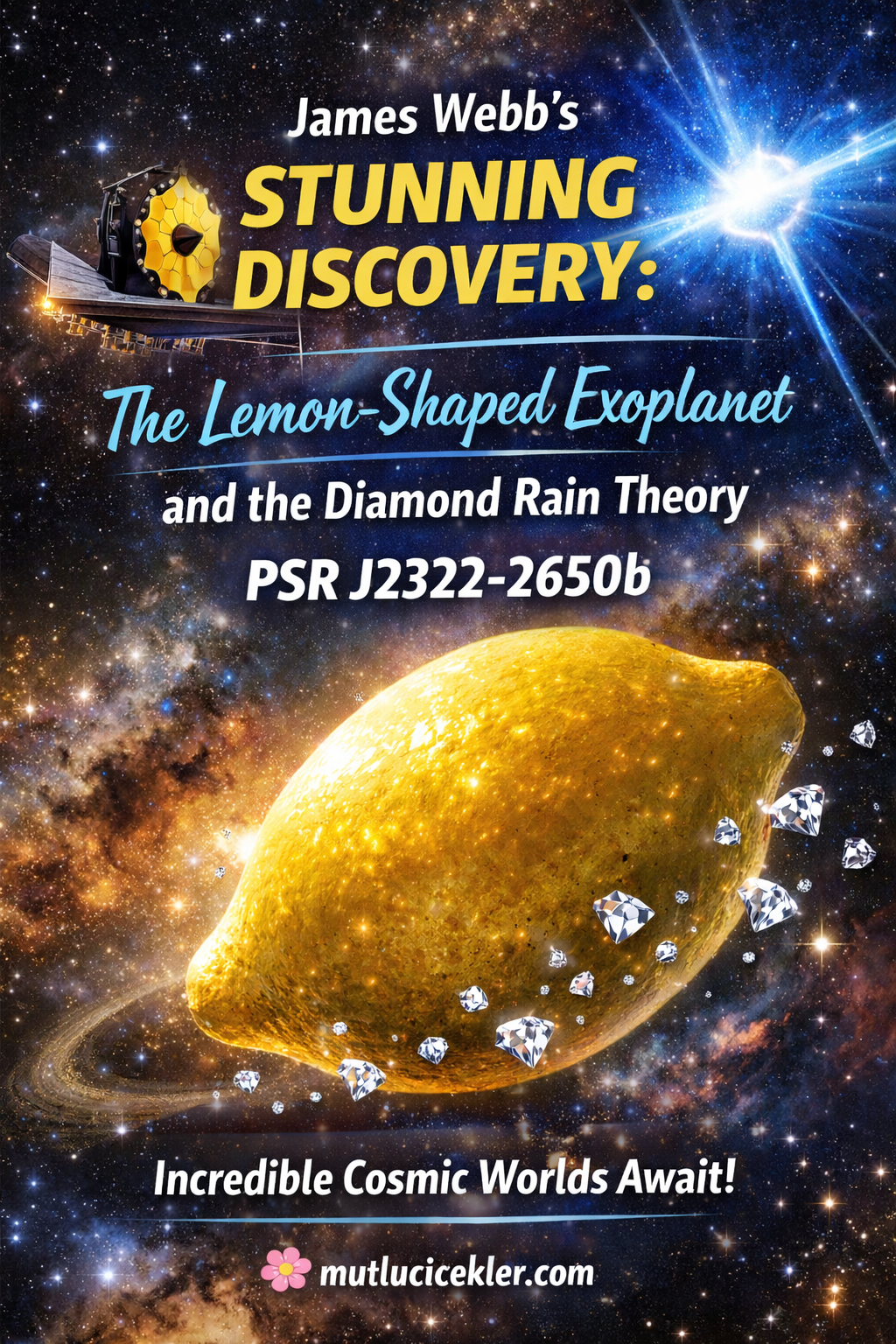
The universe continues to amaze us with worlds far beyond imagination. With the power of the James Webb Space Telescope (JWST), astronomers are uncovering exotic planets and extreme cosmic environments. One of the most talked-about objects in recent space news is the mysterious PSR J2322−2650 b — often described as a “lemon-shaped” exoplanet — and the fascinating theory of diamond rain associated with carbon-rich worlds.
If you’d like to learn more about the telescope behind these groundbreaking studies, you can also check out our detailed guide on what the James Webb Space Telescope is and how it is changing our view of the universe:
👉 click !
Let’s explore what scientists really know about this extraordinary world.
🪐 PSR J2322−2650 b: A Truly Exotic Exoplanet
PSR J2322−2650 b is an unusual exoplanet orbiting a pulsar — a rapidly spinning neutron star left behind after a supernova explosion. It lies about 750 light-years away from Earth.
What makes it so special?
✨ It is extremely close to its pulsar, completing an orbit in just a few hours.
✨ The intense gravitational forces stretch the planet, giving it an elongated, lemon-like (ellipsoidal) shape.
✨ It is far less dense than typical rocky planets, suggesting it may be the remnant core of a former star or a highly altered planetary body.
Because of its strange nature, scientists still debate whether it is a “normal” planet or a rare exotic object formed under extreme conditions.
🔬 What Do We Know About Its Atmosphere?
Unlike many hot gas giants studied by JWST, PSR J2322−2650 b is thought to be:
🌫️ Poor in hydrogen, but rich in helium and carbon-based compounds.
🌫️ Shaped and stripped by powerful radiation from its pulsar host.
While James Webb has not directly observed this pulsar planet’s atmosphere in detail, JWST studies of other carbon-rich exoplanets have shown that such extreme chemistry is possible in alien worlds. These findings help scientists model what atmospheres like this might look like.
💎 The Diamond Rain Theory
So, does it really rain diamonds?
💡 The idea of diamond rain comes from theoretical models of carbon-rich planets. Under enormous pressure and heat:
✔️ Carbon can condense into solid forms.
✔️ Graphite may transform into diamond crystals deep in the atmosphere.
✔️ These crystals could then fall like rain toward the planet’s interior.
👉 Important: There is no direct observation of diamond rain on PSR J2322−2650 b.
It remains a scientific hypothesis, inspired by laboratory experiments and models — but it captures the imagination and highlights how bizarre alien worlds can be.
🌠 Why Is This Discovery Important?
This kind of object helps astronomers:
🔭 Test theories of planet formation and survival around dead stars.
🧪 Understand how extreme radiation changes planetary atmospheres.
🌍 Expand our definition of what a “planet” can be.
🚀 Demonstrate the power of new-generation telescopes like James Webb in exploring the universe.
Each discovery pushes the limits of our knowledge and reveals how diverse cosmic worlds truly are.
❓ FAQ – Frequently Asked Questions
❓ Is PSR J2322−2650 b a real planet?
Yes, it is classified as an exoplanet, but its origin is unusual and still debated by scientists.
❓ Why is it described as lemon-shaped?
Strong tidal forces from the pulsar stretch the planet, giving it an elongated, non-spherical shape.
❓ Has diamond rain been observed?
No. Diamond rain is a theoretical possibility, not a confirmed observation.
❓ Did James Webb directly discover this planet?
The planet was first detected through radio observations of its pulsar. JWST’s role is in advancing our overall understanding of exotic exoplanet atmospheres that support such theories.
✨ Conclusion
The story of PSR J2322−2650 b shows just how strange and wonderful the universe can be. A lemon-shaped world orbiting a dead star, possibly hiding carbon oceans and diamond storms, reminds us that space is full of surprises.
As the James Webb Space Telescope continues to explore the cosmos, we can expect even more discoveries that challenge our imagination and deepen our understanding of the universe.
🌌 Follow us for more inspiring space discoveries and cosmic stories!











Bir Cevap Yazın