

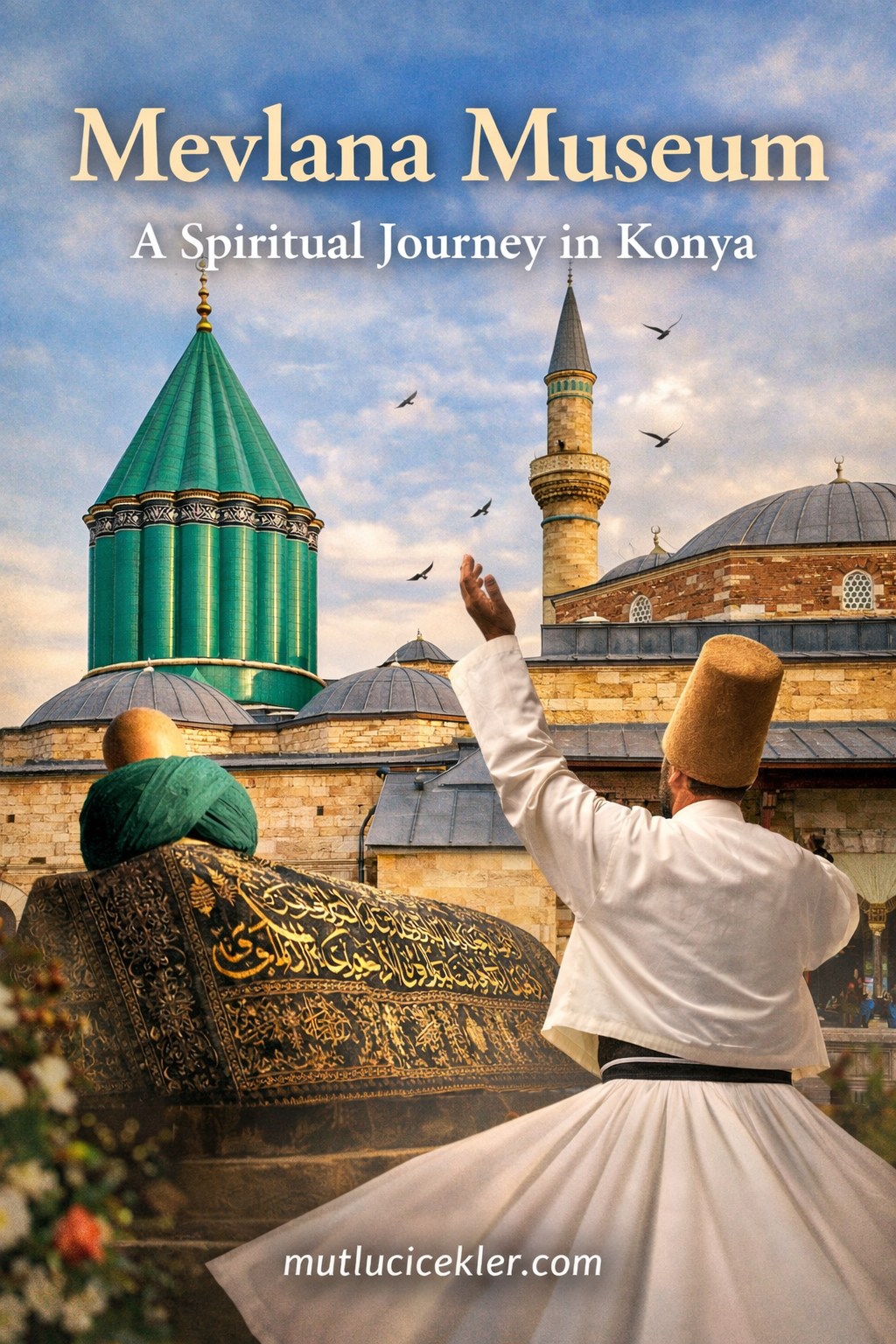
📍 A Spiritual Journey in the Heart of Konya
Located in the heart of Konya, Türkiye, the Mevlana Museum is one of the country’s most important cultural and spiritual landmarks. Known for its distinctive turquoise-green dome, peaceful courtyard, historic dervish rooms, and priceless manuscripts, the museum attracts visitors interested in history, architecture, Sufism, and the legacy of Mevlana Jalaluddin Rumi.
More than a traditional museum, this historic complex was once the center of the Mevlevi tradition. Today, visitors can explore Rumi’s tomb, the Sema Hall, dervish cells, historic manuscripts, religious objects, and architectural details that reflect centuries of Anatolian history.
Whether you are visiting Konya for a day or planning a longer cultural journey through Central Anatolia, the Mevlana Museum is one of the city’s essential stops.
🕊️ Who Was Mevlana Jalaluddin Rumi?
Mevlana Jalaluddin Rumi (1207–1273) was a scholar, poet, philosopher, and Sufi mystic whose teachings have influenced people across cultures for centuries.
Although he was born in Balkh, Rumi eventually settled in Konya, where he spent an important part of his life and produced works that would become classics of Sufi literature.
His teachings focused strongly on love, spiritual transformation, compassion, self-knowledge, and humanity’s relationship with the divine.
Among his most famous works is the Masnavi, a monumental collection of stories, teachings, and spiritual reflections.
After Rumi’s death in 1273, his teachings continued through his followers and family, particularly his son Sultan Veled, playing an important role in the development of the Mevlevi tradition.
👉 To learn more about his life and spiritual journey, you can also read Mevlana Rumi: A Life Illuminated by Sufism.
🏛️ History of the Mevlana Museum
The history of the museum is closely connected with Rumi’s family.
The area where the complex stands was once a rose garden associated with the Seljuk palace. It was given to Rumi’s father, Bahaeddin Veled, by Seljuk Sultan Alaeddin Keykubad.
After Rumi died in 1273, a mausoleum was constructed over his burial place. The tomb, which forms the heart of today’s complex, dates to 1274.
Over the following centuries, additional structures were added to the complex. These included the Semahane (Sema Hall), mosque, kitchen, fountain, and dervish cells, many of which took shape during the Ottoman period.
The lodge became an important center of Mevlevi culture and spiritual education.
Following the closure of dervish lodges in Türkiye in 1925, the complex was reorganized and opened to visitors as a museum in 1926. It officially took the name Mevlana Museum in 1954.
Today, the complex preserves both the memory of Rumi and important examples of Seljuk and Ottoman cultural heritage.
🔵 Sections to Explore Inside the Museum
🟢 1. Mevlana’s Tomb
The spiritual heart of the museum is the tomb of Mevlana Jalaluddin Rumi.
Visitors enter a richly decorated interior where Rumi’s cenotaph stands alongside the graves and cenotaphs of family members and important figures associated with the Mevlevi tradition.
The atmosphere is generally quiet and contemplative, and many visitors spend a few moments here in silence.
One of the most impressive elements is the historic wooden cenotaph, which represents the remarkable craftsmanship of the Anatolian Seljuk period.
🟢 2. The Green Dome – Kubbe-i Hadra
The museum’s most recognizable architectural feature is the Kubbe-i Hadra, meaning the Green Dome.
Covered with turquoise-green tiles, the elegant dome rises above the mausoleum and has become one of the symbols of Konya.
Its distinctive shape can be seen from many surrounding streets, making it an unmistakable landmark in the historic center.
The dome is not simply an architectural feature; for many visitors, it has become a visual symbol of Rumi and the spiritual heritage of Konya.
🟢 3. Sema Hall – Semahane
The Semahane was the hall associated with the Sema ceremony of the Mevlevi tradition.
The Sema is internationally recognized for the image of whirling dervishes, but its meaning goes far beyond a visual performance. It represents a spiritual journey based on remembrance, devotion, and the search for inner transformation.
Inside this part of the complex, visitors can discover objects associated with Mevlevi culture, music, and ceremonial life.
🟢 4. Dervish Cells
Another fascinating part of the museum is the row of historic Dervish Cells.
These rooms were constructed during the Ottoman period and were used by members of the Mevlevi community.
The cells provide visitors with a glimpse into the disciplined and simple lifestyle associated with the lodge.
Today, several of these spaces are used to display objects and information related to Mevlevi life, culture, calligraphy, and religious traditions.
🟢 5. Historic Manuscripts and Sacred Artifacts
The Mevlana Museum houses an important collection of manuscripts and historic objects.
One of its most valuable treasures is an early copy of Rumi’s Masnavi, written only a few years after his death.
Visitors can also encounter historic Qur’an manuscripts, examples of Islamic calligraphy, textiles, musical instruments, decorative objects, and items once used within the Mevlevi lodge.
These artifacts help visitors understand that the museum is not only connected with one individual but also preserves centuries of artistic, intellectual, and spiritual history.
✨ What Should You Not Miss?
If you have limited time, make sure you see:
- Mevlana’s Tomb
- Kubbe-i Hadra (Green Dome)
- The Sema Hall
- Historic Dervish Cells
- Early Masnavi manuscripts
- Historic Qur’an manuscripts and calligraphy
- The museum courtyard
The courtyard is also a beautiful place to observe the architecture and enjoy the peaceful atmosphere of the complex.
⏱️ How Long Should You Spend at the Mevlana Museum?
Most visitors can explore the main areas of the museum in approximately 1 to 2 hours.
If you are particularly interested in Rumi, Islamic art, manuscripts, Sufi history, or architecture, consider allowing more time.
Visiting without rushing will also give you an opportunity to appreciate the atmosphere of the complex rather than simply moving between exhibits.
🕐 Mevlana Museum Opening Hours
According to the official museum information, the Mevlana Museum is generally open every day.
Opening: 09:00
Closing: 19:00
Ticket office closes: 18:30
On Mondays, the ticket office opens at 10:00.
Opening hours can change during holidays, special events, restoration periods, or seasonal arrangements, so checking the official museum information before your visit is recommended.
🎟️ Mevlana Museum Entrance Fee
Entrance to the Mevlana Museum is currently free.
This makes the museum one of the most accessible major cultural attractions in Konya.
Since admission policies can change, international travelers planning their trip far in advance should check the latest official information before visiting.
📍 Where Is the Mevlana Museum?
The museum is located in Karatay, in the historic center of Konya.
Address:
Aziziye Mahallesi, Müze Alanı Caddesi No:1, Karatay, Konya, Türkiye
Its central location makes it easy to combine a museum visit with other historical and cultural attractions in Konya.
🚋 How to Get to the Mevlana Museum
The museum is easily accessible from different parts of Konya.
Visitors staying around the city center can often reach the museum by walking, tram, bus, or taxi.
If you are arriving in Konya by high-speed train, public transportation and taxis provide convenient connections between the railway station and the historic center.
Because the museum is one of Konya’s most famous landmarks, it is generally easy to find.
🌤️ Best Time to Visit
The museum can be visited throughout the year.
For a quieter experience, consider arriving early in the morning, particularly outside weekends and public holidays.
Spring and autumn are especially pleasant seasons for exploring Konya because temperatures are generally more comfortable for walking around the city.
December is a particularly meaningful period because events commemorating Rumi are traditionally held around the anniversary of his death. However, Konya can also be significantly busier during this period.
🙏 Visitor Etiquette
Although the complex operates as a museum, Mevlana’s tomb remains a place of deep spiritual significance for many visitors.
A few simple considerations can make the experience more respectful:
- Speak quietly around the tomb area.
- Follow museum signs and staff instructions.
- Avoid blocking passages while taking photographs.
- Respect restrictions on photography where indicated.
- Wear respectful clothing appropriate for a cultural and spiritual site.
- Allow other visitors space for quiet reflection.
The museum welcomes people from many cultures and backgrounds, and maintaining a calm atmosphere helps preserve its special character.
🗺️ Places to Visit Near the Mevlana Museum
Don’t leave immediately after visiting the museum. Konya’s historic center contains several other attractions that can easily be included in your itinerary.
Consider visiting:
Selimiye Mosque – Located directly beside the museum and one of the area’s most striking Ottoman monuments.
Alaeddin Hill – A historic green area associated with Konya’s Seljuk heritage.
Karatay Madrasa – An excellent destination for visitors interested in Seljuk architecture and tile art.
İnce Minareli Madrasa – Famous for its impressive stonework and monumental portal.
Exploring these places together can turn your visit to the Mevlana Museum into a half-day cultural route through central Konya.
💡 Tips for Visiting the Mevlana Museum
Try to visit early if you prefer a quieter atmosphere.
Allow at least an hour rather than rushing through the complex, and take some time to examine the manuscripts and smaller objects instead of focusing only on the famous tomb.
Comfortable walking shoes are also useful if you plan to combine your visit with other attractions in central Konya.
Most importantly, approach the museum as both a historic monument and a place that continues to hold spiritual meaning for visitors from around the world.
❓ Frequently Asked Questions
Is the Mevlana Museum free?
Yes. Entrance to the Mevlana Museum is currently free.
Is the Mevlana Museum open on Mondays?
Yes. The museum is open every day, although on Mondays the ticket office currently opens at 10:00.
How much time do I need at the Mevlana Museum?
For most visitors, approximately 1–2 hours is enough to explore the main sections comfortably.
Where is Mevlana buried?
Mevlana Jalaluddin Rumi is buried inside the historic Mevlana complex in Konya, Türkiye.
Can non-Muslims visit the Mevlana Museum?
Yes. The museum welcomes visitors from different religions, cultures, and backgrounds.
What is the Green Dome?
The Green Dome, or Kubbe-i Hadra, is the distinctive turquoise-green tiled structure rising above the mausoleum and is one of Konya’s most recognizable landmarks.
What else can I visit nearby?
Selimiye Mosque, Karatay Madrasa, Alaeddin Hill, and İnce Minareli Madrasa can easily be combined with your museum visit.
🌿 Final Thoughts
The Mevlana Museum is much more than one of Konya’s most famous attractions. It is a place where history, architecture, poetry, spirituality, and centuries of Mevlevi culture come together.
From the iconic Green Dome and Rumi’s tomb to ancient manuscripts and quiet dervish cells, each part of the complex tells a different story.
For anyone visiting Konya, spending time at the Mevlana Museum offers a deeper understanding not only of Rumi’s legacy but also of the rich cultural heritage of Anatolia.
📌 Follow mutlucicekler.com for more travel guides, cultural destinations, historical places, and inspiring journeys around Türkiye and the world.
Bir yanıt yazın