
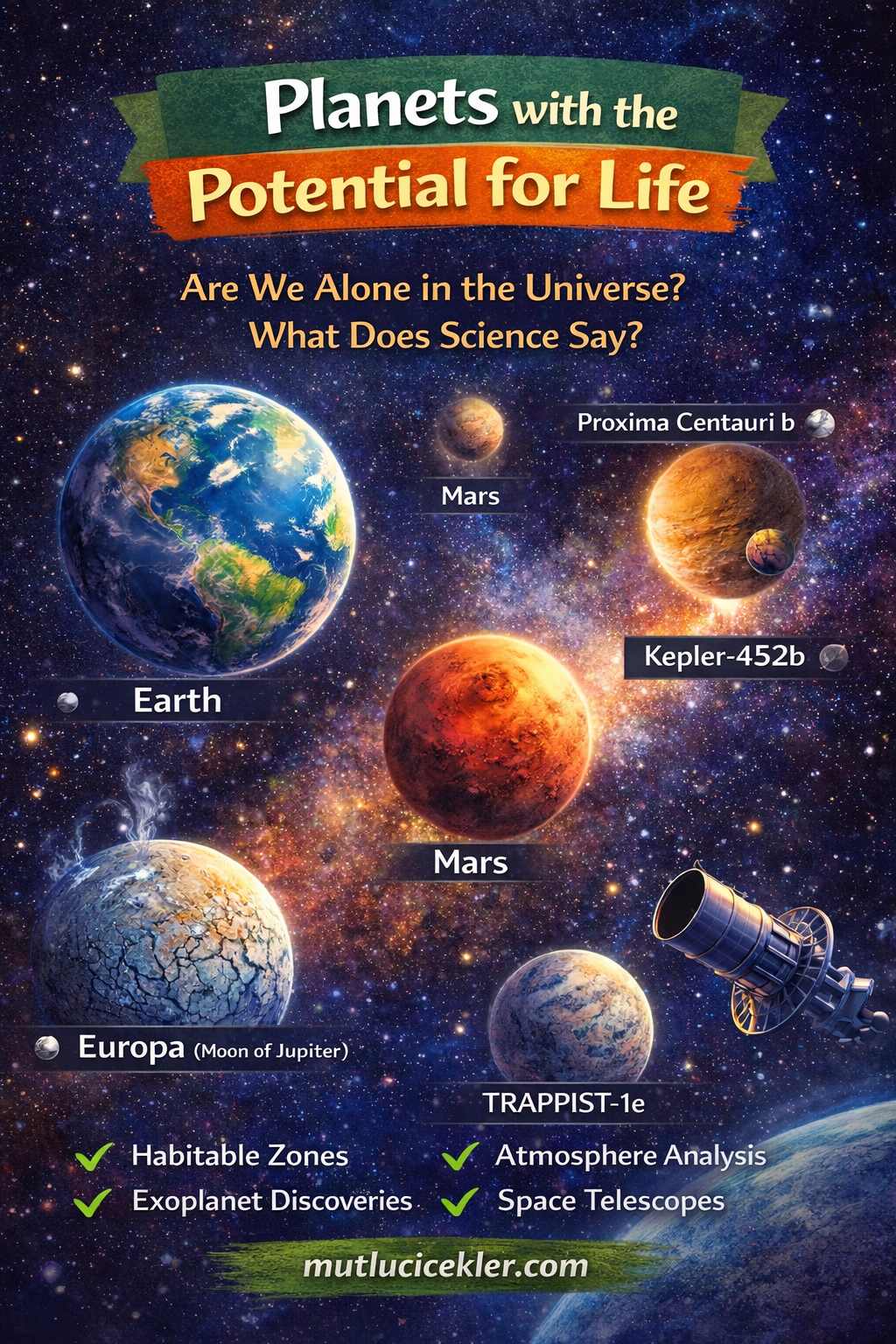
Are We Alone in the Universe? What Does Science Say?
One of humanity’s most fascinating questions has always been: Are we alone in the universe?
For decades, scientists have been searching beyond our Solar System to find planets that could potentially support life. Thanks to advanced space telescopes and modern observation techniques, we can now analyze not only the existence of distant planets but also their atmospheres, temperatures, and chemical compositions.
So, what makes a planet suitable for life, and which worlds are considered the most promising candidates?
🧬 What Does “Habitable” Mean in Astronomy?
In scientific terms, a habitable planet is one that may support Earth-like life. To be considered potentially habitable, a planet generally needs:
- Liquid water
- A suitable temperature range
- A protective atmosphere
- A stable orbit
- A location that is neither too close nor too far from its star
Planets meeting these conditions are usually found within the habitable zone.
☀️ What Is the Habitable Zone (Goldilocks Zone)?
The habitable zone, often called the Goldilocks Zone, is the region around a star where conditions are “just right” — not too hot and not too cold — for liquid water to exist on a planet’s surface.
Since water is essential for life as we know it, planets in this zone are prime targets in the search for extraterrestrial life.
🪐 Notable Planets and Moons with Life Potential
🌑 Mars
Mars is the most studied candidate for life within our Solar System.
- Evidence suggests liquid water existed in the past
- Ice reserves are present beneath the surface
- Microbial life is still considered possible
Although current surface conditions are harsh, Mars may have hosted life billions of years ago.
🌊 Europa (Moon of Jupiter)
Europa is one of the strongest life candidates due to its subsurface ocean.
- A thick ice shell covers a vast salty ocean
- Heat from tidal forces may keep the water liquid
- Chemical interactions could support microbial life
🌊 Enceladus (Moon of Saturn)
Enceladus has surprised scientists with geysers that eject water vapor into space.
- Evidence of a subsurface ocean
- Presence of organic molecules
- Active hydrothermal processes
These features make Enceladus one of the most exciting locations to search for life.
🌟 Potentially Habitable Exoplanets Beyond Our Solar System
🌍 Proxima Centauri b
This planet orbits the closest star to our Solar System.
- Located in the habitable zone
- Similar mass to Earth
However, strong stellar radiation may challenge its habitability.
🌏 Kepler-452b
Often referred to as “Earth’s cousin,” this planet:
- Is about 60% larger than Earth
- Orbits a Sun-like star
- Lies within the habitable zone
It may have surface conditions suitable for liquid water.
🌎 TRAPPIST-1 System
This star system contains multiple Earth-sized planets, several of which lie in the habitable zone.
- TRAPPIST-1e is considered the most promising
- Possible oceans and moderate temperatures
🔭 How Do Scientists Search for Life?
Scientists use several advanced techniques, including:
- Space telescopes
- Spectroscopy
- Atmospheric analysis
- Detection of biosignature gases
They search for gases like oxygen, methane, and carbon dioxide, which may indicate biological activity.
✨ Conclusion: The Universe Is Vast — and Full of Possibilities
Although no confirmed evidence of extraterrestrial life has been found yet, discoveries so far suggest that habitable environments may be far more common than once believed. As technology advances, we are getting closer to answering one of the greatest questions in science.
Perhaps we are not alone.
We just haven’t met our cosmic neighbors yet.
📌 Follow us for more content about space, science, and the mysteries of the universe.
💚 mutlucicekler.com – Welcome to the Ornamental World of Knowledge!













Uğurcan BAL için bir cevap yazınCevabı iptal et