

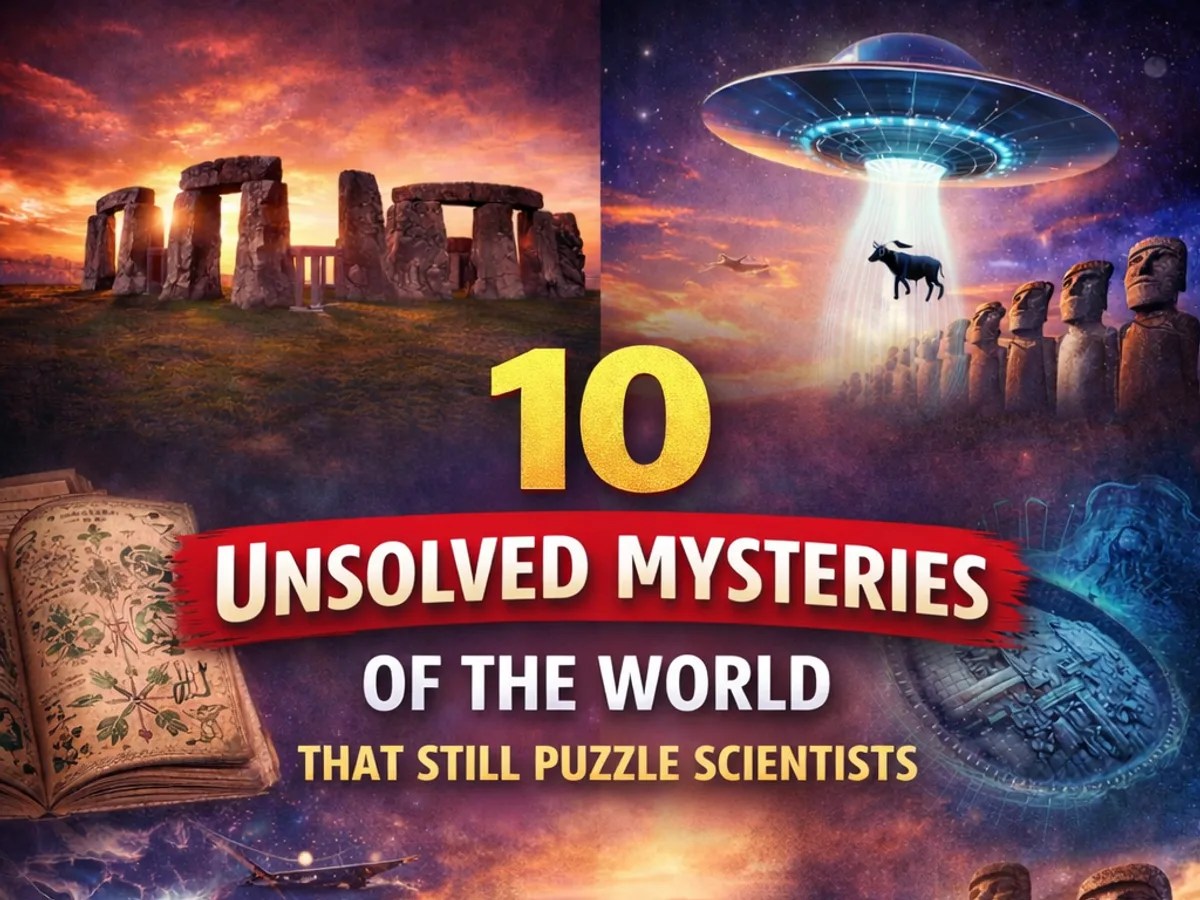
Some of the world’s greatest mysteries have become clearer thanks to archaeology, astronomy and modern technology. Others remain open questions. The important difference is between a mystery scientists are still investigating and a legend that already has a well-supported explanation.
From the stones of prehistoric Britain to an extraordinary radio signal from space, these ten stories reveal what researchers have actually found, what has changed in recent years and what we still do not know. This guide was reviewed and updated on 20 October 2026.
1. Stonehenge: Why Was It Built?
Stonehenge in Wiltshire, England, was constructed and altered in stages, beginning around 3000 BCE. Its alignment with the solstices is well established, and its landscape includes evidence of ceremonial activity and burials. But identifying every ritual, gathering or social purpose the monument served is much harder.
One remarkable discovery changed the conversation about where its stones came from. In 2024, researchers reported in Nature that the geochemical signature of the roughly six-tonne Altar Stone points to the Orcadian Basin of northeastern Scotland, at least 750 kilometres away. This does not prove the precise route taken to transport it; it demonstrates the scale of long-distance connections that Neolithic communities may have maintained.
What remains uncertain: How the Altar Stone was moved and the full range of meanings Stonehenge held for the people who built and used it.

2. The Bermuda Triangle: Mystery or Maritime Myth?
The area loosely described as the Bermuda Triangle lies between Florida, Bermuda and Puerto Rico. Its reputation grew from stories about missing ships and aircraft, including the 1945 disappearance of five US Navy aircraft known as Flight 19.
However, an unexplained individual accident is not evidence of a dangerous supernatural zone. The US National Oceanic and Atmospheric Administration (NOAA) says there is no evidence that mysterious disappearances occur more frequently here than in other heavily travelled ocean regions. Tropical storms, shifting weather, navigation mistakes and the Gulf Stream provide credible risks without invoking unusual forces.
What remains uncertain: The complete details of some historical disappearances; not the existence of a proven paranormal phenomenon. Read our separate Bermuda Triangle investigation for the legend’s wider history.

3. Rapa Nui’s Moai: How Were the Statues Moved?
On Rapa Nui (Easter Island), Polynesian communities carved and transported hundreds of monumental volcanic-stone statues, or moai. Claims that the statues could not have been moved by people ignore decades of archaeological experimentation and the knowledge of Rapa Nui descendants.
One promising explanation is that teams used ropes to rock suitable upright statues from side to side, effectively making them “walk” along prepared routes. That is a tested model, not proof that every statue moved in exactly the same way. A 2025 PLOS One study using more than 11,000 drone images identified 30 distinct quarrying areas at Rano Raraku, supporting a picture of multiple local groups working rather than one central production authority.
What remains uncertain: Which transport methods were used for different statues, how techniques changed over time and how monument-building related to the island’s social and ceremonial life.
4. The Antikythera Mechanism: An Ancient Astronomical Computer
A corroded object recovered from a shipwreck near the Greek island of Antikythera in 1901 turned out to be a sophisticated system of bronze gears. Built more than 2,000 years ago, the mechanism could model astronomical cycles, calendars and eclipse predictions.
Researchers have deciphered inscriptions and used X-ray imaging to reconstruct much of its operation. A 2021 study in Scientific Reports proposed a detailed model of the mechanism’s lost front display. Yet only a portion of the original device survives, so alternative arrangements and engineering details continue to be studied.
What remains uncertain: The precise configuration of missing components, who manufactured the device and how widespread similarly complex technology was in the ancient world. Its importance lies in ancient engineering, not alleged extraterrestrial origins.
5. The Hum: Why Do Some People Hear a Low Drone?
Reports of a persistent low-frequency humming sound have appeared in places including Taos, New Mexico. For some people the experience is disturbing; others nearby hear nothing at all.
There is no good evidence that every report around the world has a single source. In individual cases, researchers and acoustic specialists consider industrial equipment, ventilation, distant traffic, environmental vibration and auditory conditions such as tinnitus. Low-frequency sound can be difficult to trace, and the perceived location of a sound is not always its physical source.
What remains uncertain: The cause of particular reports when careful acoustic measurements and medical assessments have not identified an explanation. “The Hum” is a collection of experiences, not one verified global signal.
6. The Voynich Manuscript: Can Its Script Be Read?
Held at Yale University’s Beinecke Rare Book & Manuscript Library, the Voynich Manuscript is a lavishly illustrated codex written in a script that has resisted reliable interpretation. Its drawings feature plants, astronomical imagery and bathing figures; its text has intriguing patterns but no generally accepted translation.
Yale researchers have identified evidence of multiple scribes. Statistical analyses can reveal structure, but a proposed solution must translate the text consistently and survive independent testing. Claims that artificial intelligence or an ingenious cipher has “finally solved” the manuscript should therefore be treated cautiously.
What remains uncertain: The original language or encoding system, the identity and intentions of its creators and the meaning of its complete text.
7. Dark Matter: What Holds Galaxies Together?
Astronomers observe galaxies rotating and clusters bending light in ways that indicate substantially more gravity than visible stars, gas and dust can account for. Scientists call the additional inferred mass dark matter.
NASA estimates that dark matter accounts for roughly 27% of the universe’s mass-energy budget, compared with about 5% ordinary matter. The evidence for its gravitational effects is strong, but scientists have not established what physical particle or particles, if any, explain it. Experiments and astronomical surveys continue to test competing models.
What remains uncertain: The fundamental nature of dark matter. It should not be confused with dark energy, the name for the still-unexplained phenomenon associated with the universe’s accelerating expansion.
8. The Wow! Signal: A Radio Burst That Has Not Been Repeated
On 15 August 1977, Ohio State University’s Big Ear radio telescope recorded a powerful narrowband radio signal. Astronomer Jerry Ehman later circled its distinctive computer printout and wrote “Wow!” beside it, giving the observation its lasting name.
The signal lasted about 72 seconds as the telescope scanned the sky, and follow-up observations have not established a repeat detection of the same source. Astronomers have discussed natural astrophysical possibilities and other explanations, but none has been conclusively demonstrated.
What remains uncertain: The exact source of the recorded signal. It remains an intriguing observation, not verified evidence of extraterrestrial intelligence.
9. The Nazca Lines: What Were the Giant Designs For?
In southern Peru, the Nazca people and earlier cultures created vast geoglyphs by removing darker stones to reveal lighter ground beneath. Archaeologists understand how this can be done from the ground using planning, ropes and coordinated labour; an aircraft or an outside civilization is not required.
The bigger question concerns the designs’ different roles. A 2024 study led by Yamagata University and IBM Research used AI-assisted surveys and field verification to identify 303 previously unknown figurative geoglyphs. Their distribution suggested that smaller relief-type figures and larger line-type designs may have served different social and ceremonial functions.
What remains uncertain: The meaning of individual motifs, the variety of practices connected to them and how uses changed over centuries. AI has helped researchers discover more artwork, not decode every symbol.
10. Tunguska: What Exploded Above Siberia in 1908?
On 30 June 1908, a devastating blast flattened roughly 2,000 square kilometres of Siberian forest. No conventional impact crater was found. That absence helped make Tunguska a favourite subject of dramatic speculation.
Modern impact research strongly supports an atmospheric airburst caused by a small asteroid or similar cosmic body. Such an object can release enormous energy high above the ground without producing a classic crater. NASA’s historical review describes the evidence from damaged trees, eyewitness accounts and later physical modelling.
What remains uncertain: The object’s precise composition, dimensions and trajectory. The missing crater does not make an extraterrestrial spacecraft or an unknown weapon a credible explanation.
What Makes a Scientific Mystery Truly Unsolved?
Not all unanswered questions are equally mysterious. Scientists can know how an event happened without knowing every detail, as with Tunguska. They can identify a false pattern, as with the Bermuda Triangle legend. Or they can have strong observations but no agreed explanation for the underlying cause, as with dark matter.
That difference matters. New research may solve part of a puzzle while opening fresh questions. The most compelling mysteries are not those that disregard evidence, but those that encourage better measurements, careful comparisons and new ideas.
Frequently Asked Questions
What is the most scientifically important unsolved mystery on this list?
There is no objective single winner. Dark matter concerns fundamental physics and the structure of the universe, whereas the Voynich Manuscript and Stonehenge raise questions about human history. Each requires different kinds of evidence.
Has the Bermuda Triangle mystery been solved?
There is no evidence for an unusually high rate of disappearances in the region. Some individual incidents lack a complete historical reconstruction, but NOAA identifies ordinary maritime and weather hazards as credible explanations.
Did aliens build Stonehenge or the Nazca Lines?
No credible archaeological evidence supports that claim. Both places show the ingenuity and organizational skills of human communities, even though researchers continue to debate some details of their histories and purposes.
Research and Further Reading
The sources below support the factual claims and recent developments discussed in this article. A hypothesis or reconstruction is identified as such rather than presented as a settled fact.
- Nature (2024): A Scottish provenance for the Altar Stone of Stonehenge.
- NOAA: What is the Bermuda Triangle?
- PLOS One (2025): Megalithic statue (moai) production on Rapa Nui.
- Scientific Reports: A Model of the Cosmos in the Antikythera Mechanism.
- Yale University: Deciphering a mysterious manuscript.
- NASA Science: Dark Matter.
- Big Ear Observatory: The Wow! Signal.
- Yamagata University (2024): AI-assisted Nazca geoglyph discoveries.
- NASA: The Tunguska Asteroid Impact Event.
Editorial update: 20 October 2026. Where new evidence is preliminary or debated, it is described with appropriate caution.
Bir yanıt yazın