


Bukhara is a historic oasis city on the Silk Roads in Uzbekistan. Its old town was inscribed on the UNESCO World Heritage List in 1993, thanks to its well-preserved medieval urban fabric and its significance as a trading, religious and intellectual center. Beyond the famous minarets, the city rewards travelers who explore its narrow lanes, courtyards, working markets and layers of history.
If you dream of walking through centuries of history while discovering hidden courtyards, traditional tea houses, and breathtaking Islamic architecture, Bukhara should be on your travel list.
✨ Why Visit Bukhara?
Much of Bukhara’s old-city core can be explored on foot, and its trading domes, madrasas and historic courtyards remain central to the experience. It is a living city rather than an untouched museum: some monuments have been restored, while ordinary neighborhoods, shops and homes continue to change.
Reasons travelers love Bukhara:
✔ UNESCO World Heritage atmosphere
✔ Incredible Silk Road history
✔ Traditional Uzbek culture
✔ Stunning Islamic architecture
✔ Friendly locals and authentic markets
✔ Perfect destination for photography lovers
Uzbekistan’s official tourism portal describes more than 140 monuments across Bukhara, while UNESCO recognizes the outstanding value of the historic cityscape as a whole. The old center has been a World Heritage Site since 1993.
🏰 Top Places To Visit In Bukhara
🕌 Poi Kalyan Complex
The Po-i-Kalyan (Poi Kalon) ensemble is one of Bukhara’s defining sights. The 12th-century Kalyan Minaret, the later Kalyan Mosque and the Mir-i-Arab Madrasa frame a monumental square of brickwork, arches and tile decoration.
This historic area includes:
- Kalyan Minaret
- Kalyan Mosque
- Mir-i-Arab Madrasa
The Kalyan Minaret was completed in 1127 during the Karakhanid period. It was primarily a religious and civic landmark; accounts of its role as a beacon for travelers also appear in descriptions of Bukhara. Stories linking its survival to Genghis Khan are best treated as legends, not documented eyewitness history.
Visiting at sunset creates one of the most unforgettable views in Uzbekistan.

🏛 Ark Fortress
The Ark Citadel served as the fortified residence and administrative center of Bukhara’s rulers for centuries. Its visible structures reflect rebuilding over different periods, so it should not be described as an entirely intact ancient palace.
Inside you can discover:
- Royal courtyards
- Ancient museums
- Historic rooms
- Military exhibits
Allow time for the museum rooms and the view over the surrounding city; access to individual rooms and exhibitions can change during restoration.

🌊 Lyabi-Hauz
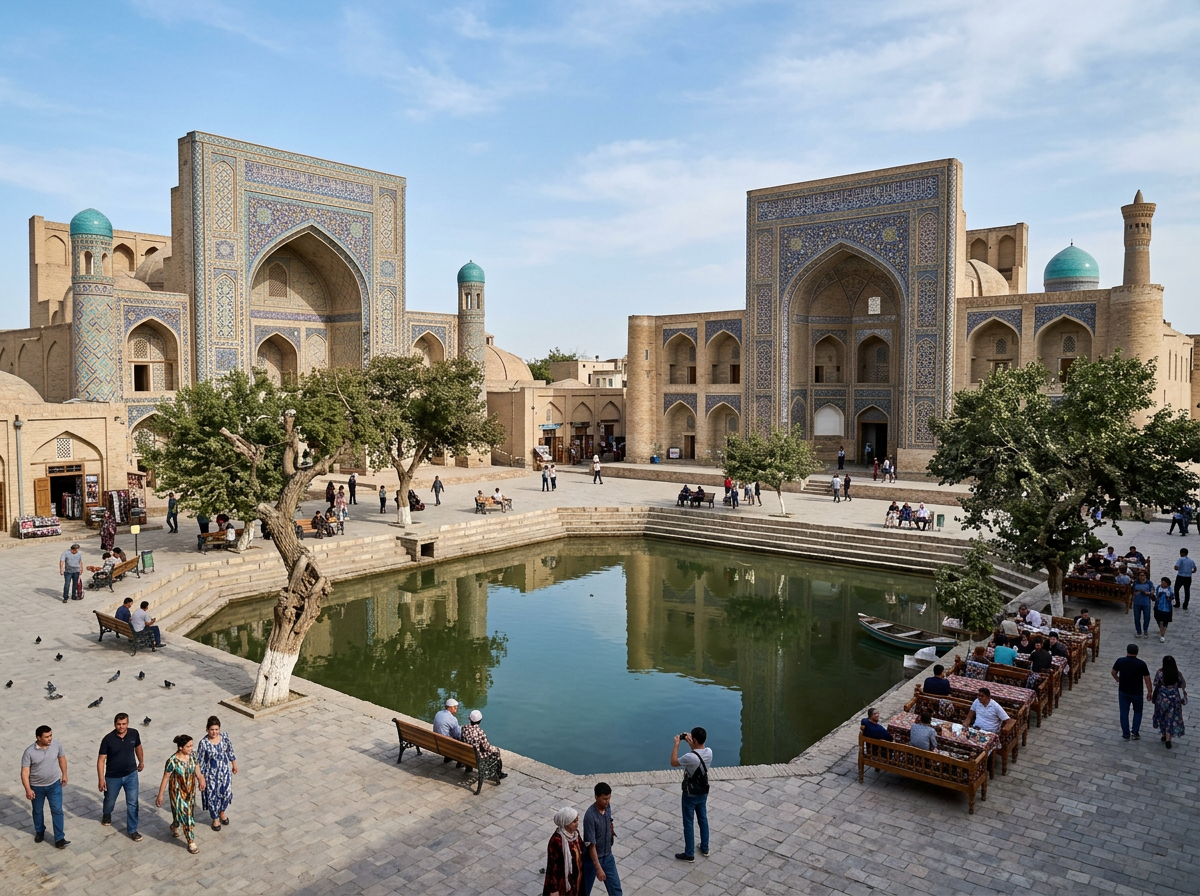
The Lyabi-Hauz ensemble centers on a historic pool and is surrounded by important buildings, including Kukeldash Madrasa and the Nadir Divan-Begi complex. It remains one of the most recognizable places to sit and observe daily life in old Bukhara.
Visitors enjoy:
☕ Traditional tea houses
🎵 Street musicians
🌳 Shaded seating areas
📸 Beautiful evening views
Visit in the late afternoon for shade and lively cafés, but remember that the most scenic waterside tables may be priced for the location. Check menus before sitting down, and try a neighborhood restaurant away from the busiest square for a different food experience.
🌙 Chor Minor
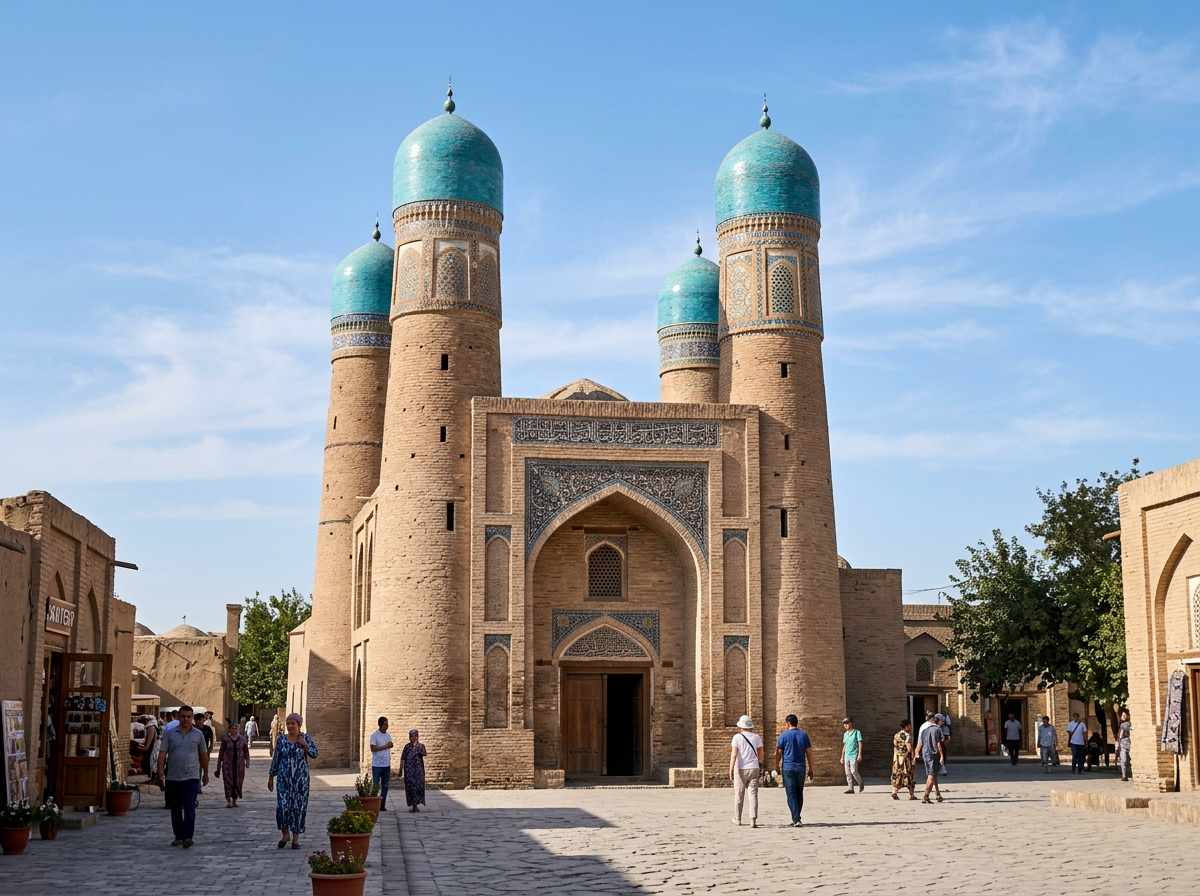
Chor Minor dates to around 1807 and is associated with the former Khalifa Niyazkul Madrasa. The surviving gateway structure has four distinctive turret-like towers, each crowned with a blue dome.
The name means “four minarets,” but the four corner towers are not equivalent to four large standalone mosque minarets. The compact building is best understood in the context of the former madrasa complex.
It has become one of the city’s most photographed sites.
More Historic Places Worth Adding
Samanid Mausoleum: A celebrated example of 10th-century brick architecture and one of the earliest surviving monuments of the city. Its geometric brickwork is the attraction, even without bright tile mosaics.
Bolo-Hauz Mosque and Chashma-Ayub: Near the Ark area, these sites offer a useful contrast between monumental religious architecture and Bukhara’s history of public water supply. Check which parts are open before visiting.
Sitorai Mokhi-Khosa: The former emir’s summer palace lies outside the compact old-town walking route and is better reached by taxi. Allow extra time if you want to add it to a two- or three-day stay.
Layers of community history: Bukhara also has an important Bukharan Jewish heritage. A responsible visit considers the living community and its places of worship, rather than treating them simply as photogenic attractions.
🛍 Traditional Silk Road Markets
The toki trading domes are reminders of Bukhara’s role in Silk Road commerce. Historically these covered intersections specialized in different goods; today many stalls sell textiles, ceramics, metalwork and souvenirs.
Popular shopping finds include:
🧵 Handmade carpets
💎 Jewelry
🎨 Miniature paintings
🧣 Silk scarves
🏺 Ceramics
🎁 Traditional souvenirs
Prices may be negotiable in some souvenir markets, but not in every shop. Ask politely about the price and origin of handmade items, compare a few workshops and avoid treating all crafts as mass-produced souvenirs.
🍽 What To Eat In Bukhara
Uzbek food draws on the country’s diverse regional traditions. In Bukhara, look beyond the familiar national dishes for oshi sofi, a local style of plov prepared in layers, and for the wider culinary heritage of the city’s Uzbek, Tajik and Bukharan Jewish communities.
Must-try dishes:
🥘 Oshi sofi — Bukhara-style plov, often layered and associated with a lighter preparation than some other regional versions
🥟 Manti — steamed dumplings with meat or other fillings
🍢 Shashlik — grilled skewers served with onions and bread
🍞 Non — traditional flatbread, often baked in a tandir oven
🥟 Samsa — savory pastries often baked in a tandir
🍜 Lagman — noodles with vegetables and meat; also common elsewhere in Central Asia
🍇 Local dried fruits and sweets
Courtyard restaurants near Lyabi-Hauz are convenient, but menu prices and opening hours change. For a regional food experience, ask your accommodation where locals eat oshi sofi at lunchtime; not every restaurant offers it daily.
A Practical 2-Day Bukhara Itinerary
Day 1 — The Walkable Old City
- Morning: Start at Po-i-Kalyan while the square is relatively cool, then follow the trading domes and explore the surrounding historic lanes.
- Lunch: Try samsa or a local plov restaurant; ask whether oshi sofi is being served that day.
- Afternoon: Continue through the trading domes to Lyabi-Hauz and, if time allows, take a short detour to Chor Minor.
- Evening: Return to Lyabi-Hauz for tea and a relaxed walk; photograph monuments without obstructing worshippers or residents.
Day 2 — Fortresses, Brickwork and Local History
- Morning: Visit the Ark Citadel and Bolo-Hauz Mosque, then continue to the Samanid Mausoleum and nearby Chashma-Ayub.
- Afternoon: Spend time in a craft workshop or museum; choose Sitorai Mokhi-Khosa if you have several extra hours and are comfortable using a taxi.
- Evening: Leave room for a slower neighborhood walk or a second look at Po-i-Kalyan in changing light.
Route-planning note: This is an editorially researched itinerary, not a first-hand trip report. Distances and visiting conditions depend on your hotel location, season, restoration work and personal pace. Consider a third day if you enjoy museums, photography or slow travel.
🏨 Where To Stay In Bukhara
Luxury Experience
Historic boutique hotels near the old city offer:
✔ Traditional architecture
✔ Courtyard gardens
✔ Rooftop terraces
Mid-Range Hotels
Family-run guesthouses can be good value near the historic center. Compare recent reviews for air-conditioning, heating, room noise and whether the bathroom is private; facilities vary more than the star label suggests.
Budget Travelers
Hostels and smaller guesthouses around the old town are excellent options for backpackers.
For a short trip, an address within walking distance of Lyabi-Hauz or the trading domes is practical. If arriving late at night, confirm whether the property can arrange a transfer, since some old-town lanes are pedestrian-only or difficult for cars to reach.
Travel Editor’s Practical Note
What makes the biggest difference to a visit? Not rushing. The old-town sights look close together on a map, but heat, uneven paving, prayer times and museum visits can make a tightly packed schedule tiring. Prioritize Po-i-Kalyan, the Ark area and Lyabi-Hauz, then use remaining time for a craft workshop or a quiet courtyard.
Experience-based planning insight, not a claim of personal travel: A two-night stay usually offers a better rhythm than a quick stop between trains. Book a central guesthouse, see the busiest landmarks earlier in the day, compare food beyond the tourist square and keep one flexible block of time for discoveries. These are practical editorial recommendations drawn from the city layout and official visitor resources.
🌤 Best Time To Visit Bukhara
The climate in Bukhara can become extremely hot during summer.
Best seasons:
🌸 Spring (March–May)
🍂 Autumn (September–November)
April–May and September–October are often the most comfortable windows for long walking days. March and November can also work, but temperatures vary; mid-summer afternoons may be extremely hot, so plan indoor breaks.
How to Get to Bukhara and Move Around
By train: Bukhara is served by rail connections from Tashkent and Samarkand, including Afrosiyob services on applicable dates. The main station commonly shown as Bukhara-1 is in Kogon (Kagan), outside the old city; arrange onward transport rather than expecting to walk from the platform to Po-i-Kalyan. Timetables and prices change, so check Uzbekistan Railways’ official electronic ticket system when booking.
Inside the city: Most major old-town highlights are walkable, but a car or taxi is useful for the station, airport and outlying sites. Carry some Uzbek som for small purchases, confirm fares in advance, and have your accommodation address available offline.
Entry and practical details: Visa rules depend on nationality, passport and length of stay. Confirm requirements with Uzbekistan’s official e-visa/consular guidance before travel. Hotels commonly handle guest registration, but visitors should confirm applicable requirements with their accommodation. Monument fees, access, photography policies and worship schedules can change without much notice.
Travel comfort: Summer days can be very hot; bring drinking water, sun protection and shoes suitable for stone paving. Dress respectfully in active religious spaces and ask permission before photographing people, private courtyards or worship.
🚶 Travel Tips For Visiting Bukhara
✔ Carry cash for local markets
✔ Wear comfortable walking shoes
✔ Dress modestly when visiting religious sites
✔ Visit historical attractions early in the morning
✔ Bring a camera—the city is incredibly photogenic
✔ Learn a few Uzbek or Russian phrases
📷 Hidden Photography Spots
Want unique photos beyond tourist areas?
Explore:
📍 Rooftop terraces around the old city
📍 Quiet alleyways behind Lyabi-Hauz
📍 Sunset near Kalyan Minaret
📍 Traditional courtyards
These hidden corners often create the most magical travel memories.
❓ Frequently Asked Questions
Is Bukhara worth visiting?
Absolutely. Bukhara offers one of the richest cultural experiences in Central Asia.
How many days should I spend in Bukhara?
Two to three days is ideal for exploring the city comfortably.
Is Bukhara safe for tourists?
Bukhara is a popular tourist destination, but no city is risk-free. Use licensed transport or a trusted taxi service, watch valuables in crowds, take care on uneven streets and confirm current travel advice and entry rules before departure.
Can you walk around Bukhara?
Yes. Most major attractions are located close together within the old city.
🌍 Final Thoughts
Bukhara is more than a destination—it feels like stepping directly into history. Ancient mosques, centuries-old fortresses, colorful bazaars, and warm hospitality make this city unforgettable.
If you want a travel experience filled with culture, architecture, and timeless Silk Road charm, Bukhara deserves a spot on your bucket list.
📲 Follow us for more travel guides, hidden destinations, and world discoveries. Don’t forget to visit mutlucicekler.com
Sources and Editorial Fact-Checking
Research checked on 20 October 2026. Key references: UNESCO World Heritage Centre, “Historic Centre of Bukhara” (property 602, inscription 1993); Uzbekistan Travel, official Bukhara, Lyabi-Hauz, Po-i-Kalyan, Chor Minor and Ark pages; Uzbekistan Railways, official e-ticket platform for current departures; and Uzbekistan’s official e-visa portal for entry guidance. Practical suggestions are editorial planning advice, not claims of first-hand visits. Verify prices, opening hours and entry conditions before traveling.

Bir yanıt yazın