
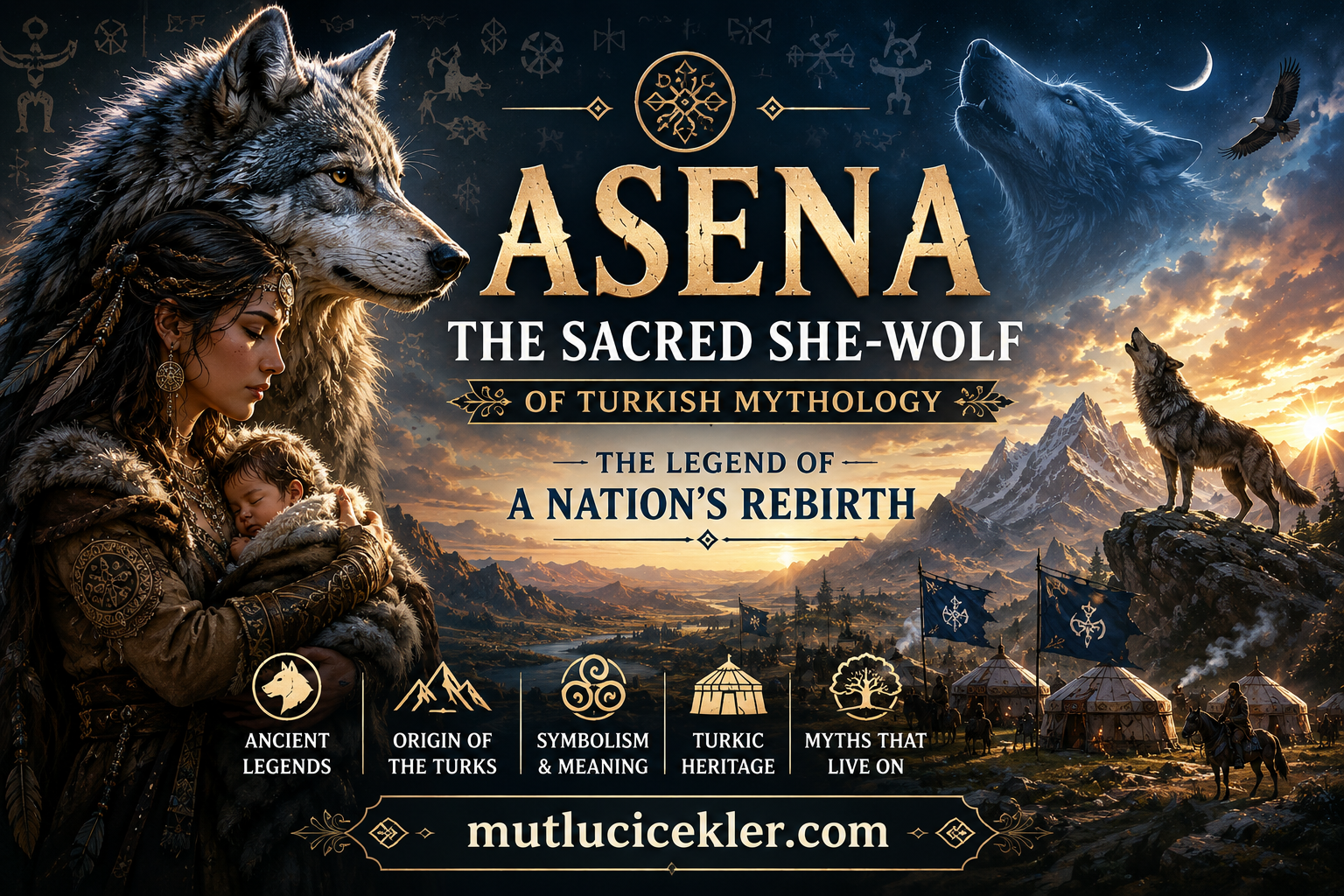
Turkish mythology is filled with epic heroes, sky gods, sacred mountains, and ancient symbols. Among its most fascinating and powerful figures stands Asena, the legendary sacred she-wolf believed to be connected to the origin story of the Turkic people.
Far more than a mythological creature, Asena represents protection, rebirth, guidance, strength, and survival. Her story is one of the most iconic legends of the ancient Turkic world and continues to inspire historians, mythology lovers, and cultural researchers today.
The tale of Asena is not simply about a wolf—it is about hope rising from destruction and a nation being reborn from near extinction.
🐺 Who Is Asena?
Asena is known in Turkish mythology as a mystical female wolf who appears during a time of great tragedy.
According to ancient legends, a Turkic tribe suffers a devastating attack and is nearly wiped out. Among the destruction, only a single young boy survives.
The child is badly injured and left alone to die.
At the moment when all hope seems lost, a sacred she-wolf appears.
That wolf is Asena.
Instead of abandoning the child, Asena protects him.
🌿 She carries him to safety
🌿 She nurses and heals him
🌿 She raises and protects him
🌿 She becomes the beginning of a new generation
Through this act, Asena becomes one of the most important symbols in Turkish mythology.
She is viewed not only as a protector but as the mother figure of rebirth and continuation of a people.
🌄 The Story Behind the Asena Legend
Long ago, according to ancient Turkic tales, a powerful tribe was attacked by enemies and nearly destroyed.
Only one child survived.
Some versions of the story say the child was severely wounded; others describe him as abandoned in the wilderness.
Left helpless in the harsh lands of the steppe, his future seemed hopeless.
Then something extraordinary happened.
A mysterious she-wolf emerged from the mountains.
This sacred wolf found the child and saved him.
Asena took him far away to a hidden valley surrounded by mountains, protecting him from danger and helping him survive.
Over time, a new lineage was born from this child.
According to legend, these descendants eventually became the ancestors of future Turkic tribes.
✨ Thus, Asena became a symbol of new beginnings after destruction.
🏔 The Connection Between Asena and the Göktürks
The Asena legend is often closely connected with the origin stories of the ancient Göktürks, one of the most important early Turkic empires.
The Göktürks viewed wolves differently from many other cultures.
For them, wolves were not simply wild animals.
They symbolized:
🐺 Courage
🐺 Leadership
🐺 Survival
🐺 Freedom
🐺 Guidance
Because of this belief, wolf imagery frequently appeared in banners, military symbols, and tribal traditions.
The wolf became an identity symbol deeply rooted in Turkic culture.
🔥 Why Was the Wolf So Important in Turkic Culture?
Life on the Central Asian steppes was difficult.
Nomadic tribes closely observed nature and animals to survive.
Among all animals, wolves stood out because of their remarkable qualities:
🐾 Meanings of the Wolf Symbol:
✅ Independence
✅ Strength
✅ Loyalty to the pack
✅ Strategic intelligence
✅ Leadership
✅ Protection
The wolf survived harsh winters and difficult landscapes while guiding its pack.
These characteristics deeply resonated with ancient Turkic societies.
👑 Is Asena a Mother Figure?
Many historians and mythology enthusiasts interpret Asena as a symbolic mother figure.
Her role was not merely rescuing a child.
She represented:
🌙 Protection
🌙 Continuation of life
🌙 Survival of future generations
🌙 Rebirth after catastrophe
Unlike many mythological creatures associated solely with war or destruction, Asena’s strength comes from preserving life.
This nurturing role makes her unique among legendary figures.
🧭 Asena and the Guide Wolf Motif
The wolf appears repeatedly throughout Turkic mythology as a sacred guide.
One of the strongest examples can be found in the famous Ergenekon Legend.
According to the story, Turks become trapped inside a hidden valley surrounded by mountains.
After many years they finally escape and rebuild their civilization.
In some interpretations, a wolf serves as the guide leading them toward freedom.
This creates a symbolic connection between Ergenekon and Asena:
🐺 Both involve salvation
🔥 Both symbolize rebirth
🏔 Both tell stories of survival
🧭 Both feature guidance during difficult times
📜 What Does the Name Asena Mean?
There are several theories surrounding the name Asena.
Some researchers connect the name with the sacred female wolf image itself.
Others link it to Ashina, the ruling clan associated with the Göktürks in historical Chinese records.
Because of this, Asena exists somewhere between myth and historical symbolism.
🌌 What Does Asena Symbolize?
The reason Asena remains important today is because of the deeper meanings attached to her legend.
✨ Symbolic meanings of Asena:
🐺 Rebirth
🛡 Protection
🌿 Survival
🔥 Strength
🧭 Guidance
👑 Identity
🌙 Hope
Asena represents the idea that even after devastation, a new future can emerge.
🐺 Animals and Symbols in Turkish Mythology
Animals hold a powerful place within Turkic mythology.
🐎 Horse
Freedom, migration, and warrior culture.
🦅 Eagle
Sky power and authority.
🐺 Wolf
Leadership, protection, and origin myths.
🐉 Dragon
Cosmic forces and natural power.
Among these symbols, the wolf occupies a particularly sacred role due to its connection with the origin of Turkic peoples.
🔥 Lessons Hidden Inside the Asena Legend
Ancient myths often contain messages that still resonate today.
🌿 Hope can survive even in darkness
When everything seemed lost, a future still emerged.
🛡 Protection comes in unexpected forms
The savior of the story is not a king or warrior—but a wolf.
🐺 Strength is not only about fighting
Asena’s power lies in nurturing and preserving life.
🧭 Knowing your roots strengthens identity
Myths help societies understand where they came from.
🔥 Every ending can become a new beginning
Perhaps this is the greatest message of all.
❓ Frequently Asked Questions
🐺 Was Asena real?
Asena is considered a mythological figure rather than a historical person.
🐺 Is Asena male or female?
Asena is traditionally portrayed as a female wolf.
🐺 What does Asena symbolize?
She symbolizes protection, rebirth, strength, and cultural identity.
🐺 Is Asena the same as the Gray Wolf?
Not exactly. The Gray Wolf is a broader Turkic symbol, while Asena is a specific mythological character.
🌍 Final Thoughts
The story of Asena is much more than an old legend.
It is a tale of resilience, hope, and survival.
For centuries, this sacred she-wolf has represented the idea that even after destruction, life can begin again.
That may be why Asena continues to live in stories, history, and cultural memory today.
🐺 Explore more mythology, history, travel, and fascinating stories on mutlucicekler.com
Bir Cevap Yazın