
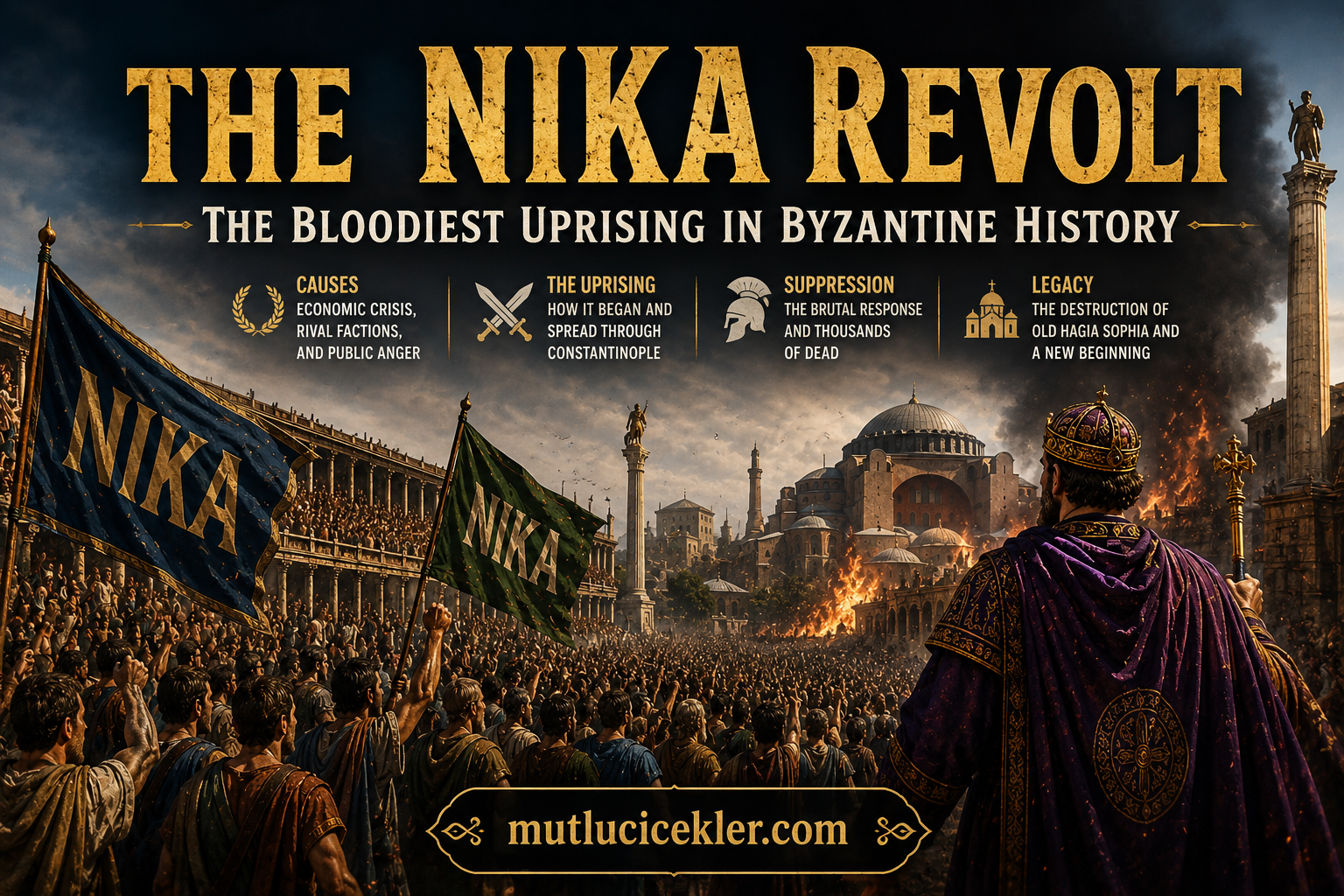
The Nika Revolt is remembered as one of the most dramatic and violent events in the history of the Byzantine Empire. More than just a public riot, it was a massive explosion of political anger, economic frustration, and social unrest that nearly brought down the empire itself. Taking place in Constantinople in 532 AD during the reign of Emperor Justinian I, the revolt caused widespread destruction and led to the deaths of tens of thousands of people.
In this article, we explore the causes, events, consequences, and historical importance of the Nika Revolt in detail.
📜 What Was the Nika Revolt?
The Nika Revolt was a major uprising against the Byzantine Emperor Justinian I in January 532 AD. The word “Nika” comes from the Greek language and means “Victory!”
The rebellion began inside the Hippodrome of Constantinople, where rival chariot racing fan groups gathered. What started as sports-related tension quickly transformed into a political revolt against imperial authority.
🏛️ Causes of the Nika Revolt
💰 1. Heavy Taxes and Economic Pressure
Emperor Justinian imposed high taxes to finance wars, construction projects, and imperial expansion. The population, especially the poor, suffered greatly under this economic burden.
Corrupt tax officials and harsh collection methods increased public anger.
🏇 2. Rivalry Between the Blues and Greens
Two major factions dominated the Hippodrome:
- The Blues
- The Greens
Although originally sports supporters, these groups became powerful political and social organizations. Their rivalry often turned violent and reflected deeper divisions within Byzantine society.
👑 3. Public Anger Toward the Government
Many people viewed Justinian’s administration as oppressive and unfair. Government officials were accused of corruption, cruelty, and abuse of power.
The public’s frustration continued to grow until it exploded into open rebellion.
🔥 How Did the Nika Revolt Begin?
The revolt started after several members of the rival factions were sentenced to execution. When some prisoners escaped, supporters from both sides united against the emperor.
Crowds gathered inside the Hippodrome shouting:
“Nika! Nika!”
meaning “Victory!”
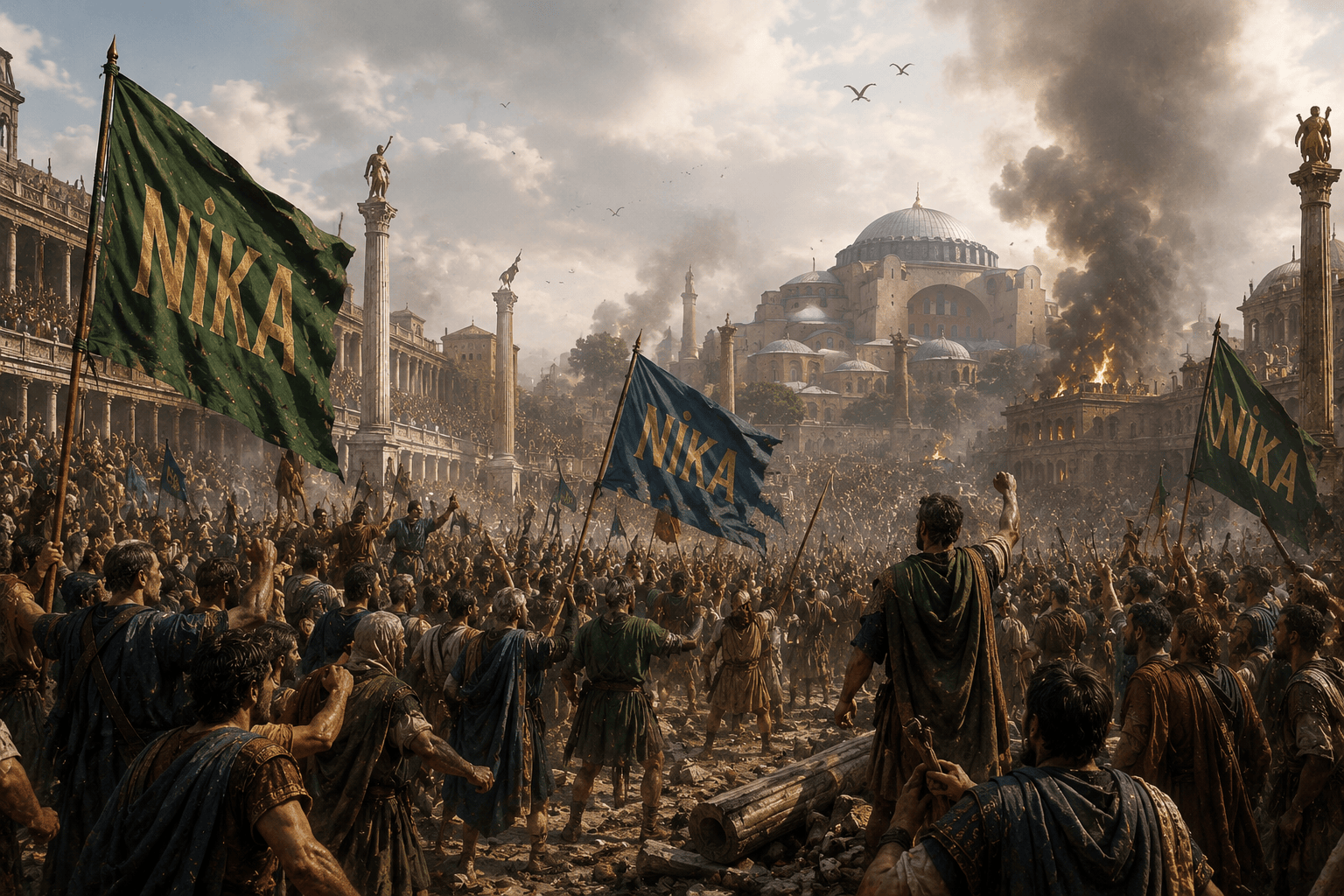
Soon, the uprising spread across the city:
- Government buildings were burned
- Large fires destroyed parts of Constantinople
- Chaos spread through the streets
- The original Hagia Sophia was heavily damaged
The Byzantine capital turned into a battlefield.
👸 Empress Theodora’s Famous Speech
At the height of the rebellion, Emperor Justinian reportedly considered fleeing the city. However, Empress Theodora delivered a powerful speech that changed history.
Her most famous quote was:
“Purple is the noblest shroud.”
This meant it was better to die as royalty than to live in disgrace.
Her courage convinced Justinian to stay and fight.
⚔️ How Was the Nika Revolt Suppressed?
Justinian ordered his generals, including the famous Belisarius, to crush the rebellion.
The rebels gathered inside the Hippodrome, believing negotiations would take place. Instead, imperial troops entered and carried out a brutal massacre.
Historical sources estimate that:
- Around 30,000 people were killed
The revolt ended in bloodshed and became one of the deadliest internal conflicts in Byzantine history.
🕌 The Nika Revolt and Hagia Sophia
During the revolt, the original Hagia Sophia was destroyed by fire. After the uprising ended, Justinian ordered the construction of a new and more magnificent Hagia Sophia.
The world-famous structure standing in Istanbul today was built as a direct result of the Nika Revolt.
🌍 Consequences of the Nika Revolt
📌 Justinian Strengthened His Power
After suppressing the rebellion, Justinian consolidated his authority and ruled with greater control.
🏗️ Massive Reconstruction Projects Began
Constantinople was rebuilt with grand architecture, including the new Hagia Sophia, which became one of the greatest achievements of Byzantine architecture.
⚖️ Increased Government Control
The empire became stricter after the revolt. Opposition groups and political unrest were more heavily controlled.
🧠 Historical Importance of the Nika Revolt
The Nika Revolt remains one of the most important events in Byzantine history because it demonstrates:
- How economic pressure can lead to social unrest
- The political power of mass movements
- The dangerous connection between sports rivalries and politics
It also marked a turning point in the reign of Justinian and the future of the Byzantine Empire.
📍 Where Did the Nika Revolt Take Place?
The center of the revolt was the Hippodrome of Constantinople, located in today’s Sultanahmet Square in Istanbul, Türkiye.
Visitors can still see important monuments in the area, including:
- The Obelisk of Theodosius
- The Serpent Column
- The Walled Obelisk
These landmarks remain connected to the memory of the revolt.
✨ Conclusion
The Nika Revolt was far more than a simple riot. It was a historic uprising that changed the political and social structure of the Byzantine Empire forever. The revolt demonstrated the devastating consequences of economic hardship, political oppression, and public anger.
Even today, historians consider the Nika Revolt one of the defining moments of Byzantine history and an event that left a permanent mark on the story of Istanbul.
❓ Frequently Asked Questions (FAQ)
When did the Nika Revolt happen?
The Nika Revolt took place in 532 AD during the Byzantine Empire.
What does “Nika” mean?
“Nika” is a Greek word meaning “Victory.”
Why did the Nika Revolt start?
The revolt began because of heavy taxes, political dissatisfaction, and conflicts between Hippodrome factions.
How many people died in the Nika Revolt?
Historical estimates suggest around 30,000 people were killed.
What is the connection between the Nika Revolt and Hagia Sophia?
The original Hagia Sophia was destroyed during the revolt, leading to the construction of the current Hagia Sophia.
Where did the Nika Revolt happen?
It took place in Constantinople, modern-day Istanbul, around the Hippodrome area.
📌 Follow us for more history, travel, culture, and discovery content from around the world!


Bir Cevap Yazın