
🌌 Introduction
Throughout history, only a few individuals have managed to change the course of science forever. One of those extraordinary figures is undoubtedly Ulugh Beg — a ruler, mathematician, astronomer, and visionary scholar of the Turkic-Islamic Golden Age.
Known for his groundbreaking astronomical calculations and the legendary Samarkand Observatory, Ulugh Beg became one of the greatest scientific minds of the 15th century. His studies on stars and planetary movements amazed even modern scientists centuries later.
Today, Ulugh Beg is remembered not only as a ruler but also as one of the most important astronomers in world history.
⭐ Who Was Ulugh Beg?
Ulugh Beg was born on March 22, 1394, in Sultaniye, Persia. His real name was Muhammad Taraghay ibn Shah Rukh. He was the grandson of the famous conqueror Timur (Tamerlane).
Unlike many rulers of his time who focused on wars and expansion, Ulugh Beg devoted his life to science, mathematics, and astronomy. From an early age, he showed exceptional intelligence and a deep fascination with the stars.
He later became the ruler of Samarkand, one of the most important cultural and scientific centers of the era.
👑 The Life Story of Ulugh Beg
🏰 Early Years
Growing up during Timur’s vast campaigns, Ulugh Beg had the opportunity to experience different cultures and intellectual traditions. He received education from leading scholars of the Islamic world and quickly became passionate about mathematics and astronomy.
Even as a young prince, he dreamed of transforming Samarkand into a global center of knowledge.
🔭 His Passion for Astronomy
Ulugh Beg believed that understanding the universe was one of humanity’s greatest missions. Instead of spending his energy on military conquests, he gathered scholars, mathematicians, and astronomers in Samarkand.
This passion eventually led him to establish one of the greatest observatories in history.
🌠 The Legendary Samarkand Observatory
Built in the 1420s, the Samarkand Observatory was among the most advanced scientific institutions of its time.
The observatory contained enormous astronomical instruments used to measure the positions of stars and planets with incredible precision. Long before modern telescopes existed, Ulugh Beg and his team were already making remarkably accurate celestial observations.
At the observatory, scientists worked on:
- Star mapping
- Planetary calculations
- Calendar systems
- Astronomical tables
- Mathematical research
The observatory became a symbol of scientific excellence in the medieval world.
📚 Ulugh Beg’s Contributions to Science
🌌 Zij-i Sultani (The Star Catalogue)
One of Ulugh Beg’s most famous works is the “Zij-i Sultani,” an advanced astronomical catalogue containing the positions of more than 1,000 stars.
This masterpiece became one of the most accurate star catalogues created before the invention of modern telescopes and was used by astronomers for centuries.
⏳ His Astonishing Calculation of the Year
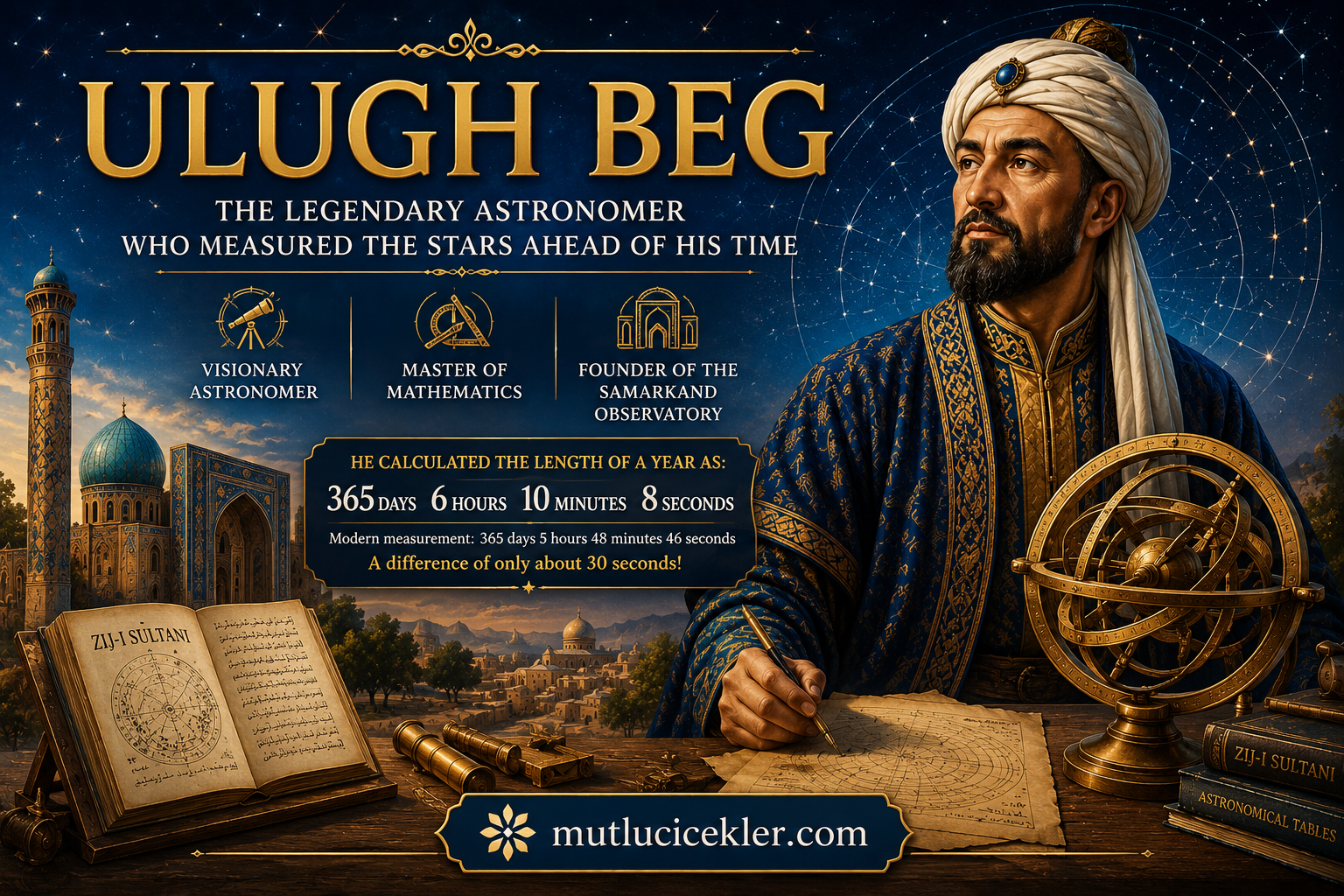
One of Ulugh Beg’s most remarkable achievements was calculating the length of a solar year with extraordinary precision.
He calculated a year as:
365 days, 6 hours, 10 minutes, and 8 seconds.
Modern scientific measurements place the tropical year at approximately:
365 days, 5 hours, 48 minutes, and 46 seconds.
This means Ulugh Beg’s calculation had only a tiny margin of error — astonishing for a scientist working nearly 600 years ago without modern technology. Some historical sources even mention that the difference was close to only about 30 seconds.
This achievement is considered one of the greatest accomplishments in the history of medieval astronomy.
➗ Contributions to Mathematics
Ulugh Beg was not only an astronomer but also an exceptional mathematician.
His work included:
- Advanced trigonometric calculations
- Precise angle measurements
- Geometric analysis
- Mathematical astronomy
His mathematical methods influenced scholars far beyond Central Asia.
🕌 Transforming Samarkand into a Scientific Capital
Under Ulugh Beg’s leadership, Samarkand became one of the intellectual capitals of the world.
He established:
- Great madrasas
- Scientific academies
- Educational centers
- Libraries for scholars
Students and scientists from different regions traveled to Samarkand to study astronomy and mathematics.
⚔️ The Tragic End of Ulugh Beg
Despite his brilliance in science, Ulugh Beg faced political struggles during his reign.
Conflicts within the ruling family eventually led to a tragic outcome. In 1449, he was assassinated during a power struggle involving his own son, Abd al-Latif.
His death was considered a devastating loss for the scientific world.
🌍 Why Ulugh Beg Still Matters Today
Historians and scientists regard Ulugh Beg as:
- One of the greatest astronomers of the Islamic Golden Age
- A pioneer of scientific observation
- A ruler who prioritized education and science
- One of the most important medieval mathematicians
In honor of his contributions, a crater on the Moon was named after him.
✨ Fascinating Facts About Ulugh Beg
🔹 Grandson of Timur (Tamerlane)
🔹 Built one of history’s greatest observatories
🔹 Created one of the world’s most accurate medieval star catalogues
🔹 Advanced astronomy centuries ahead of his time
🔹 A lunar crater carries his name today
📌 Conclusion
Ulugh Beg was far more than a ruler — he was a visionary scientist whose passion for astronomy changed the course of scientific history. His work at the Samarkand Observatory demonstrated that knowledge and curiosity can shape civilizations.
Centuries later, his achievements still inspire astronomers, historians, and science enthusiasts around the world.
Ulugh Beg remains one of the brightest scientific stars of the medieval era.
❓ Frequently Asked Questions (FAQ)
Who was Ulugh Beg?
Ulugh Beg was a 15th-century astronomer, mathematician, and ruler of the Timurid Empire.
Why is Ulugh Beg famous?
He is famous for his astronomical research, the Samarkand Observatory, and his highly accurate star catalogue.
What is the Samarkand Observatory?
It was one of the world’s most advanced medieval observatories founded by Ulugh Beg.
What did Ulugh Beg calculate?
He calculated the length of a solar year with astonishing precision and created advanced astronomical tables.
How did Ulugh Beg die?
He was assassinated in 1449 during political conflicts within the Timurid dynasty.
🌍 Follow us for more fascinating history, science, and cultural discoveries from around the world!












Bir Cevap Yazın