

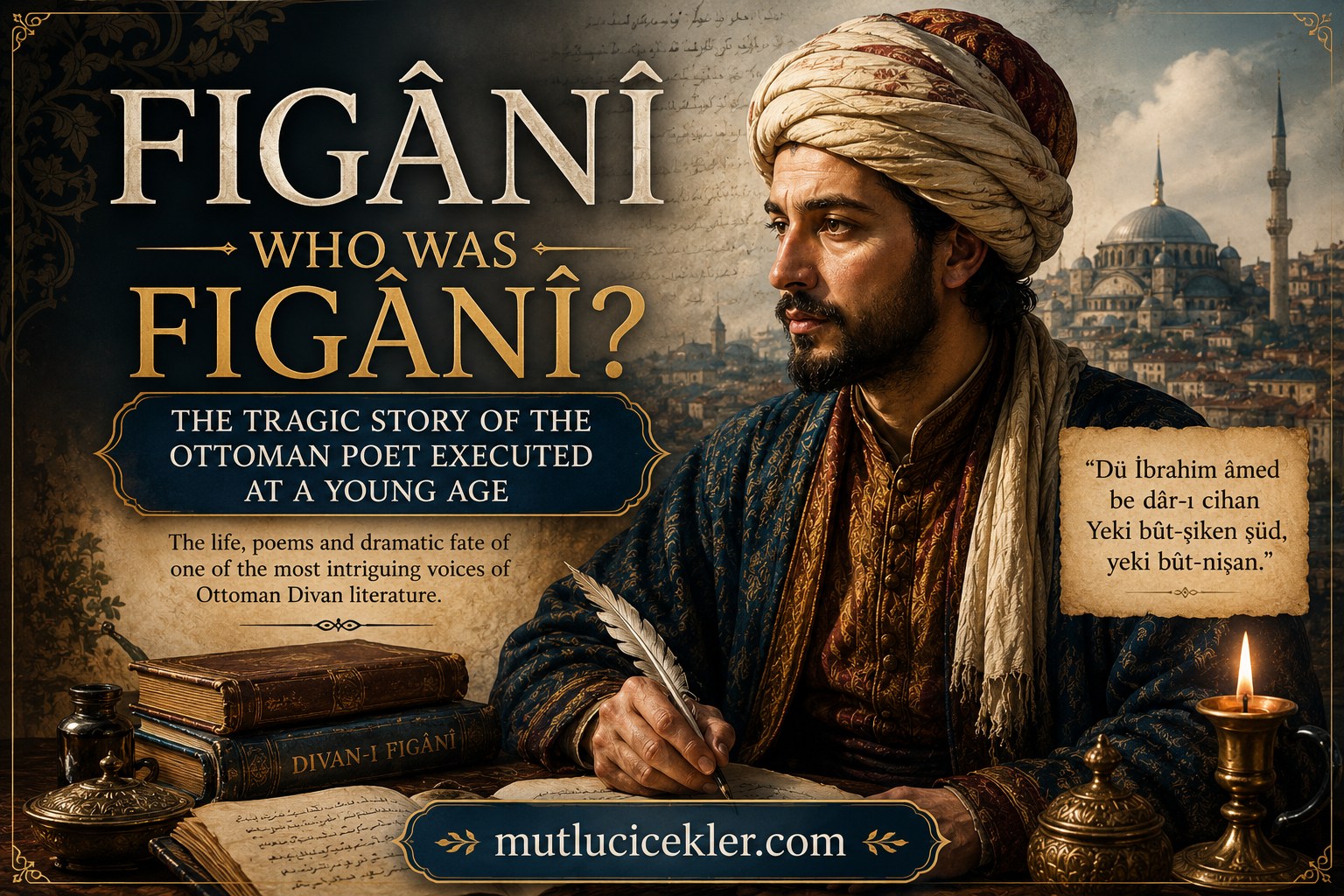
Who was Figânî, and why was he executed? Figânî (also written Figani or Fighani) was an early sixteenth-century Ottoman poet from Trabzon whose given name was Ramazan. He gained recognition in Istanbul for sophisticated divan poetry, especially a celebratory ode associated with Sultan Suleiman’s sons in 1530. He died young, most probably in 1532, after a Persian couplet criticizing Grand Vizier Pargalı Ibrahim Pasha was attributed to him. Crucially, the authorship of that couplet is disputed: an important early account suggests that Figânî may have commented on an older verse rather than written it himself.
His story is often reduced to a simple claim that one poem cost him his life. The historical record is more complicated. Accounts written by Ottoman biographers describe a gifted young poet, networks of patrons and rivals, a satirical verse circulating through Istanbul, and an arrest linked to the powerful grand vizier. This guide separates well-supported biographical details from claims that remain uncertain, explains his surviving poetry, and identifies reliable sources for further reading.
Figânî at a Glance: Life, Dates and Literary Importance
| Question | Historically supported answer |
|---|---|
| Who was Figânî? | A sixteenth-century Ottoman divan poet known for ghazals and qasidas. |
| Real name | Ramazan; the name Ramazan Çelebi also appears in reference works. |
| Birthplace | Trabzon, in the Ottoman Empire. |
| Birth year | Usually estimated at around 1505; not independently established as an exact date. |
| Other pen name | Hüseynî, reportedly used in his early writing before Figânî. |
| Where did he work? | Primarily Istanbul; he is also associated with periods elsewhere. |
| Literary language | Ottoman Turkish verse informed by Arabic and Persian literary culture. |
| Known major work | The Sûriyye qasida celebrating the 1530 circumcision festivities for Sultan Suleiman’s sons. |
| Death | Most probably in spring 1532 (938 AH), according to the standard reference account. |
| Age at death | Young, probably in his late twenties; an exact age is not securely documented. |
| Why was he punished? | A critical Persian couplet circulated and was attributed to him; its authorship remains disputed. |
| Surviving poetic corpus | A collection commonly described as eight qasidas, 107 ghazals and two tahmis poems, reconstructed from manuscripts. |
| Key modern scholar | Abdülkadir Karahan, whose critical edition of Figânî’s collected poems appeared in 1966. |
How do you pronounce or spell Figânî?
The name is commonly written Figânî in modern Turkish scholarly texts, Figani when diacritics are omitted, and sometimes Fighani in English transliteration. These refer to the poet Ramazan of Trabzon in this article. The name appears in discussions of Ottoman literary history, where spellings may vary between translations and catalogues.
Is his age at death known for certain?
No. A birth around 1505 is a scholarly estimate, and an execution around 1532 would place him at roughly 27 years old if both dates are approximately right. Some summaries give different ages. Without an exact birth date, presenting “29” or “27” as a proven age is misleading. What researchers agree on is that his career was cut short while he was still young.
Early Life: From Trabzon to Istanbul
Where was Figânî born?
The poet was born in Trabzon, a city on the Black Sea coast. The TDV Encyclopaedia of Islam entry by Abdülkadir Karahan identifies his name as Ramazan and estimates his birth around 1505. His childhood and precise family circumstances are poorly documented, so accounts of a detailed early life should be treated cautiously.
Why did he move to Istanbul?
According to the available biographical tradition, Figânî moved to Istanbul as a young man, where the imperial capital offered opportunities for study, employment, literary gatherings and the patronage of influential officials. It is reasonable to understand his relocation within that cultural setting, but the sources do not preserve a reliable personal explanation in his own words for why he left Trabzon.
What did he study? Was he a physician?
Early biographical notices describe him as knowledgeable in grammar, Arabic, Persian, literature and medicine. Two Ottoman biographers, Sehî and Latîfî, report an association with a physician known as Şah Mehmed. These reports support the claim that Figânî had some medical education or training. They do not, however, establish that he completed a modern-style medical qualification or practiced as a formally licensed physician.
Did he work outside poetry?
Âşık Çelebi’s biographical account associates him with a period of work as a mukataa clerk, a role connected with Ottoman fiscal administration. Like other poets of the time, he also depended on support from individuals in political and administrative circles. His work and his poetry were therefore connected to the social structures of imperial Istanbul rather than to an isolated literary career.
Was his original poetic name Hüseynî?
Yes, major reference accounts say he first signed some poems Hüseynî and later adopted Figânî. The name Figânî evokes lament or crying out, although it should not be used to invent a single emotional explanation for every poem he wrote. His surviving work includes more than sorrow: literary praise, love, imagery, verbal ingenuity and engagement with social life all matter.
Figânî and Literary Life under Suleiman the Magnificent
What was Ottoman divan poetry?
Divan poetry was a learned literary tradition written primarily in Ottoman Turkish and shaped by Persian and Arabic poetic forms. Poets employed established meters, allusions, elaborate metaphors and highly developed genres. A ghazal generally comprised linked lyric couplets; a qasida was often a longer poem of praise or public occasion. Literary skill could win admiration and patronage, but writers also depended on courtly and administrative relationships that could be unstable.
Which literary figures were active in his world?
Figânî belonged to the period of poets such as Zâtî and Hayâlî Bey. Later biographical writers placed him among the talented young voices of the age. His reputation was not merely retrospective: contemporary or near-contemporary accounts already described the attention his poetry attracted. Yet their character portraits, including stories of rivals and quarrels, reflect the storytelling conventions of the Ottoman tezkire (poets’ biography) genre.
Who supported Figânî?
The TDV account, drawing on Âşık Çelebi, identifies Defterdar İskender Çelebi and Kara Balioğlu among the figures who supported him. Such patronage could help a poet earn a living and make influential connections. It could also leave a poet vulnerable when personal relations or the political atmosphere changed.
Was he a rebel or an outspoken critic of the state?
Modern profiles sometimes call Figânî “fearless,” “rebellious” or a modern champion of free speech. Those are interpretive labels, not straightforward facts from his own writings. Biographical accounts describe an unconventional social life and verbal wit, but Figânî also composed poems of praise for powerful people. His biography is better understood as a combination of literary ambition, courtly patronage, social conflict and later legend than as a simple story of a lifelong political dissident.
The Sûriyye Qasida: How Figânî Became Famous
What was the Sûriyye poem?
The Sûriyye was a celebratory qasida associated with the festivities for Sultan Suleiman’s sons Mustafa, Mehmed and Selim in the summer of 1530. Ottoman court ceremonies provided major opportunities for poets to demonstrate their skill. Figânî’s poem was reportedly received with considerable admiration, raising his standing among Istanbul’s literary elite.
Why did the 1530 celebration matter?
Royal festivities were public displays of dynastic prestige as well as cultural events. A poet who produced a compelling ceremonial work could reach an audience of patrons, officials and fellow writers. The acclaim surrounding Figânî’s Sûriyye helps explain why his name was already well known before the episode that led to his death.
Did the Sûriyye itself cause his execution?
No. The Sûriyye was a celebratory poem that brought recognition. It should not be confused with the separate Persian couplet associated with Ibrahim Pasha’s statues. Conflating the two creates an inaccurate chronology: the ode brought praise, while the controversial verse later became central to accusations against the poet.
Why Was Figânî Executed? The Statues and the Famous Couplet
What happened after the Battle of Mohács?
The Ottoman victory at Mohács in 1526 was followed by an increasingly visible political and artistic connection with Hungary. Grand Vizier Pargalı Ibrahim Pasha had statues brought from Buda and displayed near his palace in the Atmeydanı (Hippodrome) area of Istanbul. Scholars usually place the public display in the late 1520s; it became the setting for a pointed piece of verse circulating through the city.
What did the Persian couplet say?
The verse is commonly translated along these lines: “Two Ibrahims came into the world: one broke idols; the other set them up.” The contrast used the shared name Ibrahim to make a culturally charged comparison between a famous destroyer of idols in religious tradition and the grand vizier who had displayed statues. In the political language of the period, the line could be understood as a severe insult rather than a harmless observation about sculpture.
Did Figânî actually write the couplet?
That is the central historical uncertainty. The couplet circulated in Istanbul and became associated with Figânî, but attribution is not the same as proven authorship. Abdülkadir Karahan’s encyclopaedia article explains that an earlier poet may have composed a similar verse long before Ibrahim Pasha’s statues were installed. According to a report preserved by Âşık Çelebi, Figânî may merely have suggested changing one expression in the existing verse when it was read aloud at a gathering.
Specifically, the discussion concerned whether the Persian expression dâr-i cihân (“the abode of the world”) should instead be deyr-i cihân, an expression with a temple-related resonance that would fit the line’s reference to idols. This detail changes the story significantly: someone who commented on a circulated line could later be accused of having created it. Sources disagree, and the record does not permit a definitive verdict on who first composed the couplet.
Was the accusation sufficient to provoke official action?
Accounts connect Figânî’s arrest and execution with the political anger generated by the attributed verse. The episode illustrates the risks of speech within a world in which powerful individuals could both sponsor and punish writers. However, there is no surviving modern-style trial record that allows every step of the decision to be reconstructed. We should therefore distinguish the historically reported outcome from an exact judicial or personal motive that the evidence does not establish.
What does the story reveal about Ibrahim Pasha?
Ibrahim Pasha was one of the most influential figures at Suleiman’s court. The controversy around the statues reveals how artistic display, the public reputation of a grand vizier and court rivalry could intersect. The poem’s sharp wording was especially dangerous because of whom it appeared to target. That context helps explain the episode without pretending that a single couplet gives a complete account of palace politics.
When and Where Did Figânî Die?
What year was he executed?
The standard dating is 938 AH / approximately 1531–1532 CE, with the TDV Encyclopaedia of Islam giving spring 1532 as the most likely time. This is a scholarly reconstruction rather than a confirmed day and month. A headline that presents a precise execution date would go beyond the available evidence.
Where was he arrested and executed?
Karahan’s account says Figânî was arrested in the Tahtakale area of Istanbul and taken to the waterfront or landing area, where he was reportedly beaten and then hanged. This information comes from the historical biographical tradition. Modern writers should not convert it into an unverified precise street address, named pier, or tourist landmark.
Was he exactly 29 years old?
No exact age is established. If his estimated birth around 1505 and probable death in 1532 are both close to correct, he would have been about 27. Some secondary retellings use other figures. “In his twenties” or “in his late twenties” is the more careful description.
Is it correct to say Figânî was the first poet executed for criticism?
Such a sweeping claim requires a comprehensive comparison with other writers and periods, which the surviving evidence for Figânî alone cannot provide. His case is certainly a striking example in Ottoman literary history, but presenting him as the first poet ever executed for a verse is not a substantiated fact. His significance does not depend on that dramatic label.
How Reliable Are the Historical Stories about Figânî?
What is a tezkire?
An Ottoman tezkire was a biographical collection that introduced poets, preserved examples of their work and often narrated anecdotes about reputation, friendships, patronage or personal conduct. Such books are indispensable sources for cultural history, but they were not compiled as modern documentary biographies. They can include embellished episodes, moral lessons and competing versions of the same event.
What did Âşık Çelebi contribute?
Âşık Çelebi devoted an unusually memorable account to Figânî in Meşâ’irü’ş-Şu’arâ. His narrative includes a dream associated with the poet’s fate. Historian Aslı Niyazioğlu, in a 2013 study of this account, argues that the dream should be read as part of the biographer’s way of portraying power, friendship and the literary world—not automatically treated as a verified premonition of historical events.
Why does the dream story matter?
The dream story is useful evidence of how Ottoman readers and biographers remembered Figânî. It does not by itself prove that the poet foresaw his death, confessed to writing the couplet, or experienced every scene as later narrated. Distinguishing an author’s literary purpose from independently corroborated events is essential when reconstructing a sixteenth-century life.
Which parts of his biography are firmer than others?
| Claim | Assessment | Reason |
|---|---|---|
| His real name was Ramazan and he came from Trabzon | Strongly supported in standard reference accounts | Repeated in the biographical and scholarly literature |
| He wrote the celebratory Sûriyye associated with 1530 | Well supported | Discussed in several literary reference works |
| He died young, probably around 1532 | Strongly supported with approximate dating | Reference works agree on the general period |
| He personally composed the anti-Ibrahim couplet | Disputed | Early account also describes his editing/commenting on older verse |
| His exact age was 29 | Not established | His birth year is an estimate |
| Every detail of the dream narrative happened as told | Not independently verified | A poetic biographer’s literary narrative, not a court record |
| He was the first Ottoman poet executed solely for poetry | Not established | Requires broader historical proof |
| His complete original divan survives in one manuscript | Incorrect | Modern editions reconstruct poems from scattered manuscript witnesses |
Figânî’s Poetry: Themes, Forms and Literary Style
What did Figânî write about?
His surviving poems participate in the conventions of Ottoman lyric and praise poetry. Literary scholars highlight love, longing, imaginative comparisons, refined wording and the skilful use of Turkish idioms and proverbs. His reputation for wit should not lead readers to assume that all of his verse was political satire. The sensational execution story is only one aspect of a broader literary achievement.
What is a ghazal?
A ghazal is a lyric poetic form built from a sequence of couplets, typically linked by rhyme and sometimes a repeated ending. In the Ottoman divan tradition it was a major vehicle for love, longing, spiritual or worldly reflection and elaborate imagery. Figânî’s ghazals are an important part of the surviving material through which his technique can be studied.
What is a qasida?
A qasida is often a longer formal poem, frequently composed for praise, celebration or another public occasion. Figânî’s Sûriyye illustrates how a poet could use this genre to gain recognition among influential audiences. Not every qasida is political, and not every satire is a qasida; the form and purpose must be identified separately.
What does tahmis mean?
A tahmis is a poetic practice that expands existing couplets into five-line stanzas by adding lines. Reference descriptions of Figânî’s surviving corpus include two tahmis compositions. Explaining this term helps readers understand why catalogues count different kinds of poems rather than listing everything simply as a “poem.”
What makes his literary language distinctive?
Karahan describes Figânî as a poet with command of the literary language, an inventive imagination and the ability to incorporate everyday Turkish expressions, idioms and proverbs within learned verse. He was shaped by Arabic and Persian literature, but that does not mean his writing should be treated as a direct imitation without local character. The interplay of learned artistry and living speech is one reason scholars continue to study him.
What Survives of Figânî’s Work Today?
Did Figânî leave a complete divan?
There is no known single complete author-prepared divan manuscript that preserves his work exactly as he would have arranged it. His premature death and the dispersal of poetic texts complicate the record. Poems attributed to him survive in collections and manuscript miscellanies, known as mecmua, which later scholars compared to reconstruct a small collection or divançe.
How many poems are attributed to him?
A commonly cited scholarly inventory contains eight qasidas, 107 ghazals and two tahmis. These figures describe a reconstructed corpus in the standard reference literature; they are not proof that this is every poem he ever wrote. Attribution and the discovery of additional manuscripts can change the evidence available to researchers.
Who published his poetry?
Scholar Abdülkadir Karahan prepared a critical edition, Kanunî Sultan Süleyman Çağı Şairlerinden Figânî ve Divançesi, published in 1966. The work brought together manuscript witnesses held in institutions including Istanbul, Edirne and Paris. A critical edition compares texts rather than simply reproducing an imagined definitive original.
Have researchers discovered more of his work?
Yes. A study published in the Journal of Ottoman Legacy Studies examines an unpublished ghazal associated with Figânî, found in a poetry miscellany in the Topkapı Palace collection. Such discoveries remind readers that early modern literary history can change as archives are catalogued and manuscripts are examined. They also caution against claiming that every surviving verse is already known.
Where can readers study the poems?
Begin with the scholarly TDV biography and the research article on a previously unpublished ghazal. Readers comfortable with academic Turkish can consult Karahan’s critical edition and the Turkish Literature Works Dictionary entry on the divançe. Manuscript references should be checked through the relevant library catalogue before making a research visit.
A Brief Timeline of Figânî’s Life
| Period | Event | How certain is it? |
|---|---|---|
| Around 1505 | Estimated birth in Trabzon; named Ramazan | Approximate date, established birthplace in major references |
| Early sixteenth century | Moves to Istanbul, studies and participates in literary circles | Broadly reported; exact dates unknown |
| Early career | Uses Hüseynî, then Figânî, as a poetic pen name | Reported in literary reference works |
| 1526 | Ottoman victory at Mohács; later statue controversy follows | Historical background rather than a personal action by Figânî |
| Late 1520s | Statues from Buda displayed near Ibrahim Pasha’s palace | Documented in historical scholarship; exact narrative details vary |
| Summer 1530 | Figânî’s Sûriyye qasida receives acclaim at royal festivities | Well supported by literary accounts |
| 1531–1532 | Critical Persian couplet circulates and is attributed to Figânî | Circulation and attribution reported; original authorship disputed |
| Most likely spring 1532 | Figânî is executed in Istanbul | Standard historical reconstruction |
| 1966 | Abdülkadir Karahan publishes a critical edition of the divançe | Bibliographically documented |
| Modern scholarship | Researchers reexamine biographical narratives and manuscript poems | Continuing scholarly work |
Why Figânî Still Matters in Ottoman Literary History
His reputation was more than the circumstances of his death
Reducing Figânî to a victim of a famous couplet overlooks the achievement that made his name worth recording in the first place. He became admired through technically skilled poems and a successful ceremonial ode. Later collections continued to include his ghazals, showing that his work remained in circulation after his death.
His life shows how literary patronage worked
His career reveals the dependence of many poets on patrons and the fine line between recognition and vulnerability. Poets could be welcomed, rewarded or protected by powerful administrators while also becoming exposed to rivalry and political anger. Figânî’s biography is a useful case study of this unstable relationship.
His case teaches readers to question memorable quotations
The most popular version of Figânî’s story treats the alleged couplet as a direct confession of authorship. More careful scholarship shows why a memorable quotation may have an uncertain origin. Even when a line undeniably influenced a historical event, identifying the person who first wrote it can be much harder.
Why do modern accounts disagree?
Some summaries repeat the dramatic narrative without qualification; others examine manuscript evidence and the conventions of poets’ biographies. Differences also arise when approximate dates are converted into exact numbers or when an English translation makes uncertain attribution sound definite. A responsible account preserves those distinctions instead of pretending every part of the story is equally proven.
Frequently Asked Questions about Figânî
Who was Figânî?
Figânî was a sixteenth-century Ottoman divan poet from Trabzon, known for his lyric poetry, ceremonial verse and his death after a satirical Persian couplet was attributed to him.
What was Figânî’s real name?
His given name was Ramazan. Reference works also identify him as Ramazan Çelebi.
Where was Figânî born?
He was born in Trabzon, on the Black Sea coast of the Ottoman Empire.
When was Figânî born?
Scholars generally estimate a birth around 1505; no securely documented exact day or year is available.
When did Figânî die?
The standard historical reconstruction places his death in 938 AH, most likely in spring 1532.
How old was Figânî when he died?
He was young, probably in his late twenties. If the estimated birth year 1505 and death year 1532 are close to correct, he was about 27, not a securely established 29.
Why was Figânî executed?
Historical accounts link his execution to a Persian couplet attacking Grand Vizier Ibrahim Pasha’s display of statues. The couplet was attributed to Figânî, but whether he wrote it is disputed.
Did Figânî write the “two Ibrahims” couplet?
Not certainly. An early account suggests the verse was older and Figânî may have proposed changing one expression rather than composing the lines.
Who was Pargalı Ibrahim Pasha?
He was the powerful grand vizier of Sultan Suleiman the Magnificent and the person criticized in the couplet linked to Figânî’s execution.
What were the statues mentioned in the controversy?
Statues transported from Buda after Ottoman campaigns and displayed near Ibrahim Pasha’s palace in Istanbul’s Atmeydanı area.
What is the Sûriyye Qasida?
A celebratory poem by Figânî associated with the 1530 festivities for the circumcision of Sultan Suleiman’s sons Mustafa, Mehmed and Selim.
Was the Sûriyye the poem that got Figânî executed?
No. The successful ceremonial qasida and the later controversial Persian couplet are different works or episodes.
Was Figânî a physician?
Biographical sources associate him with medical study and a physician, but they do not establish a completed formal medical career.
What poetic forms did Figânî use?
His known work includes ghazals, qasidas and tahmis compositions, all forms associated with classical Ottoman divan literature.
How many poems by Figânî survive?
A commonly cited reconstructed corpus contains eight qasidas, 107 ghazals and two tahmis poems; additional manuscript finds may expand the known evidence.
Did Figânî write in Persian or Ottoman Turkish?
Most of the reconstructed surviving corpus is discussed as Ottoman Turkish divan poetry, shaped by Persian and Arabic literature; the notorious disputed couplet is Persian.
Are the dream stories about Figânî historical fact?
They are important biographical narratives, especially in Âşık Çelebi’s work, but they should not be treated as independently verified predictions or records of everything that happened.
Where can I read a trustworthy Figânî biography?
Start with Abdülkadir Karahan’s TDV Encyclopaedia of Islam entry, then consult academic articles on Figânî’s poetry and the historical controversy.
Is there a Turkish version of this guide?
Yes. Mutlu Çiçekler also publishes a Turkish article about Figânî; the research references here help readers distinguish commonly repeated claims from documented uncertainty.
Conclusion: The Poet, the Couplet and the Unanswered Question
Figânî was not simply a name attached to a notorious quotation. He was a skilled Ottoman poet who moved from Trabzon into Istanbul’s literary world, earned praise for his verse and died while still young. His death is closely associated with a satirical couplet aimed at Pargalı Ibrahim Pasha—but the evidence does not establish beyond doubt that he composed it. That distinction is central to understanding both the historical event and the way later generations have retold it.
His poetry also deserves attention in its own right. The surviving ghazals and qasidas, reconstructed by scholars and enriched by further manuscript research, offer a window into the language and culture of Suleiman’s era. For readers exploring the story in Turkish, see our Turkish-language article on Figânî; for historical verification, the research sources below are the best starting point.
Sources and Further Reading
- Abdülkadir Karahan, “Figânî,” TDV Encyclopaedia of Islam. Core biographical reference for his estimated dates, early education, 1530 ode, disputed couplet, execution narrative and surviving corpus.
- Türk Edebiyatı İsimler Sözlüğü (Turkish Literature Names Dictionary), “Figânî”. Academic reference on the poet’s life, literary style and the disputed attribution of the verse.
- “Trabzonlu Figânî ve Yayımlanmamış Bir Gazeli,” Journal of Ottoman Legacy Studies. Peer-reviewed literary research on an additional poem in a manuscript miscellany and the biographical tradition.
- Göker İnan, “İbrahim Paşa’nın Budin’den Getirttiği Heykeller, Şair Figânî ve Ölümüne Dair Yeni Tespitler” (2020). Specialist research devoted to the statues, poet and circumstances of his death.
- Aslı Niyazioğlu, “How to Read an Ottoman Poet’s Dream? Friends, Patrons and the Execution of Figânî” (2013). Historical study of the dream narrative and Ottoman literary biography.
- Türk Edebiyatı Eserler Sözlüğü, “Divançe (Figânî)”. Reference for the reconstructed poetic collection and its literary context.
- Abdülkadir Karahan, Kanunî Sultan Süleyman Çağı Şairlerinden Figânî ve Divançesi (Istanbul, 1966). Scholarly critical edition of the poems, cited in the reference literature.
Bir yanıt yazın