


Who Was Ali Qushji?
Ali Qushji (also spelled Ali Kuşçu, Ali al-Qushji, or Ala al-Din Ali ibn Muhammad al-Qushji) was one of the most influential astronomers, mathematicians, linguists, and scholars of the 15th century. His groundbreaking work helped bridge the scientific traditions of Central Asia and the Ottoman Empire, making him one of the most respected figures in the history of Islamic science.
Renowned for his astronomical observations, mathematical research, and educational reforms, Ali Qushji played a crucial role in advancing scientific thought. His contributions continue to be recognized by historians of science worldwide.
Early Life
Ali Qushji was born around 1403 in Samarkand, a major intellectual center in present-day Uzbekistan.
His surname, “Qushji” (meaning “falconer”), originated from his father’s position as the royal falconer in the court of the Timurid ruler Ulugh Beg.
Growing up in one of the world’s leading centers of learning, Ali Qushji developed an early passion for mathematics, astronomy, and philosophy.
Education and Scientific Training
Ali Qushji studied under some of the greatest scholars of his era, including:
- Ulugh Beg
- Qadi Zada al-Rumi
- Jamshid al-Kashi
These scholars worked at the famous Ulugh Beg Observatory, one of the world’s most advanced astronomical observatories during the 15th century.
There, Ali Qushji gained extensive experience in:
- Observational astronomy
- Mathematics
- Geometry
- Trigonometry
- Planetary motion
- Scientific calculations
The Ulugh Beg Observatory
The Ulugh Beg Observatory in Samarkand was among the most sophisticated scientific institutions of its time.
Ali Qushji participated in detailed astronomical observations that improved the understanding of:
- Star positions
- Lunar movements
- Solar calculations
- Planetary orbits
His work contributed significantly to the famous Zij-i Sultani, one of the most accurate astronomical catalogs before the invention of the telescope.
Journey to the Ottoman Empire
After the death of Ulugh Beg, political instability spread across Central Asia.
Ali Qushji later traveled to Tabriz, where he served as a diplomat for the Aq Qoyunlu ruler Uzun Hasan.
During this period, his extraordinary scientific reputation reached Sultan Mehmed II (Mehmed the Conqueror).
Recognizing his brilliance, the Ottoman sultan personally invited Ali Qushji to Istanbul.
Around 1472, Ali Qushji accepted the invitation and became one of the leading scholars of the Ottoman Empire.
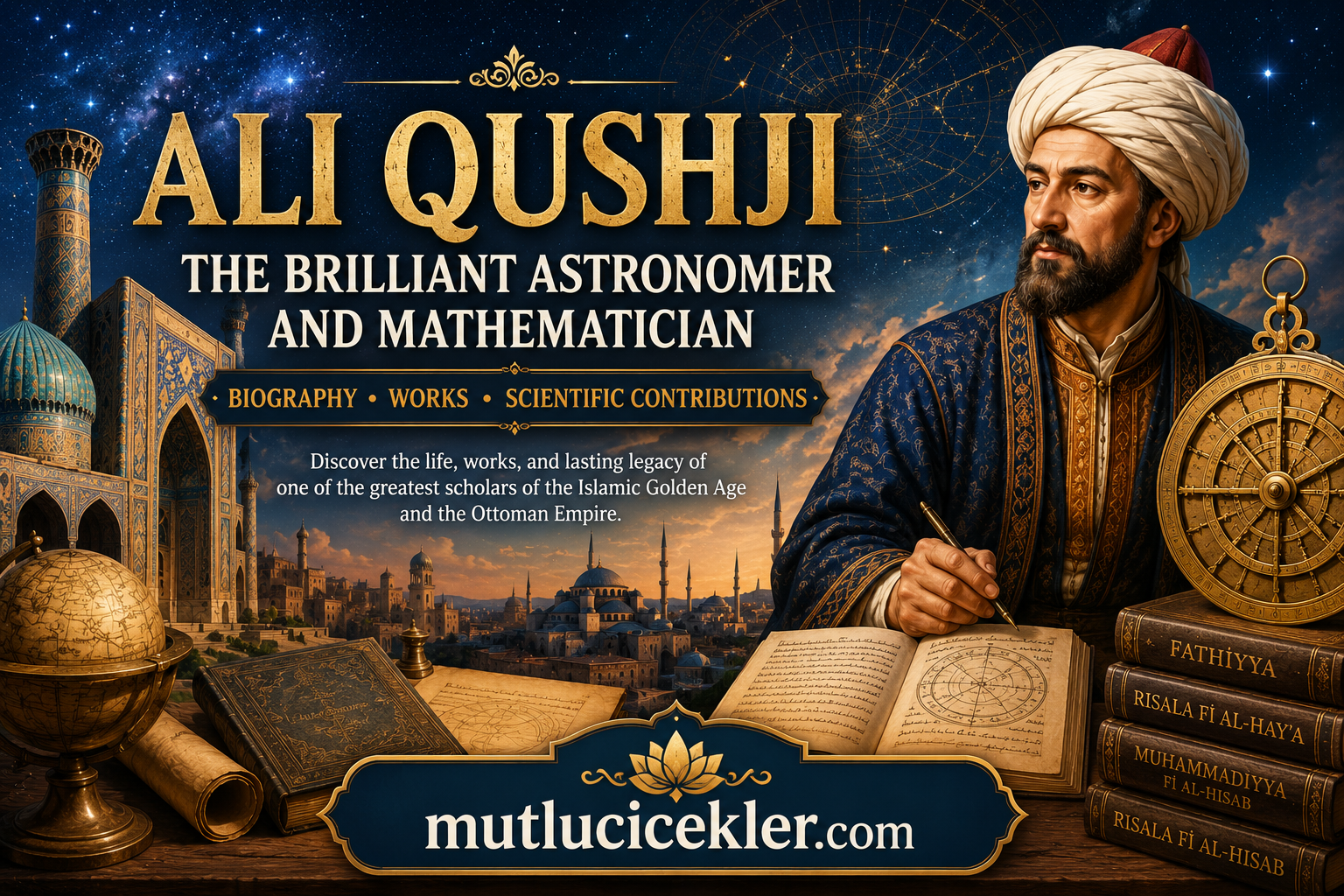
Contributions to Ottoman Science
Ali Qushji’s arrival marked a turning point in Ottoman scientific education.
He helped modernize higher education by:
- Improving astronomy curricula
- Advancing mathematics education
- Introducing more systematic scientific methods
- Training future scholars
- Strengthening the educational system of the Ottoman madrasas
His influence remained strong long after his death.
Scientific Contributions
Ali Qushji made remarkable advances in several fields.
Astronomy
His astronomical work focused on:
- Planetary motion
- Celestial mechanics
- Lunar observations
- Solar calculations
- Astronomical measurements
- Mathematical astronomy
One of his most significant intellectual achievements was arguing that astronomy should rely on mathematical reasoning rather than solely on Aristotelian natural philosophy. This perspective helped shape later scientific thought.
Mathematics
Ali Qushji authored important mathematical works covering:
- Arithmetic
- Algebra
- Geometry
- Trigonometry
His textbooks were studied for centuries throughout the Islamic world.
Linguistics
Beyond science, Ali Qushji also produced influential works on Arabic grammar and linguistics, demonstrating his broad scholarly expertise.
Famous Works
Some of Ali Qushji’s best-known writings include:
Fathiyya
A celebrated astronomy book dedicated to Sultan Mehmed II.
Risala fi al-Hay’a
An important treatise explaining the structure of the universe and astronomical principles.
Muhammadiyya fi al-Hisab
A mathematical textbook focusing on arithmetic and calculation methods.
Risala fi al-Hisab
A comprehensive work discussing mathematical theory and practical computation.
Sharh al-Tajrid
A respected commentary covering theology and philosophy.
Why Is Ali Qushji Important?
Ali Qushji transformed scientific education by encouraging observation, mathematical precision, and critical thinking.
His legacy includes:
- Advancing observational astronomy
- Improving mathematical education
- Influencing Ottoman scientific institutions
- Inspiring generations of scholars
- Preserving and expanding Islamic scientific knowledge
- Bridging Central Asian and Ottoman intellectual traditions
Today, historians recognize him as one of the most significant scientists of the medieval Islamic world.
Interesting Facts About Ali Qushji
🌟 His nickname came from his father’s profession as a royal falconer.
🌟 He studied under the legendary astronomer Ulugh Beg.
🌟 Sultan Mehmed II personally invited him to Istanbul.
🌟 His scientific works remained standard educational texts for centuries.
🌟 He contributed to one of history’s most accurate pre-telescopic star catalogs.
🌟 His ideas anticipated later developments in the philosophy of science.
Death and Legacy
Ali Qushji passed away in 1474 in Istanbul, where he had spent the final years of his life teaching and writing.
His influence extends far beyond the Ottoman Empire. Modern historians consider him one of the greatest scholars of the Islamic Golden Age and a pioneer in astronomy and mathematics.
Today, universities, schools, observatories, and scientific institutions continue to honor his remarkable legacy.
Conclusion
Ali Qushji’s dedication to science transformed astronomy, mathematics, and education during a critical period of history. His work connected the intellectual achievements of Central Asia with the growing scientific culture of the Ottoman Empire.
More than five centuries later, his discoveries, writings, and educational philosophy continue to inspire historians, scientists, and students around the world.
Frequently Asked Questions (FAQ)
Who was Ali Qushji?
Ali Qushji was a 15th-century astronomer, mathematician, linguist, and scholar who made major contributions to Islamic and Ottoman science.
Where was Ali Qushji born?
He was born in Samarkand, in present-day Uzbekistan.
What is Ali Qushji famous for?
He is best known for his contributions to astronomy, mathematics, and scientific education, as well as his role in strengthening Ottoman scholarship.
What are Ali Qushji’s most famous books?
His best-known works include Fathiyya, Risala fi al-Hay’a, Muhammadiyya fi al-Hisab, Risala fi al-Hisab, and Sharh al-Tajrid.
When did Ali Qushji die?
He died in 1474 in Istanbul.
🌿 Follow MutluCicekler.com
Explore more in-depth articles about history, science, famous historical figures, world travel, nature, gardening, recipes, and culture at MutluCicekler.com. New informative content is published regularly to inspire curious readers worldwide.
Bir yanıt yazın