


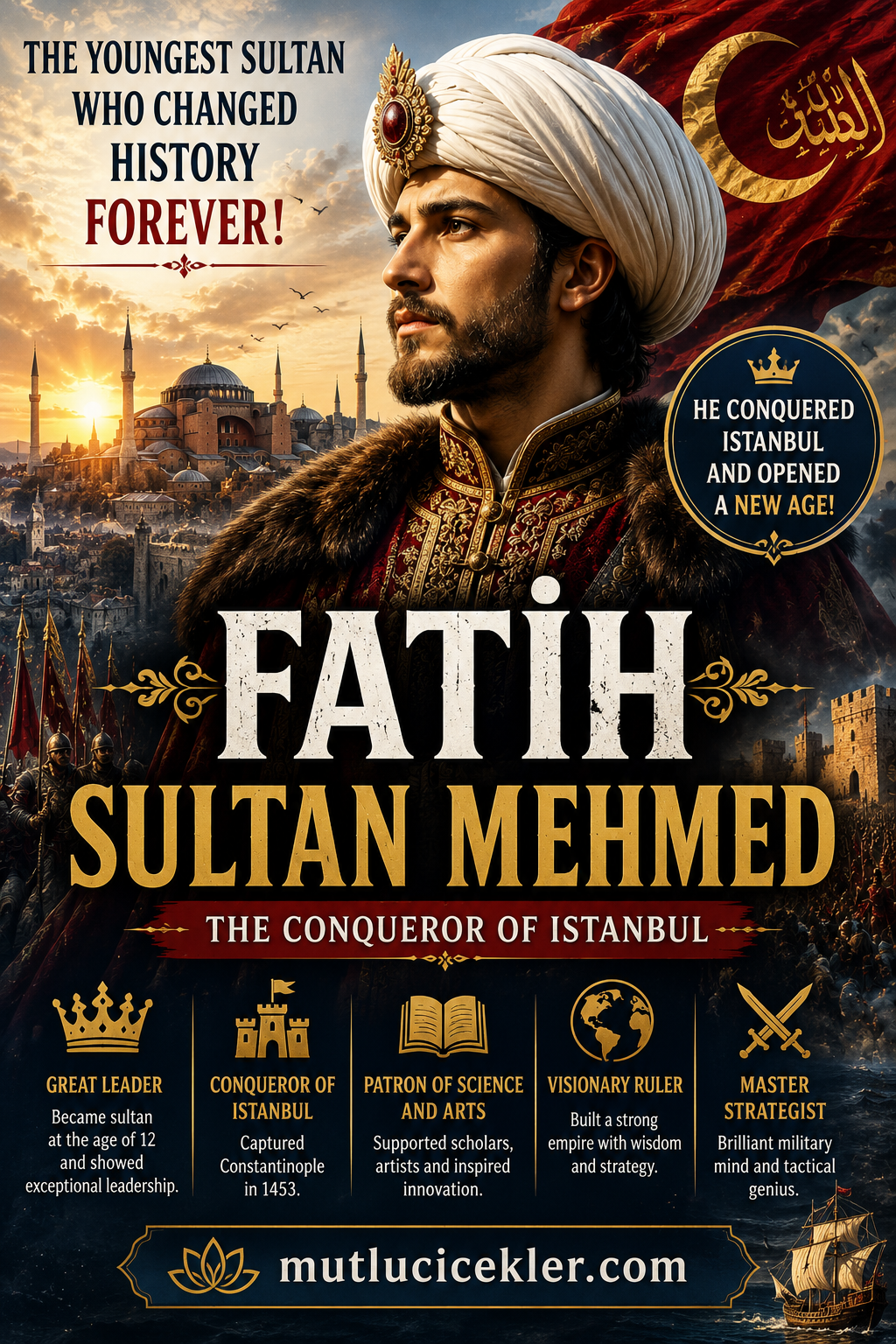
Fatih Sultan Mehmed (Mehmed II): The Visionary Ottoman Sultan Who Changed World History
Few rulers have influenced the course of history as profoundly as Fatih Sultan Mehmed, also known internationally as Mehmed II or Mehmed the Conqueror. Best known for conquering Constantinople in 1453, he transformed the Ottoman Empire into one of the world’s greatest powers and forever changed the political, cultural, and economic landscape of Europe and Asia.
This comprehensive guide explores the life, achievements, military genius, reforms, and lasting legacy of one of history’s most remarkable leaders.
Who Was Fatih Sultan Mehmed?
Fatih Sultan Mehmed was born on March 30, 1432, in Edirne, then the capital of the Ottoman Empire. He was the son of Sultan Murad II and ascended to the throne twice during his lifetime.
Although remembered primarily as the conqueror of Constantinople, Mehmed II was much more than a military commander. He was:
- A brilliant strategist
- A skilled diplomat
- A multilingual scholar
- A patron of science and the arts
- A visionary statesman
His reign marked the beginning of the Ottoman Empire’s rise as a global superpower.
Early Life and Education
Unlike many medieval rulers, Mehmed received an exceptional education.
His tutors taught him:
- Islamic studies
- Mathematics
- Astronomy
- History
- Literature
- Philosophy
- Military strategy
He also learned several languages, including:
- Ottoman Turkish
- Arabic
- Persian
- Greek
- Latin (to varying degrees)
This broad education shaped him into a ruler with both military brilliance and intellectual curiosity.
Becoming Sultan
Mehmed first became sultan in 1444 while still a teenager.
Due to political challenges and military threats, his father Murad II temporarily returned to the throne.
When Murad II died in 1451, Mehmed became sultan once again—this time determined to fulfill an ambitious dream:
The conquest of Constantinople.
The Conquest of Constantinople (1453)
The conquest of Constantinople remains one of the most significant events in world history.
At the time, Constantinople served as the capital of the Byzantine Empire and was protected by massive defensive walls that had resisted attacks for nearly a thousand years.
Why Was Constantinople Important?
The city controlled:
- Major trade routes
- Maritime access between Europe and Asia
- Political influence in Eastern Europe
- Religious importance for Christianity
Capturing Constantinople would give the Ottomans control over one of the world’s most strategic cities.
Mehmed’s Military Preparations
Before launching the siege, Mehmed carefully prepared.
His strategy included:
- Building the fortress of Rumeli Hisarı
- Expanding the Ottoman navy
- Producing enormous siege cannons
- Recruiting experienced engineers
- Organizing a highly disciplined army
His preparation demonstrated remarkable military planning rarely seen during the 15th century.

The Siege of Constantinople
The siege began on April 6, 1453.
For 53 days:
- Massive cannons bombarded the city walls.
- Ottoman ships blockaded the harbor.
- Soldiers launched repeated assaults.
- Engineers built innovative siege works.
One of Mehmed’s most famous tactics involved transporting Ottoman ships over land into the Golden Horn, bypassing the city’s defensive chain.
This unexpected maneuver stunned the Byzantine defenders.
The Fall of Constantinople
On May 29, 1453, Ottoman forces entered Constantinople.
The Byzantine Empire, which had existed for more than one thousand years, came to an end.
This victory is widely regarded as:
- The end of the Middle Ages
- The beginning of a new geopolitical era
- A turning point in world history
The city later became the Ottoman capital and eventually evolved into modern-day Istanbul.
Why Was He Called “Fatih”?
The word “Fatih” means “The Conqueror.”
Following his victory over Constantinople, Mehmed earned this title and became known throughout history as Fatih Sultan Mehmed.
Expanding the Ottoman Empire
After conquering Constantinople, Mehmed continued expanding Ottoman territory.
His campaigns reached:
- Serbia
- Bosnia
- Albania
- Greece
- Crimea
- Anatolia
- The Black Sea region
During his reign, the empire became one of the strongest political and military powers in Europe.
Administrative Reforms
Fatih Sultan Mehmed understood that military success alone could not sustain an empire.
He introduced important reforms such as:
Centralized Government
He strengthened the authority of the central administration and improved provincial governance.
Legal Reforms
He issued legal codes that helped standardize governance throughout the empire.
Economic Policies
Mehmed encouraged:
- International trade
- Market development
- Infrastructure improvements
- Commercial growth
These policies contributed to long-term prosperity.
A Patron of Science and the Arts
Mehmed II admired knowledge and culture.
He welcomed:
- Scholars
- Artists
- Architects
- Scientists
- Philosophers
His court became one of the most intellectually vibrant centers of the 15th century.
He invited famous Italian artists, including Gentile Bellini, whose portrait of Mehmed remains one of the best-known Renaissance paintings of an Ottoman ruler.
Religious Policy
Although the Ottoman Empire was an Islamic state, Mehmed adopted a pragmatic approach toward religious communities.
Following the conquest of Constantinople, he allowed:
- Orthodox Christians
- Armenians
- Jews
to maintain their religious institutions under Ottoman administration.
This policy helped stabilize the newly conquered capital.
Architectural Legacy
Fatih Sultan Mehmed initiated numerous construction projects.
These included:
- Mosques
- Schools
- Libraries
- Hospitals
- Caravanserais
- Public baths
One of his most important architectural projects is the Fatih Mosque, built in Istanbul after the conquest.
Leadership Style
Historians often describe Mehmed II as:
- Determined
- Highly intelligent
- Strategic
- Ambitious
- Visionary
- Disciplined
His combination of military skill and administrative ability distinguished him from many contemporary rulers.
Death
Fatih Sultan Mehmed died on May 3, 1481, while preparing for another military campaign.
The exact cause of his death remains debated by historians, with theories ranging from illness to possible poisoning.
He was buried in Istanbul near the Fatih Mosque.
Lasting Legacy
More than five centuries after his death, Fatih Sultan Mehmed continues to be recognized as one of history’s greatest military and political leaders.
His achievements include:
- Ending the Byzantine Empire
- Transforming Constantinople into the Ottoman capital
- Expanding one of history’s largest empires
- Encouraging education, science, and culture
- Establishing reforms that shaped Ottoman governance for centuries
His legacy extends beyond Turkish history and remains an important chapter in world civilization.
Quick Facts
| Fact | Information |
|---|---|
| Full Name | Mehmed II (Fatih Sultan Mehmed) |
| Born | March 30, 1432 |
| Birthplace | Edirne |
| Father | Sultan Murad II |
| Reign | 1444–1446, 1451–1481 |
| Famous For | Conquest of Constantinople |
| Title | Fatih (The Conqueror) |
| Capital | Constantinople (Istanbul) |
| Died | May 3, 1481 |
Frequently Asked Questions (FAQ)
Why is Fatih Sultan Mehmed famous?
He is famous for conquering Constantinople in 1453, ending the Byzantine Empire, and transforming the Ottoman Empire into a major global power.
What does “Fatih” mean?
“Fatih” is a Turkish title meaning “The Conqueror.”
How old was Mehmed II when he conquered Constantinople?
He was 21 years old during the conquest.
Why was Constantinople so important?
The city controlled vital trade routes between Europe and Asia and served as the capital of the Byzantine Empire for centuries.
Did Mehmed II support science and the arts?
Yes. He actively encouraged scholars, architects, artists, scientists, and intellectuals, helping Istanbul become an important center of learning and culture.
Conclusion
Fatih Sultan Mehmed was far more than a conqueror. His military brilliance, administrative reforms, intellectual curiosity, and commitment to cultural development reshaped the Ottoman Empire and influenced world history. His capture of Constantinople stands among history’s most transformative events, while his vision for governance, education, and architecture ensured that his legacy would endure for centuries. Today, Mehmed II remains a symbol of leadership, strategic thinking, and historical change.
🌿 Follow mutlucicekler.com for more inspiring stories, travel guides, plant care tips, recipes, and fascinating insights from around the world!
Bir yanıt yazın