
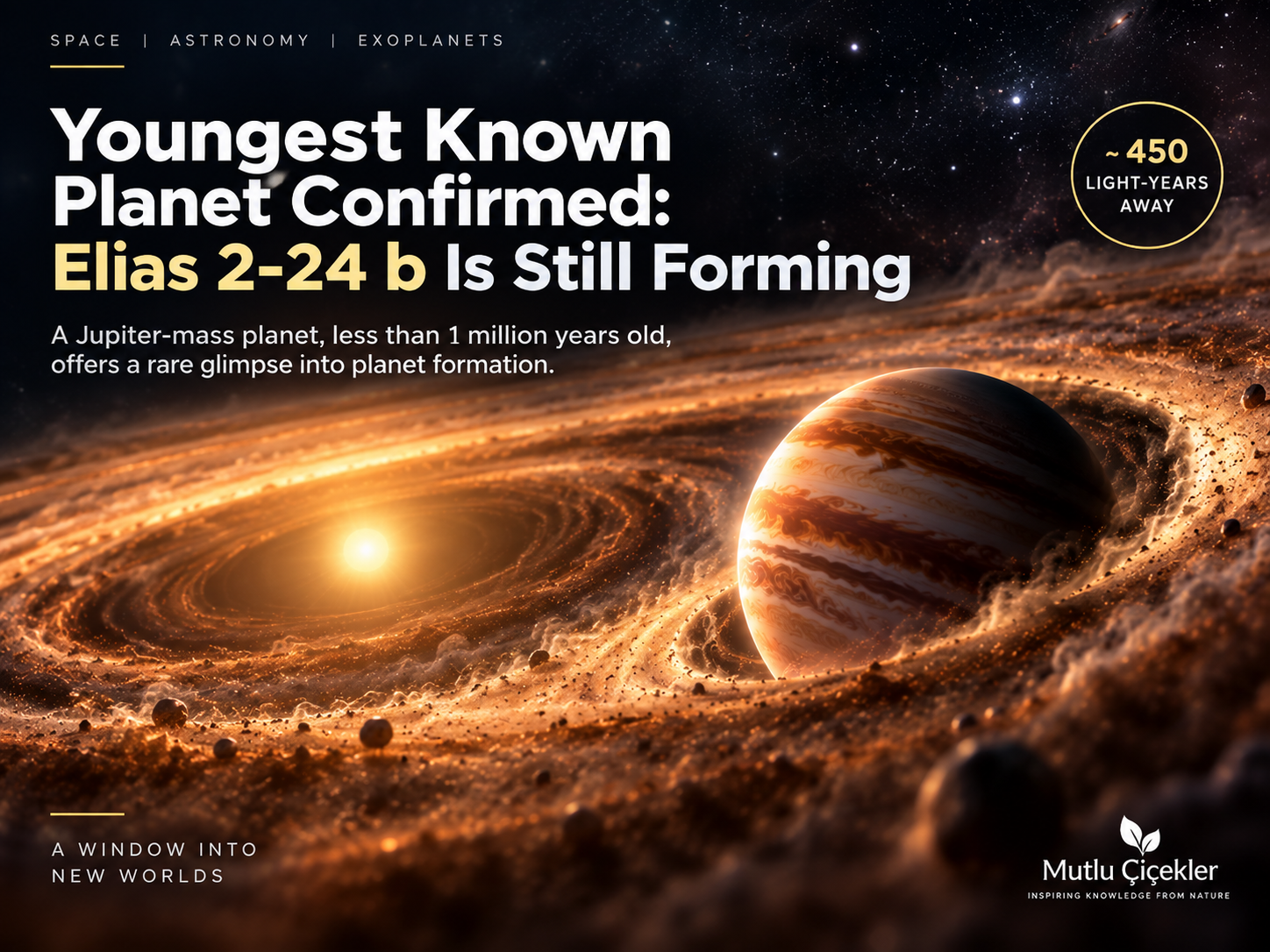
Astronomers have confirmed Elias 2-24 b, a planet less than one million years old, as the youngest known planet ever detected.
The Jupiter-mass world is still embedded in the disk of gas and dust surrounding its young host star, giving scientists a rare opportunity to observe a giant planet while it is still growing.
Located around 450 light-years from Earth, Elias 2-24 b could also challenge existing ideas about how quickly giant planets can form.
What Is Elias 2-24 b?
Elias 2-24 b is a young exoplanet orbiting the star Elias 2-24.
An exoplanet is a planet located outside our Solar System.
What makes this particular world extraordinary is its age. Scientists estimate that the system is less than one million years old, making Elias 2-24 b significantly younger than the previous record-holding young planets.
The planet has roughly the mass of Jupiter and is still surrounded by material left over from the formation of its host star.
Rather than observing a mature planetary system, astronomers are effectively looking at a planetary construction site.
A Planet Still Growing Inside Its Birth Disk

Young stars are often surrounded by broad disks made of gas, dust, ice and rocky material.
These structures, known as protoplanetary disks, contain the raw ingredients from which planets form.
Over time, material within a disk begins to accumulate into larger structures. Some of these eventually become planets.
Elias 2-24 b appears to be doing exactly that.
The planet sits inside a prominent gap in the disk surrounding its star and is still actively gathering material from its environment.
This gives astronomers a rare opportunity to study giant planet formation while the process is still underway.
Astronomers Had Been Watching the Gap for Years
The story of Elias 2-24 b did not begin with a single observation.
About a decade ago, observations made with the Atacama Large Millimeter/submillimeter Array (ALMA) revealed a gap in the disk surrounding Elias 2-24.
Such gaps are particularly interesting to astronomers because growing planets can clear paths through the material surrounding their stars.
Later observations from the European Southern Observatory’s Very Large Telescope (VLT) detected a faint source of light inside the gap.
Scientists suspected that it could be a young planet, but additional evidence was needed to confirm its identity.
The Evidence Was Hidden in Archived Telescope Data
Researchers led by Andrea Bernardi of Universidad Diego Portales in Chile examined archival observations from the W. M. Keck Observatory in Hawaii.
The team found the same faint object in observations taken in 2018 and 2020.
By combining observations obtained at different times and studying how the object moved, researchers were able to determine that it behaved like a planet orbiting Elias 2-24 rather than a distant background star or an imaging artifact.
The result confirmed the object as Elias 2-24 b.
The discovery also demonstrates how valuable astronomical archives can be. Data collected years earlier can reveal new discoveries when scientists revisit it with improved methods and additional observations.
Why Is Elias 2-24 b So Important?
The age of Elias 2-24 b creates an intriguing problem for existing models of planet formation.
Some models predict that forming a Jupiter-size planet at approximately Jupiter’s distance from the Sun could take around five million years.
Elias 2-24 b is less than one million years old.
It is also located extremely far from its star — at a distance roughly 55 times greater than the distance between Earth and the Sun.
Despite its young age and distant orbit, the planet has already grown to roughly Jupiter’s mass.
That suggests giant planets may be capable of forming much faster than some current models predict.
Researchers therefore hope that studying Elias 2-24 b will reveal previously overlooked processes involved in the earliest stages of planet formation.
Previous Record Holders Were Much Older
Before Elias 2-24 b was confirmed, some of the youngest known planets included worlds orbiting PDS 70 and WISPIT 2.
Those planets are more than five million years old.
Finding a confirmed planet younger than one million years therefore represents a major step toward observing planets closer to the beginning of their formation.
Most of the thousands of confirmed exoplanets discovered so far are much older.
Very young planets are especially difficult to observe because they are often hidden inside thick disks of gas and dust.
A Glimpse Into the Early History of Our Own Solar System
Studying Elias 2-24 b may also help scientists better understand how our own planetary system formed.
The Sun was once surrounded by a disk of gas and dust similar to the structures observed around young stars today.
Earth, Jupiter and the other planets eventually emerged from that material approximately 4.6 billion years ago.
Astronomers obviously cannot travel back in time to observe the Solar System’s birth.
Instead, young systems such as Elias 2-24 provide natural laboratories where researchers can study similar processes occurring elsewhere in the galaxy today.
In that sense, observing Elias 2-24 b is almost like looking at a snapshot from the distant past of our own planetary neighborhood.
Multiple Telescopes Made the Confirmation Possible
The confirmation of Elias 2-24 b also highlights the importance of combining observations from different astronomical facilities.
Data associated with the discovery involved observations from the W. M. Keck Observatory, ALMA and the Very Large Telescope.
Each instrument provided a different piece of the puzzle.
Together, the observations allowed researchers to establish that the faint object within the disk was a genuine young planet.
Future observatories and more powerful instruments could make it possible to detect many more planets during similarly early stages of development.
What Happens Next?
Elias 2-24 b is likely to remain an important target for astronomers.
Future observations could help determine how rapidly the planet is accumulating material, how its atmosphere is developing and how it interacts with the surrounding disk.
Scientists may also use the system to test competing models of giant planet formation.
If more extremely young planets are discovered, researchers will be able to determine whether Elias 2-24 b is unusual or whether massive planets commonly form much faster than previously expected.
For now, Elias 2-24 b provides one of the clearest opportunities yet to watch planet formation in action.
Scientific Study and Sources
The research confirming Elias 2-24 b was led by Andrea Bernardi and published in The Astrophysical Journal Letters.
Study:
Searching for Embedded Protoplanets with the Keck/NIRC2 Vortex Coronagraph: Confirmation of a Core-accretion Planet in the Narrow Gap of the Elias 2-24 Disk
DOI: 10.3847/2041-8213/ae9bb6
Sources
- NASA Science — Newfound ‘Baby’ Planet Smashes Record for Youngest Known World, September 16, 2026
- The Astrophysical Journal Letters — Andrea Bernardi et al., 2026
- W. M. Keck Observatory — Keck/NIRC2 observations of the Elias 2-24 system
- ALMA — Observations of the Elias 2-24 protoplanetary disk
- European Southern Observatory (ESO) — Very Large Telescope observations of the system
Bir Cevap Yazın