
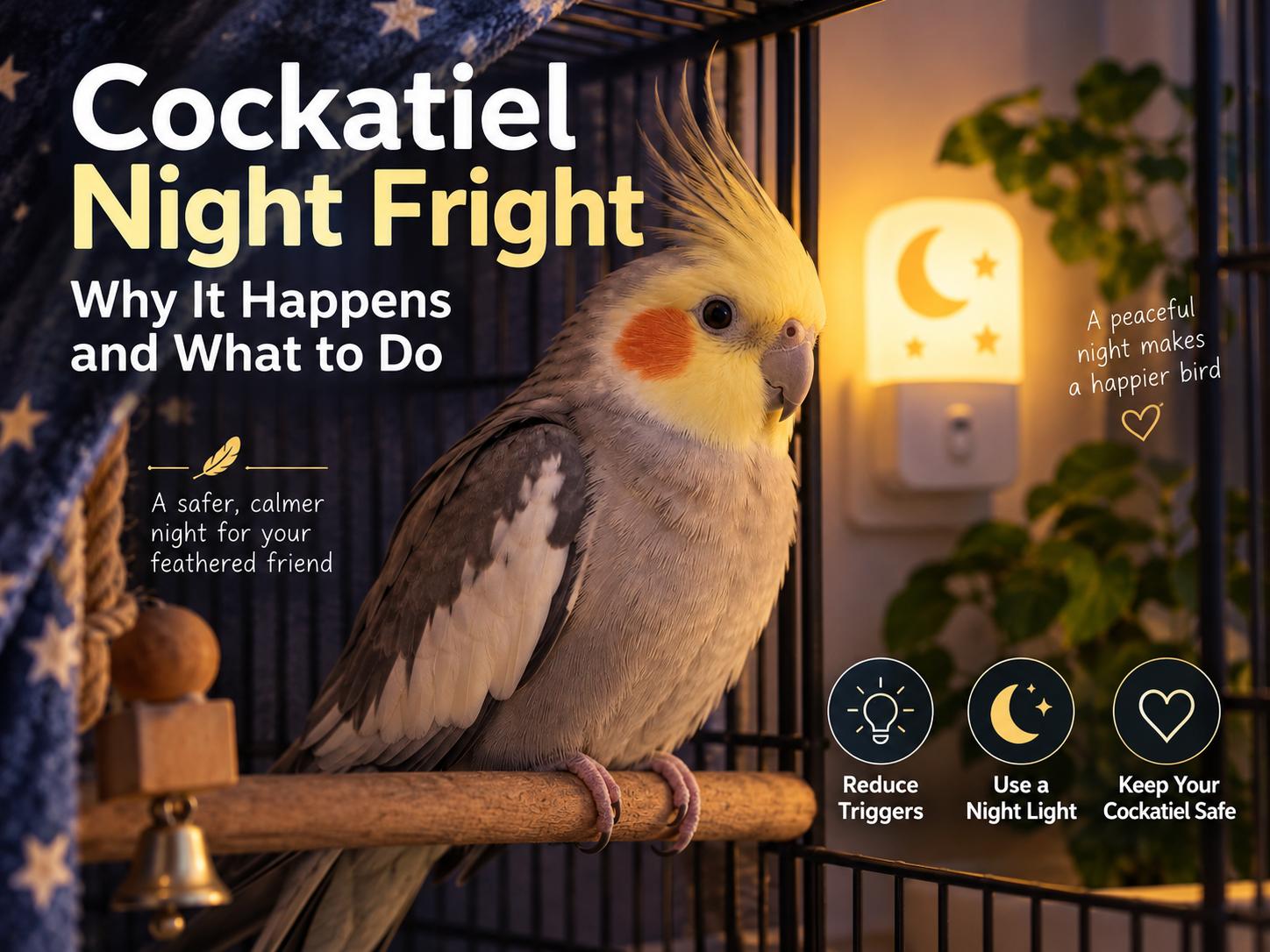
If your cockatiel suddenly starts flapping, thrashing, screaming, or crashing into the cage at night, you may be witnessing what bird owners commonly call a night fright.
Night frights can look dramatic. A cockatiel that was sleeping peacefully may suddenly panic, lose its orientation in the dark, flap violently against cage bars, knock into toys or perches, and sometimes lose feathers or injure a wing.
Cockatiels appear to be particularly prone to these nighttime panic episodes. Lafeber notes that pet cockatiels may occasionally experience night frights and recommends a night light to help them find their perch again. Bird Health also describes cockatiels as especially prone to night fright when disturbed by movement, shadows, or noises in darkness.
The good news is that many episodes can be managed by making the sleeping environment calmer and easier for your bird to navigate.
However, a night fright should not automatically be dismissed as harmless. A frightened cockatiel can injure itself while thrashing inside the cage, so it is important to check your bird carefully after an episode.
What Is a Night Fright in Cockatiels?
A cockatiel night fright is a sudden episode of panic that happens while the bird is resting or sleeping.
The cockatiel may wake suddenly and react as though it needs to escape immediately. Inside a cage, there is limited space to fly away, so the bird may flap frantically against the bars or surrounding objects.
Owners commonly describe it as:
- “My cockatiel suddenly started flapping at night.”
- “My cockatiel is freaking out in the cage at night.”
- “My bird woke up screaming and crashing into the cage.”
- “My cockatiel falls off the perch and panics.”
- “My cockatiel is scared of the dark.”
- “My cockatiel suddenly flies around the cage at night.”
Lafeber describes cockatiels as particularly prone to night frights and advises turning on the light and speaking calmly when one occurs.
Why Do Cockatiels Have Night Frights?
There is not always one obvious cause.
Night frights are generally thought to begin when something unexpectedly startles the bird while it is sleeping. Once startled in darkness, the cockatiel may have difficulty immediately understanding its surroundings and may react with an instinctive escape response.
Lafeber notes that there does not appear to be one single established cause and lists possible nighttime triggers such as outside lights, vehicle headlights, moving trees or shadows, barking dogs, fighting cats, alarms, and other sudden noises or movements.
Possible triggers include:
Sudden noises
A door closing, barking dog, thunderstorm, object falling, traffic noise, television sound, or someone entering the room can startle a sleeping bird.
Moving shadows
Curtains, trees outside a window, people walking past the cage, or headlights passing through a room can create sudden changes in light and shadow.
Light from outside
Car headlights, security lights, streetlights, or other rapidly changing light sources may disturb a sleeping cockatiel.
Movement near the cage
Another pet, a person entering the room, insects, or unexpected movement close to the cage may trigger panic.
Changes in the sleeping environment
Moving the cage, introducing unfamiliar objects, or changing the bird’s usual bedtime environment may contribute to nighttime insecurity in some birds.
Rodents or other animals
Repeated unexplained nighttime disturbances deserve investigation. Lafeber notes that rodents approaching a bird’s cage at night can cause night-fright-type episodes.
Are Cockatiels More Prone to Night Frights Than Other Birds?
Night frights can occur in more than one bird species, but cockatiels are particularly well known for them.
Lafeber specifically states that cockatiels are prone to night-fright episodes, while Bird Health describes them as “especially prone” when disturbed by a shadow or noise in darkness.
That does not mean every cockatiel will experience them.
Some birds may have only one episode in their lifetime, while others may be more sensitive to nighttime disturbances.
What Does a Cockatiel Night Fright Look Like?
Signs can include:
- Sudden frantic wing flapping
- Crashing into cage bars
- Falling from the sleeping perch
- Loud distress calls or screaming
- Trying to fly inside the cage
- Rapid climbing around the cage
- Raised crest and frightened posture
- Broken or lost feathers
- A damaged wing feather
- Small amounts of blood after striking a feather
- Appearing disoriented immediately after waking
The episode may last only a short time, but the bird can injure itself quickly.
What Should You Do During a Cockatiel Night Fright?
The first priority is helping your bird regain its orientation without increasing the panic.
1. Turn on a light
Do not leave the bird thrashing around in darkness.
Turn on enough light for the cockatiel to see the cage, perches, and surroundings.
Lafeber specifically recommends turning on the light when a cockatiel begins flailing during a night fright.
2. Speak calmly
Use the voice your bird normally associates with you.
Quietly talking to your cockatiel can help it recognize that it is in a familiar environment.
Avoid shouting or making sudden movements.
3. Give the bird a moment to settle
Do not immediately reach into the cage and grab a panicking bird unless there is an immediate danger that requires intervention.
A frightened cockatiel may bite, struggle harder, or injure itself further if restrained unnecessarily.
Let the bird regain its balance and orientation.
4. Check for injuries
Once your cockatiel has calmed down, carefully observe it.
Check whether:
| Check | What you are looking for |
|---|---|
| Wings | Both wings are held normally |
| Perching | The bird can stand and grip normally |
| Feathers | No active bleeding or badly damaged feathers |
| Feet and legs | No limping or inability to bear weight |
| Beak and face | No obvious injury from hitting cage bars |
| Breathing | No open-mouth breathing or obvious distress |
| Behavior | The bird gradually returns to its normal behavior |
Merck Veterinary Manual advises prompt veterinary attention for abnormal wing movement, limping, reduced activity, weakness, or ongoing bleeding. A bird that is weak, unresponsive, huddled, or lying on the cage floor should be treated as an emergency.

Should Cockatiels Have a Night Light?
For cockatiels that are prone to night frights, a dim night light may help.
The goal is not to brightly illuminate the room throughout the night.
Instead, the light should provide just enough illumination for the cockatiel to recognize the cage, perch, and surroundings if it suddenly wakes.
Lafeber’s cockatiel care information specifically recommends leaving a night light on to help a cockatiel find its way back to its perch after a night fright. Its nighttime care guidance also recommends turning on a night light for birds prone to night frights.
Can you use a plug-in baby night light?
A small, steady, dim plug-in night light, including the type commonly sold for nurseries or children’s rooms, can be a practical option.
Choose one that:
- Produces only a gentle glow
- Does not shine directly into the cage
- Does not flash or rapidly change colors
- Does not create moving shadows
- Is positioned where the bird cannot reach the plug or electrical components
The room should still feel like nighttime.
This matters because birds also need adequate, uninterrupted sleep. The Association of Avian Veterinarians notes that light and noise can interrupt sleep and that adequate sleep is important for avian health and well-being.
So the practical balance is:
dark enough for healthy sleep, but with a very dim reference light if your cockatiel is prone to night frights.
Should You Cover a Cockatiel’s Cage at Night?
There is no rule that every cockatiel’s cage must be completely covered.
Some birds appear calmer with a cover, while others may be more comfortable if part of the cage remains uncovered.
Lafeber states that covering a bird cage at night is not always necessary and notes that cockatiels prone to night frights may benefit from a night light.
For birds that repeatedly experience night frights, Lafeber also suggests that a partial cage cover combined with a night light may work better for some individuals than complete darkness.
Watch your bird’s behavior rather than assuming one method is correct for every cockatiel.
If using a cover:
- Maintain good airflow.
- Do not allow loose fabric to hang where the bird can chew it.
- Avoid creating an overheated or poorly ventilated enclosure.
- Observe whether the bird appears calmer or more anxious.
Where Should a Cockatiel Sleep?
A good nighttime location should be:
- Quiet
- Predictable
- Away from sudden activity
- Away from drafts
- Protected from rapidly moving shadows
- Away from headlights and other changing outdoor lights
If the cage is directly beside a window and your cockatiel has repeated night frights, consider moving it to a calmer location.
Bird Health specifically recommends moving a cockatiel away from windows and using a night light as possible ways to reduce night-fright problems.
Can a Cockatiel Get Hurt During a Night Fright?
Yes.
This is the main reason night frights deserve attention.
A cockatiel panicking inside a cage may collide with:
- Cage bars
- Perches
- Feeding bowls
- Toys
- Ladders
- Swings
- Other cage accessories
Bird Health reports that cockatiels can suffer feather loss, wing injuries, and bleeding during night-fright episodes.
Merck Veterinary Manual also notes that birds can sustain traumatic injuries inside cages and advises monitoring traumatized birds for active bleeding, inability to perch, wing droop, breathing problems, and abnormal use of the legs.
What Is a Blood Feather?
Growing feathers are sometimes called blood feathers or pin feathers.
While a new feather is developing, it has a blood supply inside the shaft.
VCA Animal Hospitals explains that a growing feather contains blood while it develops. If a blood feather is damaged, bleeding can occur.
Because night frights can cause a cockatiel to crash into cage bars, a developing feather may occasionally become damaged.
What Should You Do If Your Cockatiel Is Bleeding?
First determine whether you are seeing old, dried blood or active bleeding.
According to Merck Veterinary Manual, ongoing bleeding—particularly from the wing, beak, or foot—is an emergency requiring veterinary attention.
Do not repeatedly restrain or manipulate a frightened bird while trying to identify the exact feather.
If active bleeding continues, contact an avian or exotic-animal veterinarian immediately.
Merck also cautions that birds can hide signs of injury, making changes in behavior especially important after trauma.
Should You Pull Out a Broken Blood Feather Yourself?
Do not routinely attempt to remove a blood feather at home.
Handling and removing feathers incorrectly may worsen trauma or cause additional bleeding.
If you suspect a broken blood feather and bleeding is ongoing, contacting an avian veterinarian or an emergency clinic that treats birds is the safer approach.
How Can You Reduce Cockatiel Night Frights?
No method can guarantee that a night fright will never happen, but several environmental changes may reduce the risk.
Keep bedtime predictable
Cockatiels generally do better with a consistent daily routine.
Try to maintain similar sleeping and waking times.
Reduce sudden nighttime noise
Keep the sleeping area away from televisions, loud speakers, frequently used doors, and other unpredictable sources of noise when possible.
Control moving lights and shadows
Watch the room after dark.
You may notice triggers that are invisible during the day, such as car headlights sweeping across a wall or branches creating moving shadows.
Move the cage away from windows if necessary
This can reduce exposure to external animals, headlights, lightning, and moving shadows.
Consider a dim night light
A gentle, constant night light can provide orientation without turning the sleeping area into a brightly lit room.
Make the cage safer
Check nighttime cage accessories.
Remove or replace:
- Frayed ropes
- Sharp edges
- Broken toys
- Dangerous hooks
- Objects the bird could become trapped in
Lafeber recommends regularly checking toys for frayed strings, gaps, and damaged components that could create a nighttime safety hazard.
Maintain healthy sleep
Do not solve night frights by leaving a bright room light on all night.
The Association of Avian Veterinarians emphasizes that parrots need adequate sleep and that light and noise can interrupt it.
My Cockatiel Had One Night Fright. Should I Worry?
A single episode may happen after an obvious disturbance and may never occur again.
Once your bird is calm, check for:
- Bleeding
- Missing or damaged feathers
- Wing drooping
- Limping
- Difficulty perching
- Abnormal breathing
- Unusual tiredness or reduced activity
If none of these signs are present and your cockatiel returns to its normal behavior, continue monitoring it closely.
Repeated episodes deserve more investigation.
Why Does My Cockatiel Keep Having Night Frights?
If night frights become frequent, look for recurring environmental triggers.
For example:
- Does a vehicle pass the window at the same time?
- Does another pet enter the room?
- Is there a security light outside?
- Are there rodents or insects near the cage?
- Does heating or cooling equipment suddenly switch on?
- Are tree branches casting moving shadows?
Persistent or newly recurring episodes can also justify a veterinary check.
Bird Health notes that anxiety associated with night fright may sometimes be related to underlying illness and recommends a bird-veterinary health evaluation following night-fright episodes, particularly when the problem persists.
Is a Night Fright the Same as a Seizure?
No.
A night fright is generally an acute fear and escape response after the bird is startled.
A seizure is a medical event involving abnormal neurological activity.
From across the room, unusual nighttime movements may occasionally be difficult for an owner to distinguish.
If your cockatiel repeatedly:
- Falls unexpectedly
- Loses balance
- Shows abnormal involuntary movements
- Appears unresponsive
- Remains disoriented
- Has episodes during both the day and night
do not assume the problem is simply night fright.
Contact an avian veterinarian for an examination.
A video of an episode—if it can be recorded without delaying emergency care—may also help your veterinarian understand what is happening.
When Should You Call an Avian Veterinarian?
Seek veterinary advice promptly after a night fright if your cockatiel has:
- Active or recurrent bleeding
- A drooping wing
- Difficulty using one wing
- Limping
- Difficulty standing or perching
- Weakness or unusual inactivity
- Open-mouth breathing or respiratory distress
- A visible wound
- A suspected fracture
- Repeated falls
- Persistent disorientation
- Recurrent unexplained nighttime episodes
Merck Veterinary Manual states that a bird that is weak, unresponsive, huddled, or lying on the bottom of the cage requires emergency attention. Ongoing bleeding is also considered an emergency.
Whenever possible, choose a veterinarian experienced with avian or exotic-animal medicine.
What to Check the Morning After a Night Fright
Even if your cockatiel looks fine immediately afterward, check again the following morning.
Look at:
The cage floor:
Are there unusually large feathers, blood spots, or broken feather shafts?
The wings:
Are they held evenly?
The feet:
Can your bird grip the perch normally?
Activity:
Is your cockatiel moving and interacting as usual?
Food and water:
Is it eating and drinking normally?
Droppings:
Are they reasonably consistent with your bird’s usual pattern?
Birds naturally conceal weakness and illness, so subtle changes after an injury deserve attention. Merck specifically notes that pet birds can hide signs of illness or injury.
Cockatiel Night Fright Prevention Checklist
Before bedtime:
✓ Keep the sleeping area quiet and predictable.
✓ Check that cage doors are securely closed.
✓ Remove damaged or unsafe cage accessories.
✓ Reduce moving shadows and outside lights.
✓ Consider moving the cage away from a busy window.
✓ Use a dim, steady night light if your cockatiel is prone to night frights.
✓ Keep the electrical light and cord completely out of the bird’s reach.
✓ Give your cockatiel adequate uninterrupted sleep.
✓ Learn where the nearest avian or exotic-animal veterinarian is before an emergency occurs.
Final Thoughts
Cockatiel night frights can be frightening for both birds and their owners, but understanding what is happening makes them much easier to manage.
Cockatiels are particularly susceptible to sudden nighttime panic. Noise, moving shadows, unexpected light, or other environmental disturbances may trigger an episode, although in many cases the exact cause cannot be identified.
For birds that experience night frights, a quiet sleeping area, predictable routine, safer cage setup, and dim night light can help reduce risk.
Most importantly, always check your cockatiel after an episode.
Night fright itself may last only moments, but injuries caused by striking cage bars or breaking a growing feather can require veterinary attention.
If you notice active bleeding, weakness, breathing difficulty, inability to perch, abnormal wing position, or repeated unexplained episodes, contact an avian veterinarian promptly.
Frequently Asked Questions
Why does my cockatiel suddenly flap its wings at night?
Your cockatiel may have experienced a night fright. A sudden sound, movement, shadow, or light may startle a sleeping bird, causing it to panic and flap around the cage. Cockatiels are particularly prone to night-fright episodes.
Do cockatiels need a night light?
Not every cockatiel needs one. However, cockatiels that are prone to night frights may benefit from a dim night light that helps them see their surroundings if they suddenly wake.
Can I use a baby night light for my cockatiel?
A small, steady, dim plug-in night light can be used as long as it does not brightly illuminate the bird all night, flash, create moving shadows, or sit where the cockatiel can access electrical components. The bird should still have a quiet nighttime environment that supports adequate sleep.
Should I cover my cockatiel’s cage at night?
Not necessarily. Some cockatiels prefer a covered cage, while others do well without one. For birds prone to night frights, a partially covered cage combined with a dim night light may work better than total darkness.
Why is my cockatiel scared at night?
Potential triggers include sudden noises, moving shadows, headlights, other pets, people entering the room, or unfamiliar nighttime movement. In some cases, the specific trigger is never identified.
Can night fright hurt a cockatiel?
Yes. During a severe episode, a cockatiel can hit the cage bars or accessories and suffer broken feathers, bleeding, or wing injuries.
What should I do when my cockatiel has a night fright?
Turn on a light, speak calmly, allow the bird to regain its orientation, and then check for injuries. Avoid adding more sudden movement or noise.
When is a cockatiel night fright an emergency?
Active bleeding, difficulty breathing, inability to perch, severe weakness, a drooping or unusable wing, repeated falling, or lying on the cage floor require prompt veterinary attention.
Do cockatiels have nightmares?
Owners often describe night frights as “nightmares,” but there is not enough evidence to say that nightmares are the usual cause. The established practical approach is to look for environmental disturbances such as noise, movement, light, and shadows rather than assuming the bird had a bad dream. Lafeber notes that several explanations have been proposed for night frights but that there is no single established cause.
Sources
Merck Veterinary Manual — Injuries and Accidents of Pet Birds
Reviewed and updated in May 2026. Guidance on trauma, bleeding, abnormal wing use, weakness, and emergency signs in pet birds.
Merck Veterinary Manual — Traumatic Injury of Pet Birds
Professional veterinary guidance on cage injuries, bleeding, wing droop, respiratory distress, and trauma assessment in birds.
Lafeber — Cockatiel Care Guide
Cockatiel-specific information explaining night-fright episodes and the use of a night light to help birds orient themselves.
Lafeber — Night Fright in Birds
Discusses possible environmental triggers, night lights, partial cage covers, and the lack of one established cause.
Association of Avian Veterinarians — Providing Adequate Sleep
Guidance on the importance of uninterrupted sleep and the effects of light and noise on parrots.
VCA Animal Hospitals — Blood Feathers in Birds
Veterinary information explaining growing blood feathers and their blood supply.
Bird Health — Cockatiels: Night Fright
Cockatiel-specific information about night-fright susceptibility, injury risk, night lights, and cage placement.
Medical note: This article provides general educational information and is not a substitute for an examination by an avian veterinarian. Active bleeding, breathing difficulty, severe weakness, suspected trauma, or neurological signs require professional veterinary care.
Bir Cevap Yazın