
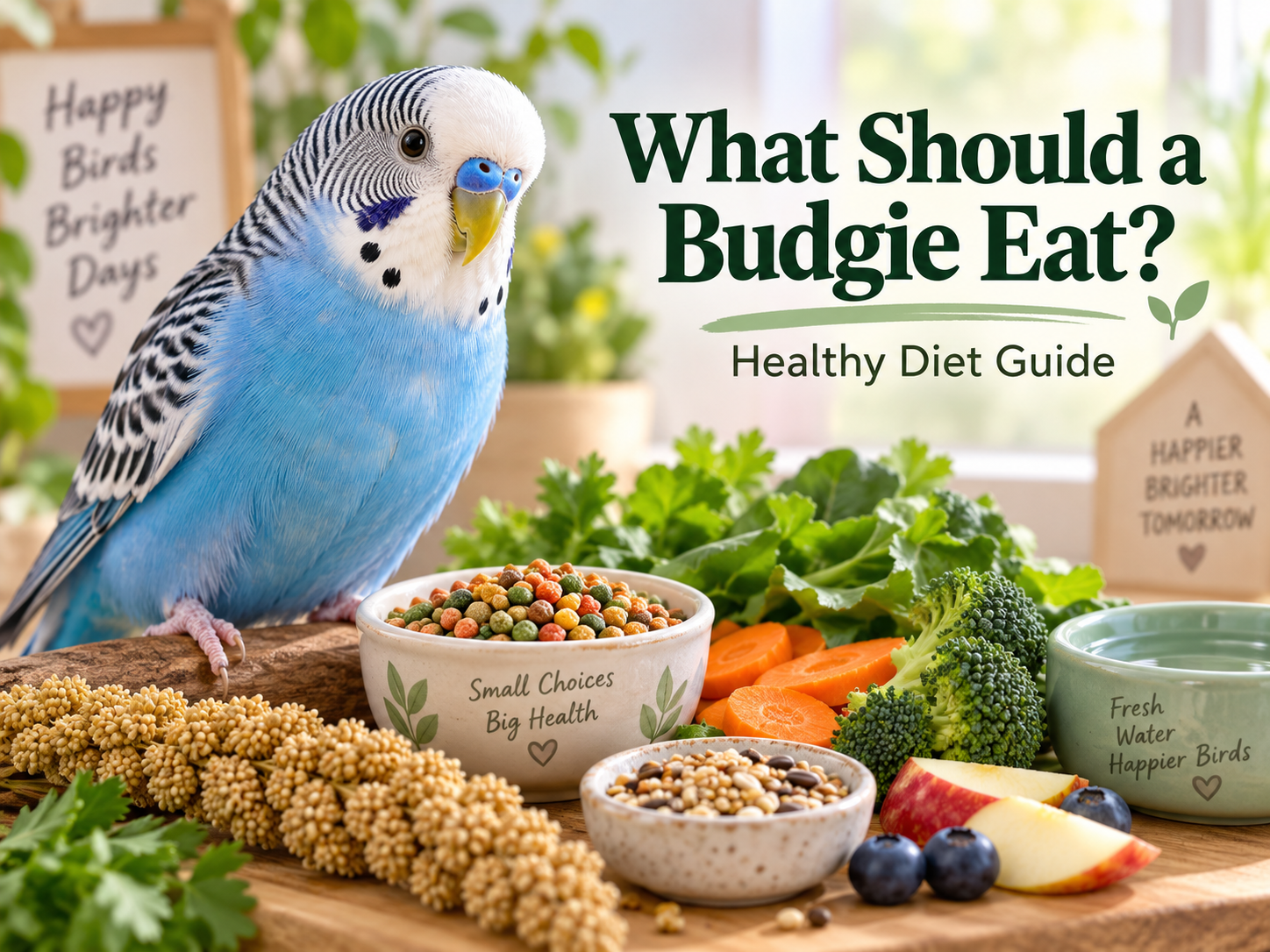
A budgie should not live on seed alone.
Pet budgies need a balanced diet that includes a nutritionally complete main food, fresh vegetables, limited amounts of fruit and seed, and clean water at all times.
Veterinary sources warn that seed-only diets can contribute to nutritional deficiencies, obesity and other diet-related health problems. Budgies also tend to pick out their favorite high-fat seeds, which can make an apparently varied seed mix much less balanced in practice.
What Should a Budgie’s Main Diet Be?
For most pet budgies, current veterinary guidance favors a balanced pellet formulated for small parrots as the main part of the diet.
VCA Animal Hospitals notes that pellets can make up around 60–80% of a budgie’s diet. RSPCA guidance also emphasizes pellets, fresh vegetables and fruit while recommending that seeds remain a relatively small part of the diet for small parrots such as budgies.
The exact balance can vary depending on the bird’s age, weight, health, activity level, reproductive status and current diet.
The most important principle is simple:
A budgie should not be fed only seeds or millet.
Are Seeds Bad for Budgies?
Seeds are not automatically bad.
The problem is a diet that is mostly or entirely seed-based.
Commercial seed mixes are often high in fat and carbohydrates while being comparatively poor sources of several important vitamins, minerals and amino acids. Budgies may also selectively eat only their favorite seeds from the mix.
Seeds can still be included in moderation, especially as part of a varied feeding plan or as a training reward.
What Vegetables Can Budgies Eat?
Fresh vegetables can add useful variety and nutrients to a budgie’s diet.
Suitable options include:
- Broccoli
- Carrot
- Red or yellow bell pepper
- Pumpkin
- Sweet potato
- Peas
- Cucumber
- Zucchini
- Kale
- Spinach
- Romaine lettuce
VCA lists a wide range of vegetables suitable for budgies and recommends thoroughly washing fresh produce before offering it.
Colorful vegetables such as carrot, pumpkin, sweet potato and red pepper are particularly useful additions to a varied diet.
Fresh food should be offered in portions appropriate for a small bird rather than in large human-sized servings.
Can Budgies Eat Fruit?
Yes, but fruit should generally be offered in smaller amounts than vegetables.
Suitable fruits can include:
- Apple
- Pear
- Banana
- Blueberries
- Strawberries
- Kiwi
- Mango
- Melon
- Pomegranate
Fruit naturally contains sugar, so it should be treated as part of the variety in the diet rather than as the main fresh food.
Remove pits and seeds from fruits such as apples, cherries, peaches, apricots and plums before offering them. The Association of Avian Veterinarians advises against intentionally feeding these fruit seeds or pits to pet birds.
Can Budgies Eat Millet Every Day?
Budgies usually love millet, especially millet spray.
That does not mean it should be the foundation of the diet.
Millet is nutritionally incomplete when used as a main food, and some budgies will choose it over healthier foods if it is constantly available.
VCA recommends offering millet only in limited quantities rather than relying on it as a staple food.
Millet is especially useful as:
- A training reward
- A hand-taming reward
- An occasional treat
- A way to encourage positive interaction
What Foods Should Budgies Never Eat?
Some foods that are safe for people can be dangerous to birds.
Avoid giving budgies:
- Avocado
- Chocolate
- Coffee
- Tea and other caffeinated products
- Alcohol
- Very salty foods
- Foods containing xylitol
- Onion
- Garlic
- Fruit pits and seeds from certain fruits
The Association of Avian Veterinarians identifies chocolate, caffeine, avocado, Allium-family foods such as onion and garlic, high-salt foods and xylitol among household food hazards for birds.
Highly processed human foods such as chips, salty crackers and sweets should also stay out of a budgie’s regular diet.
Can Budgies Eat Bread or Biscuits?
Budgies do not need bread, biscuits or similar processed foods as part of a healthy diet.
These foods can be high in:
- Salt
- Sugar
- Fat
- Refined carbohydrates
A budgie being interested in something you are eating does not mean that food is nutritionally suitable for the bird.
My Budgie Only Eats Seeds. What Should I Do?
This is very common.
A budgie that has eaten seeds for years may not immediately recognize pellets or vegetables as food.
Diet conversion should therefore be gradual.
VCA notes that switching a mature budgie from seeds to pellets can take days, weeks or even months. RSPCA also recommends gradually reducing the old food while increasing healthier alternatives and monitoring the bird’s weight during the transition.
You can try:
- Offering new foods early in the day
- Presenting vegetables in different shapes
- Attaching leafy greens to the cage
- Offering pellets separately
- Mixing small amounts of pellets with familiar foods
- Trying different pellet sizes or shapes
Important
Do not suddenly remove the bird’s familiar food and assume it will eventually eat the new food.
A budgie can refuse unfamiliar food even when it is hungry.
Make sure the bird is actually eating during any diet change.
How Long Can Fresh Food Stay in the Cage?
Fresh vegetables and fruit should not remain in the cage all day.
VCA recommends removing fresh foods after a couple of hours, particularly in warm conditions, because they can spoil.
Remove leftovers and wash the food dish before the next serving.
This is especially important during hot weather.
How Much Water Does a Budgie Need?
Fresh, clean drinking water should be available at all times.
Water bowls and bottles should be cleaned daily.
If seed husks, food or droppings enter the water, replace it immediately rather than waiting until the next day.
Does My Budgie Need Vitamin Supplements?
Not every budgie needs routine vitamin supplementation.
VCA notes that birds eating a properly balanced pellet-based diet often do not require additional vitamins unless there is a specific medical or nutritional reason.
Supplement needs may be different in birds that are:
- Laying eggs
- Growing
- Recovering from illness
- Eating a poorly balanced diet
- Living with a diagnosed nutritional deficiency
Vitamin and mineral supplements should ideally be used under the guidance of an avian veterinarian.
More is not always better.
Do Budgies Need Grit?
No.
Budgies remove the outer hull of seeds before swallowing the kernel, so they do not need grit for digestion.
VCA specifically advises against offering grit to budgies because some birds may consume too much, which can lead to gastrointestinal obstruction.
A Simple Daily Feeding Approach for Budgies
A practical feeding routine can look like this:
Main food:
A nutritionally balanced pellet formulated for small parrots.
Daily fresh foods:
A variety of safe vegetables.
Limited amounts:
Seeds and seed mixes.
Small portions:
Safe fruits.
Treats:
Millet or favorite seeds for training and positive reinforcement.
Always available:
Fresh, clean water.
This is a general feeding framework, not an individual veterinary prescription.
A young bird, an egg-laying female, an underweight bird or a budgie with a medical condition may need a different plan.
“What Should My Budgie Eat?” Is Different From “My Budgie Is Not Eating”
This difference matters.
Researching healthy foods for a normally active budgie is one thing.
A bird that suddenly stops eating may have a medical problem.
Loss of appetite, lethargy, fluffed feathers, sitting at the bottom of the cage, vomiting or regurgitation, weight loss, changes in droppings or difficulty breathing can indicate illness and should not simply be treated as picky eating.
Birds often hide signs of illness until they are already unwell, so prompt veterinary attention is important when a budgie stops eating or shows other significant changes.
The Most Important Rule: Balance and Variety
A healthy budgie diet is not about offering as many different foods as possible.
It is about creating a balanced routine.
A pellet-based diet supported by suitable vegetables, limited fruit and seeds, plus constant access to fresh water, provides a more balanced approach than feeding only seed or millet.
If your budgie has been eating a seed-only diet for a long time, make changes gradually and monitor whether the bird is actually eating.
And if your budgie suddenly refuses food, becomes lethargic or develops other signs of illness, contact an avian veterinarian rather than assuming it is simply being selective.
Ask Kuş Dostum
If you have questions about your budgie’s diet, appetite, vomiting, feathers or behavior, you can use Kuş Dostum to describe the problem in your own words and get an initial guidance response.
Kuş Dostum:https://mutlucicekler.com/kusdostum/
Sources
VCA Animal Hospitals – Budgies: Feeding
Veterinary guidance on pellets, seeds, fresh produce, water, supplements, grit and gradual diet conversion in budgies.
RSPCA – What to Feed Your Pet Bird
Guidance on balanced parrot diets, limiting seed intake and gradually introducing healthier foods.
Association of Avian Veterinarians – Protecting Your Pet Birds From Household Dangers
Veterinary information on foods and household substances that can be dangerous to pet birds, including avocado, chocolate, caffeine, salty foods and certain fruit seeds.
Association of Avian Veterinarians – Signs of Illness in Companion Birds
Guidance on appetite changes, vomiting, weight loss, abnormal droppings, fluffed posture and other signs that warrant veterinary attention.
Bir Cevap Yazın