
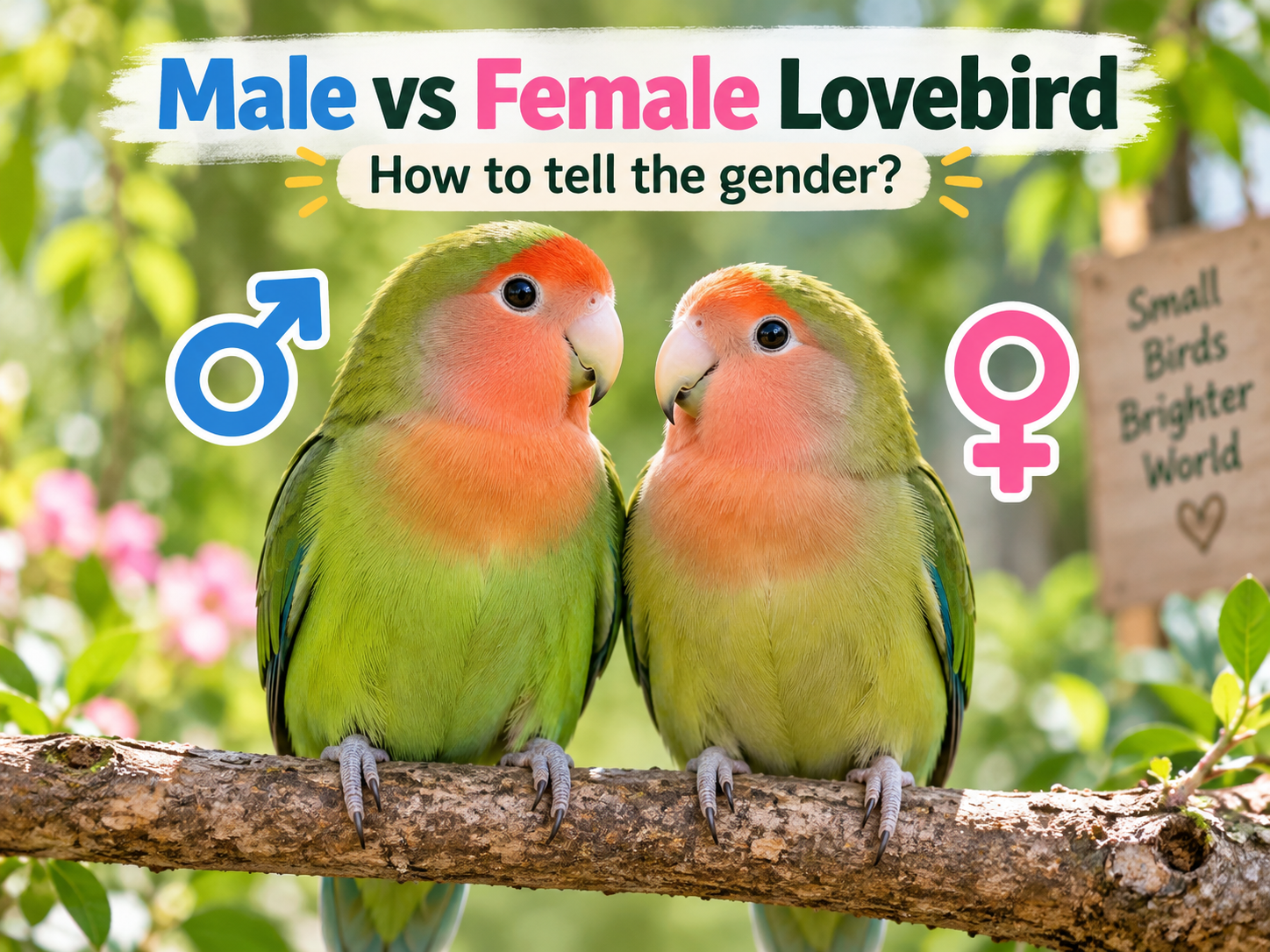
Determining whether a lovebird is male or female is not as simple as looking at its color, head shape, or body size. In many of the lovebird species commonly kept as pets, males and females look extremely similar.
This is especially true for Fischer’s lovebirds, masked lovebirds, and peach-faced lovebirds. In these species, visual characteristics may suggest a possibility, but they should not be treated as reliable proof of sex.
For owners who need an accurate answer, particularly before breeding or pairing birds, DNA sexing is the most reliable practical method. VCA Animal Hospitals notes that there are no obvious external differences between male and female lovebirds and that blood testing can be used to distinguish the sexes.
Why Is Lovebird Gender So Difficult to Determine?
Many bird species show obvious sexual dimorphism, meaning males and females have visibly different colors, markings, or body features.
Most popular pet lovebirds are different.
Male and female Fischer’s lovebirds (Agapornis fischeri) are described as identical in appearance by Animal Diversity Web. The same source lists the species as having the sexes alike.
The situation is similar in masked or yellow-collared lovebirds (Agapornis personatus). Males and females do not show a significant difference in size or plumage coloration.
This is why claims such as “the brighter bird is male” or “the larger bird must be female” should not be considered reliable gender tests.
Lovebird Gender Identification Methods
| Method | Reliability | What You Should Know |
|---|---|---|
| DNA sexing | Very high | The most reliable practical method |
| Egg laying | Confirms female | A bird that lays an egg is female |
| Behavior | Limited | Can offer clues but cannot confirm sex |
| Pelvic bone spacing | Unreliable | Males and females can both have narrow or wide spacing |
| Head shape | Unreliable | Individual variation makes this inaccurate |
| Feather color | Usually unreliable | Common pet lovebird species often look alike |
DNA Sexing for Lovebirds
DNA testing is generally the best option when you need to know a lovebird’s sex accurately.
Depending on the veterinarian or laboratory, the test may be performed using an appropriate biological sample. VCA Animal Hospitals specifically notes that blood testing is used to differentiate male and female lovebirds.
Lafeber also recommends DNA testing for reliable sex determination and notes that visual identification is not dependable for lovebirds.
If a sample is required, follow the instructions provided by your avian veterinarian or testing laboratory. Do not unnecessarily pull feathers or attempt to collect blood at home without proper guidance.
Can You Tell a Lovebird’s Gender by Behavior?
Behavior can sometimes provide clues, especially during breeding season, but behavior alone cannot reliably determine whether a lovebird is male or female.
Females may show behaviors such as:
- Increased interest in nesting areas
- Collecting or shredding nesting material
- Becoming more territorial around a nest
- Laying eggs
Males may be observed feeding a mate through regurgitation or displaying courtship behaviors.
In Fischer’s lovebirds, for example, the male approaches the female during courtship and may regurgitate food for her, while the female is responsible for nest preparation and incubation.
However, pet birds do not always follow textbook behavior. Two birds of the same sex may bond closely, preen each other, feed each other, or display behaviors normally associated with a bonded pair.
Therefore:
“My lovebird shreds paper, so she must be female” is not a reliable conclusion.
Can Pelvic Bones Tell a Lovebird’s Gender?
One of the most common traditional methods involves feeling the distance between the bird’s pelvic bones.
You may hear claims that:
- females have wider pelvic spacing;
- males have narrower pelvic spacing.
This method is not reliable.
Lafeber explains that male lovebirds can have a wide pelvic gap while females can have a very narrow one. The spacing may also change depending on how relaxed the bird is during examination.
For this reason, pelvic bone spacing should not be used as proof that a lovebird is male or female.
Unnecessary handling or pressure around the abdomen and pelvis should also be avoided because it can cause stress or injury.
Can You Tell a Lovebird’s Gender by Head Shape?
Another common claim is that female lovebirds have a rounder or broader head while males have a flatter or narrower head.
This is not a dependable method.
Head and beak shape can vary between individual birds because of genetics, age, breeding lines, and natural variation.
Because common pet lovebird species show few obvious external differences between males and females, head shape alone cannot accurately determine sex.
Can Feather Color Reveal a Lovebird’s Gender?
For most of the popular lovebird species kept as pets, feather color is not a dependable way to determine sex.
Fischer’s Lovebird
Male and female Fischer’s lovebirds are essentially identical in appearance. Animal Diversity Web specifically describes the sexes as alike.
Masked Lovebird
Masked lovebirds also show no significant male-versus-female difference in adult coloration.
Captive lovebirds are also available in many color mutations, including blue, lutino, pied, violet, and pastel varieties. These mutations can make visual assumptions even less useful.
A brighter or darker bird is therefore not automatically male or female.
If a Lovebird Lays an Egg, Is It Female?
Yes. A lovebird that lays an egg is female.
A female bird does not need a male present to produce an egg. Unmated females can lay infertile eggs.
However, the reverse is not true.
A lovebird that has never laid an egg is not necessarily male. Some females may never lay eggs, even when mature. Lafeber notes that some female lovebirds simply do not lay eggs.
So:
Egg laid = female confirmed
No egg = sex still unknown
Fischer’s Lovebird: Male vs Female
Fischer’s lovebirds are one of the clearest examples of why visual sexing can be misleading.
Both sexes typically have:
- A green body
- Orange to red facial coloration
- A red-orange beak
- A prominent white eye ring
Animal Diversity Web states that males and females are identical in appearance and categorizes the species as having no visible sexual dimorphism.
Therefore, head shape, body size, feather brightness, or pelvic spacing should not be used to confidently label a Fischer’s lovebird male or female.
DNA testing is the safer choice when certainty matters.
Masked Lovebird: Male vs Female
The masked lovebird, also called the yellow-collared lovebird (Agapornis personatus), presents a similar challenge.
Adult males and females look very similar, and Animal Diversity Web reports no notable difference in adult plumage coloration between the sexes.
Color alone cannot reliably tell you whether a masked lovebird is male or female.
Peach-Faced Lovebird: Male vs Female
Peach-faced lovebirds (Agapornis roseicollis) are also commonly kept as companion birds.
Although owners and breeders sometimes describe differences in body shape, head shape, stance, or behavior, these characteristics overlap too much between individuals to provide dependable gender identification.
VCA notes generally that male and female lovebirds do not have obvious external differences, although females may average slightly heavier than males.
For an individual peach-faced lovebird, DNA testing remains a much better option than judging appearance alone.
Can Two Male or Two Female Lovebirds Act Like a Pair?
Yes.
Two birds bonding closely does not prove that they are male and female.
Same-sex lovebirds may:
- Sit closely together
- Preen one another
- Feed each other
- Sleep beside each other
- Defend the same area
- Display courtship-like behavior
This is one reason why behavior should be treated as an observation rather than a gender test.
If two lovebirds were sold as a “male and female pair” but do not have documented DNA results, their sex should not automatically be assumed.
What Is the Most Reliable Way to Determine a Lovebird’s Gender?
For commonly kept species such as Fischer’s, masked, and peach-faced lovebirds, DNA testing is the most reliable practical method when you need to determine sex accurately.
An egg definitively confirms that a bird is female, but the absence of eggs does not prove that a bird is male.
Characteristics such as:
- Head shape
- Beak size
- Body size
- Pelvic bone spacing
- Feather color
- Nesting behavior
may provide observations, but they should not be considered definitive evidence.
If sex matters for breeding, pairing, or health management, an avian veterinarian can help arrange appropriate DNA testing.
Frequently Asked Questions
How can I tell if my lovebird is male or female?
For many common pet lovebird species, males and females look almost identical. DNA testing is the most reliable practical way to determine sex.
Do female lovebirds have bigger heads?
Not reliably. Head size and shape vary between individuals and cannot be used as an accurate gender test.
Are male lovebirds more colorful than females?
Not in species such as Fischer’s and masked lovebirds. Males and females have very similar plumage.
Can pelvic bones tell whether a lovebird is male or female?
No. A wide pelvic gap does not prove that a bird is female, and a narrow gap does not prove that it is male.
Is a lovebird definitely female if it lays an egg?
Yes. A bird that lays an egg is female. Females can also lay infertile eggs without a male.
Is a lovebird male if it never lays eggs?
No. Some female lovebirds never lay eggs, so the absence of egg laying does not confirm a male.
Can two male lovebirds bond with each other?
Yes. Same-sex lovebirds can form strong social bonds and may display behaviors similar to those seen in male-female pairs.
Sources
VCA Animal Hospitals – Lovebirds: Veterinary information about lovebird characteristics and sex determination.
Animal Diversity Web – Fischer’s Lovebird: Species information, physical characteristics, sexual dimorphism, and breeding behavior.
Animal Diversity Web – Masked Lovebird: Physical characteristics and differences between males and females.
Lafeber Pet Birds: Expert guidance on DNA sexing and why pelvic bone spacing and visual examination are unreliable for lovebird gender determination.
Bir Cevap Yazın