

If you love Turkish desserts, künefe is one recipe you absolutely need to try. Crispy, buttery strands of shredded pastry surround a layer of warm, stretchy cheese, while a fragrant sugar syrup adds just the right amount of sweetness.
Unlike many traditional desserts, künefe combines sweet syrup, crisp pastry, and melted cheese in the same dish. The contrast is exactly what makes it so memorable.
This homemade Turkish Künefe recipe shows you how to recreate this famous dessert with simple ingredients and clear step-by-step instructions.
What Is Künefe?
Künefe is a traditional dessert strongly associated with Hatay and Antakya in southern Türkiye. It is made by layering finely shredded tel kadayıf (kataifi pastry) with unsalted cheese, cooking it until crisp and golden, and finishing it with sugar syrup.
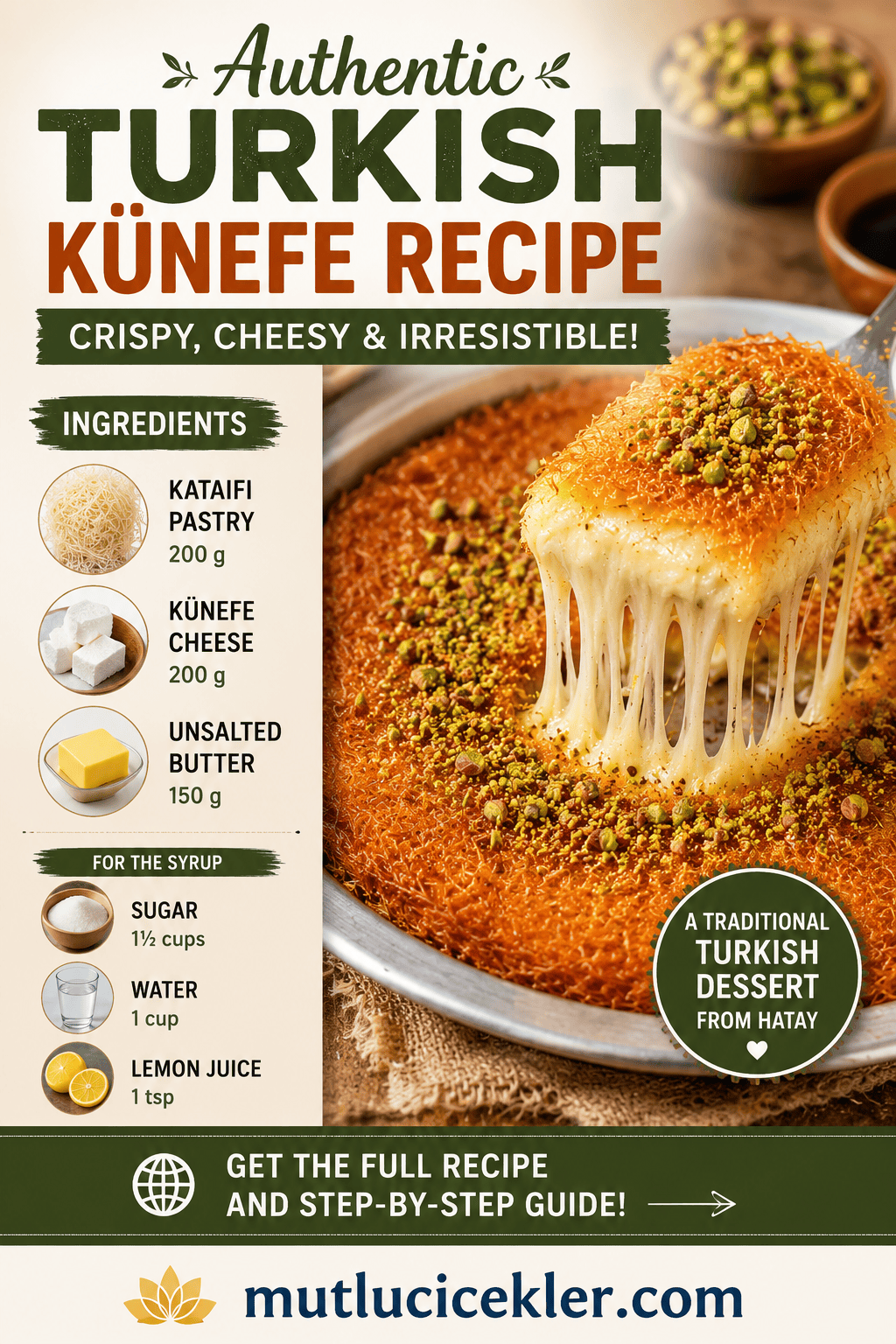
The best künefe has three distinctive textures:
- A crispy, golden exterior
- Soft, stretchy melted cheese in the center
- Sweet syrup absorbed into the warm pastry
It is traditionally served immediately after cooking, often topped with finely ground pistachios.
Why Is Hatay Künefe Special?
Künefe has an especially important place in the culinary culture of Hatay, where making and serving the dessert has been part of local food traditions for generations.
Traditional Antakya-style künefe is prepared with fine tel kadayıf and a special fresh, unsalted cheese known as künefelik peynir.
The dessert is traditionally cooked in a shallow metal tray. The kadayıf is pressed firmly into the pan, cheese is spread between two thin layers, and both sides are cooked until beautifully golden.
The result is the signature contrast that makes künefe famous: crispy outside, stretchy and cheesy inside.
Turkish Künefe Recipe at a Glance
Prep Time: 15 minutes
Cooking Time: 20–25 minutes
Total Time: About 40 minutes
Servings: 6
Cuisine: Turkish
Course: Dessert
Difficulty: Medium
Ingredients
For the Künefe
- 200 g (about 7 oz) kataifi or tel kadayıf pastry
- 150 g (about ⅔ cup) unsalted butter, melted
- 200 g (about 7 oz) unsalted künefe cheese
- 2 tablespoons finely ground pistachios, for serving
Cheese Alternatives
Authentic künefe cheese may be difficult to find outside Türkiye.
If you cannot find it, use a mild cheese that melts well without adding too much saltiness.
Good alternatives include:
- Unsalted mozzarella
- Fresh mozzarella, well drained
- A combination of mozzarella and mild fresh cheese
Avoid strongly flavored or very salty cheeses because they can overpower the dessert.
For the Sugar Syrup
- 1½ cups granulated sugar
- 1 cup water
- 1 teaspoon fresh lemon juice
Optional:
- ½ teaspoon rose water or orange blossom water
Traditional Turkish versions do not necessarily require floral flavoring, so consider this completely optional.
How to Make Turkish Künefe
1. Prepare the Sugar Syrup
Add the sugar and water to a saucepan and stir briefly.
Bring the mixture to a boil over medium heat.
Once boiling, reduce the heat and allow it to simmer for approximately 10–12 minutes.
Add the lemon juice during the final few minutes.
Remove the syrup from the heat and set it aside.
The syrup should be ready before the künefe finishes cooking.
2. Prepare the Kataifi Pastry
Place the tel kadayıf or kataifi pastry in a large bowl.
Using your hands, gently separate and break apart the strands into shorter pieces.
Pour the melted butter over the pastry.
Massage the butter into the strands until the kadayıf is evenly coated.
This step is extremely important because evenly distributed butter helps create the crispy golden crust that defines a good künefe.
3. Prepare the Pan
Generously butter a shallow round pan or skillet.
A traditional künefe pan works best, but a small non-stick skillet can also work well at home.
Spread half of the buttered kataifi over the bottom of the pan.
Press it down firmly using your hands, the bottom of a glass, or a flat spatula.
Creating a compact base prevents the künefe from falling apart when it is flipped.
4. Add the Cheese
Spread the cheese evenly over the kataifi layer.
Leave a small border around the edge of the pan.
Keeping the cheese away from the edges helps prevent it from leaking out during cooking.
5. Add the Top Layer
Cover the cheese with the remaining buttered kataifi.
Press the surface down firmly again.
You should now have a compact layer of kataifi, cheese, and another layer of kataifi.
How to Cook Künefe on the Stovetop
Traditional künefe is cooked slowly so the pastry becomes crisp without burning.
Place the pan over low to medium-low heat.
Cook for approximately 8–12 minutes, rotating the pan occasionally to encourage even browning.
Check the bottom carefully.
Once it has developed a deep golden color, place a flat plate over the pan and carefully flip the künefe.
Add a little butter to the pan if necessary.
Slide the künefe back into the pan with the uncooked side facing downward.
Cook for another 8–10 minutes, or until the second side is equally crisp and golden.
Can You Make Künefe in the Oven?
Yes.
Although stovetop cooking gives you more control over the traditional crispy crust, an oven can make homemade künefe easier.
Preheat your oven to 190°C / 375°F.
Assemble the künefe in a buttered oven-safe pan and bake for approximately 20–25 minutes, or until deeply golden.
For additional browning, you can briefly place it under the broiler at the end.
Watch it carefully because kataifi can brown very quickly.
Add the Syrup
Once the künefe is fully cooked, remove it from the heat.
Slowly pour the prepared syrup over the hot dessert.
Do not drown it all at once.
Allow the syrup to absorb gradually so the pastry remains crisp rather than becoming soggy.
Let the künefe rest for approximately 2–3 minutes before serving.
How to Serve Künefe
Künefe should ideally be eaten hot and freshly prepared.
Sprinkle finely ground pistachios over the surface before serving.
You can also serve it with:
- Turkish tea
- Turkish coffee
- Vanilla ice cream
- Traditional Turkish dondurma
- Kaymak
Cut it into wedges and serve immediately while the cheese is still hot and stretchy.
That famous cheese pull is part of the künefe experience!
Tips for Perfect Homemade Künefe
Use Unsalted Cheese
The cheese is one of the most important parts of the recipe. Traditional künefe uses a fresh, mild, unsalted cheese.
If substituting mozzarella, choose the least salty variety possible.
Coat Every Strand With Butter
Do not simply pour butter over the pastry and leave it.
Work the butter thoroughly through the kataifi with your fingers. This helps the strands brown evenly and creates a much better texture.
Press the Kataifi Firmly
A loosely assembled künefe can fall apart during flipping.
Press both layers firmly into the pan.
Cook Slowly
High heat can burn the outside before the cheese melts.
Low to medium-low heat produces better results.
Serve Immediately
Künefe is at its best shortly after cooking.
As it cools, the cheese loses its characteristic stretch and the pastry gradually softens.
Common Künefe Mistakes
Why Is My Künefe Soggy?
Too much syrup is one of the most common reasons.
Pour the syrup gradually instead of adding a large amount immediately.
The kadayıf should remain noticeably crispy.
Why Didn’t My Cheese Stretch?
The cheese may not have been suitable for melting, or the künefe may have cooled before serving.
Use fresh künefe cheese or a good melting mozzarella and serve the dessert hot.
Why Did My Künefe Fall Apart?
The kataifi probably wasn’t pressed firmly enough into the pan.
Compact both the bottom and top layers before cooking.
Why Did the Bottom Burn?
The heat was probably too high.
Künefe needs enough time for the cheese to melt while the pastry gradually develops its golden crust.
Künefe vs. Baklava: What’s the Difference?
Both are famous syrup-based desserts, but they are very different.
Baklava is generally made from layers of thin phyllo pastry combined with nuts such as pistachios or walnuts.
Künefe, on the other hand, uses shredded kataifi pastry and contains a layer of melting cheese.
This gives künefe its unusual combination of crispy, sweet and savory flavors.
Künefe vs. Knafeh: Are They the Same?
You may see similar desserts called künefe, kunafa, knafeh, kanafeh, or konafa in different countries.
They belong to a broader family of related desserts found throughout Türkiye, the Levant, and the Middle East.
Recipes vary considerably by region.
Turkish künefe—particularly the version associated with Hatay and Antakya—is known for its fine tel kadayıf, fresh unsalted cheese, butter, syrup and thin, crisp preparation.
How to Store Künefe
Fresh künefe is always preferable, but leftovers can be stored.
Allow the dessert to cool completely, then transfer it to an airtight container.
Store it in the refrigerator for up to 2 days.
Because the pastry absorbs moisture over time, refrigerated künefe will not remain as crispy as freshly prepared künefe.
How to Reheat Künefe
For the best texture, reheat künefe in an oven or air fryer rather than a microwave.
Heat at approximately 175°C / 350°F until warm and crisp.
Microwaving can melt the cheese quickly, but it tends to make the kataifi softer.
Approximate Nutrition Information
One serving of homemade künefe may contain approximately:
Calories: 450–550 kcal
Carbohydrates: 55–65 g
Fat: 22–30 g
Protein: 8–12 g
Sugar: 30–40 g
These figures are estimates only. The actual nutritional values will vary depending on the type and quantity of cheese, butter, syrup and serving size used.
Frequently Asked Questions About Künefe
What is Turkish künefe made of?
Turkish künefe is primarily made from tel kadayıf (kataifi pastry), butter, fresh unsalted cheese and sugar syrup. It is commonly garnished with ground pistachios.
What cheese is used for künefe?
Traditional Hatay-style künefe uses fresh, unsalted künefelik cheese. If it is unavailable, mild unsalted mozzarella is one of the easiest substitutes for home cooking.
Is künefe served hot or cold?
Künefe should be served hot or warm. Serving it shortly after cooking gives you the best combination of crispy pastry and stretchy melted cheese.
Can I make künefe without a special pan?
Yes. A shallow non-stick skillet or oven-safe round pan can be used instead of a traditional künefe tray.
Can I prepare künefe ahead of time?
You can assemble the kataifi and cheese in advance and refrigerate it for a short period before cooking. For the best results, cook it just before serving.
Is künefe the same as baklava?
No. Baklava is usually made from phyllo pastry and nuts, while künefe uses shredded kataifi pastry and contains melted cheese.
Where does künefe come from?
Künefe belongs to a wider family of related desserts found throughout the Eastern Mediterranean and Middle East. In Türkiye, it is particularly associated with Hatay and Antakya, where it holds an important place in the region’s culinary culture.
Final Thoughts
This authentic Turkish Künefe recipe brings together everything that makes the dessert unforgettable: buttery and crispy kataifi, warm stretchy cheese, sweet syrup and pistachios.
The secret is not complicated ingredients. It is achieving the right balance.
Keep the pastry thin and well buttered, use a mild unsalted cheese, cook the künefe slowly until both sides are deeply golden, and serve it while the center is still hot.
Whether you already love Turkish cuisine or are discovering it for the first time, homemade künefe is one of those desserts worth experiencing straight from the pan.
Afiyet olsun!


Bir Cevap Yazın